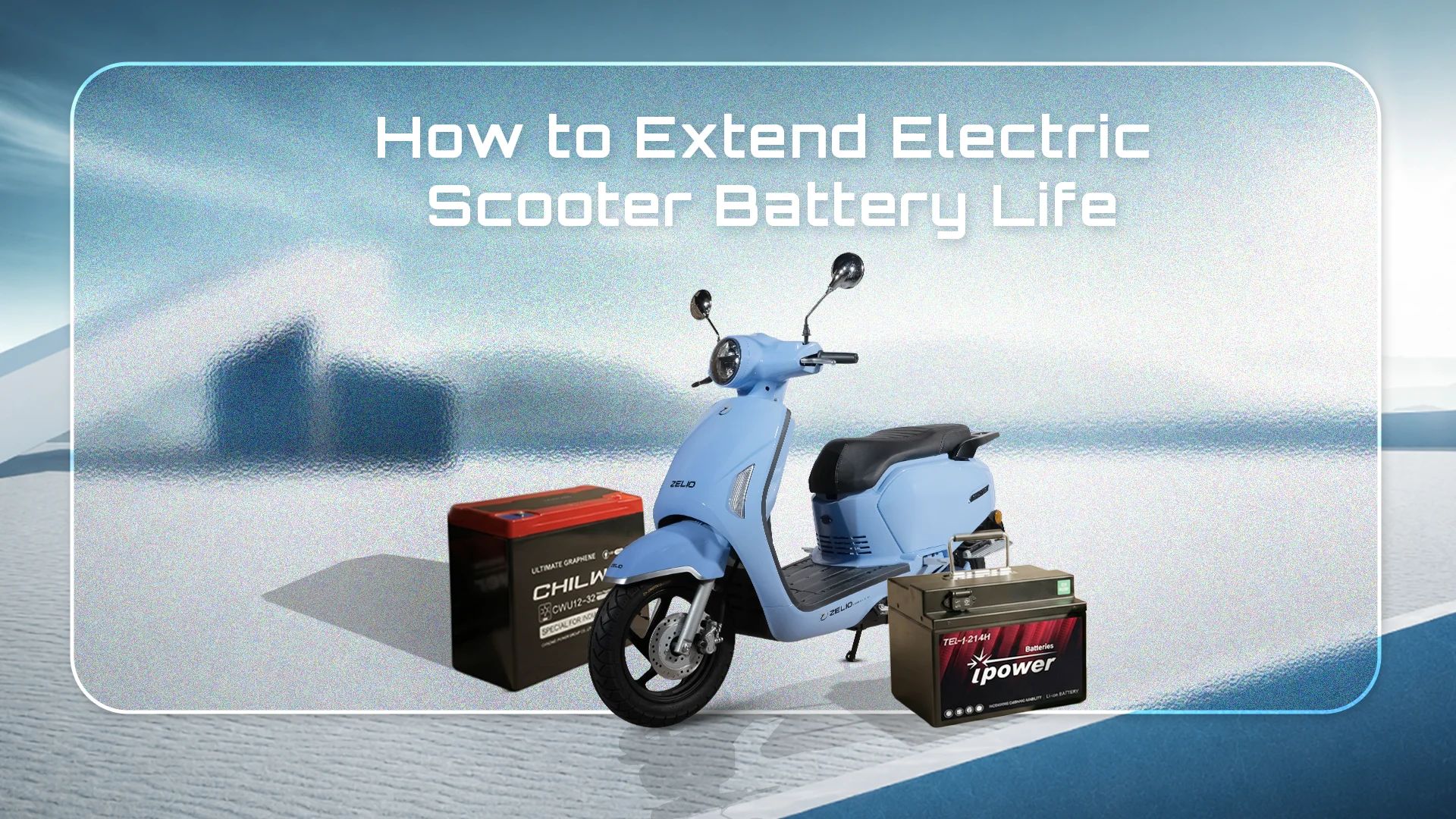
How to Extend Electric Scooter Battery Life in India

How to Extend Electric Scooter Battery Life in India

You bought an electric scooter to save money on petrol. The battery is the only part of that equation that can quietly work against you if you are not careful with it.

A well-maintained electric scooter battery in India lasts 3 to 5 years on lithium-ion and 2 to 3 years on lead acid. A poorly maintained one starts losing range within 8 to 12 months. That difference has nothing to do with luck or brand quality. It is entirely about how you charge it, how you ride it, and how you store it.

This guide covers every real factor that affects electric scooter battery life.


Firstly Understand What Type of Battery Your Scooter Has

Find out which battery your Zelio electric scooter is running on. The care routine is different for each type.

Lead Acid (Gel Battery): Most affordable Zelio models like the Zelio Eeva Eco LX and Zelio Little Gracy come with a gel battery as standard. Lead acid batteries are heavier, take 7 to 10 hours to charge, and last 2 to 3 years. They are sensitive to overcharging, deep discharge, and heat.

Lithium-Ion: Available as an upgrade across the Zelio range including the Zelio Gracy iZelio Legender Plus Premium, and Zelio X-Men Plus. Lithium batteries are lighter, charge in 4 to 5 hours, last 3 to 5 years, and handle Indian weather better overall. They are still sensitive to overcharging and heat but significantly more forgiving.

Knowing which battery you have tells you exactly how to follow each tip below.


1. Never Let Your Battery Drop to Zero

This is the single most damaging habit for any electric scooter battery in India.

Both lead acid and lithium-ion batteries degrade faster when they are regularly discharged to zero percent. The chemical process inside the battery causes permanent capacity loss every time this happens.

Charge your scooter when the battery indicator drops to 20 to 25 percent. Never leave it parked for days with a near-empty battery. If you are going out of town, charge to at least 50 percent before leaving it.

For lead acid gel batteries, deep discharge is even more damaging than for lithium. A single full discharge down to empty can permanently reduce the battery’s usable capacity. For daily riders in UP, Haryana, or Punjab doing 30 to 40 km routes, make it a habit to plug in every night regardless of how much charge is left. If you are still deciding which Zelio model fits your commute distance, the best electric scooter under 70,000 guide covers all current models with their real-world range figures.


2. Do Not Overcharge Either - Unplug After Full Charge

Overcharging is just as damaging as deep discharging, and it is actually the more common mistake in Indian households.

Most riders plug in the scooter at night and leave it connected until morning, sometimes 10 to 12 hours even though the battery was full in 4 to 5 hours. For lithium-ion batteries, this is harmful. Heat builds up in a fully charged battery that is still connected to the charger. Over weeks and months, that heat degrades the cells.

Unplug the charger once the indicator shows a full charge. If overnight charging is your only option, check if your scooter’s charger has an auto-cutoff feature. For lead acid batteries, 7 to 10 hours is the correct charge window. Do not stretch it.

Zelio scooters with the lithium variant, like the Zelio Gracy i, have a Battery Management System (BMS) that helps regulate overcharge. But BMS is a safety net, not a substitute for good charging habits.


3. Always Use the Original Charger

This sounds obvious but it gets overlooked constantly. Using a third-party charger that does not match the voltage and current specifications of your battery is one of the fastest ways to damage an electric scooter battery in India.

A wrong charger can deliver too much current and overheat the cells, undercharge the battery and leave sulphation deposits in lead acid batteries, or trigger false full-charge readings in the BMS.

Always use the charger that came with your Zelio scooter. If it is damaged or lost, contact your nearest Zelio authorised dealer for a genuine replacement. Never borrow a charger from a different scooter brand or model.


4. Charge at Room Temperature - Avoid Extreme Heat and Cold

India has two extremes that both hurt electric scooter batteries. Peak summer heat above 40 degrees Celsius in states like UP, Haryana, and Rajasthan, and winter nights that drop below 5 degrees in northern India.

In summer: Do not charge the scooter immediately after a long afternoon ride. The battery is already warm from use. Let it cool for 15 to 20 minutes before plugging in. Avoid parking in direct sunlight for hours. Heat soaking an idle battery accelerates cell degradation. Do not charge in a closed, unventilated space in peak summer. Basic airflow around the battery during charging matters more than most people think.

In winter: Cold temperatures reduce chemical activity inside the battery, which temporarily reduces range. This is normal and reverses as the battery warms up during riding. Do not charge a battery that is ice cold. Let the scooter warm up to room temperature first. Store lithium batteries at 15 to 25 degrees Celsius wherever possible.

This is a tip that almost no electric scooter battery care blog covers specifically for Indian climate conditions, but it makes a real difference in battery lifespan over 2 to 3 years.


5. Ride Smart - How You Ride Directly Affects Battery Life

The way you accelerate, brake, and load the scooter has a direct impact on how fast the battery depletes and how quickly it degrades over time.

Avoid full-throttle acceleration from a standstill. Hard acceleration draws a large current spike from the battery in a short burst. Repeated spikes over thousands of rides stress the battery cells. Accelerate gradually from a stop instead. You will cover the same distance with better range and less strain on the battery.

Avoid riding with a consistently heavy load. Every Zelio scooter has a rated weight capacity. Regularly exceeding it draws more current from the battery to maintain speed, increases heat inside the battery, and shortens its useful life.

Use the scooter’s riding modes if available. Some Zelio models offer low-speed and eco modes. Using a lower power mode on flat city roads reduces the depth of each discharge cycle and extends overall battery lifespan. If you are still deciding between a low speed vs high speed electric scooter, that choice also directly affects how you manage battery use every day.

Avoid riding through flooded roads. The Indian monsoon brings flooded streets in most cities. Riding through deep water can allow moisture into the battery compartment, corroding connectors and damaging cells. Zelio scooters are built for Indian roads but not for waterlogged conditions.


6. Check Tyre Pressure Every Two Weeks

This is the most underrated battery life tip and the one most riders skip entirely.

Under-inflated tyres create more rolling resistance. More rolling resistance means the motor works harder. The motor working harder means the battery discharges faster. Over time the battery is being pushed through more charge cycles than necessary, which reduces its lifespan.

Check tyre pressure every 15 days or before any long ride. Refer to the recommended pressure in your Zelio owner’s manual, typically 30 to 35 PSI depending on the model. Check pressure when the tyres are cold, not after riding. Properly inflated tyres can improve your electric scooter range in India by 8 to 12 percent in real-world conditions. That means fewer charge cycles per month, which directly extends battery life.

7. Store the Scooter Correctly During Long Breaks

 If you are not going to use the scooter for more than 2 weeks, how you store it matters a lot for the battery.

For lithium-ion batteries: Store at 40 to 60 percent charge, not at 100 percent and not at zero. Keep in a dry, shaded location away from direct sunlight. Check the charge level every 30 days and top up to 50 percent if it has dropped below 30 percent. Do not store in a closed car boot or on a rooftop terrace in peak summer.

For lead acid gel batteries: Store at full charge. Check every 15 days and top up as needed since lead acid self-discharges faster than lithium. Never store a lead acid battery in a discharged state. Sulphation sets in within days and permanently reduces capacity.

Most battery problems reported by Indian riders after a long break, reduced range, battery not holding charge, battery draining fast, come from improper storage and not from a defective battery.


8. Keep the Battery and Connectors Clean

In Indian conditions, dust from unpaved roads, moisture from the monsoon, and salt in coastal areas can corrode battery connectors and terminals over time. Corroded connectors increase resistance, which causes the battery to heat up during charging and discharging.

Visually inspect the battery connector points every month. Wipe down the battery casing with a dry cloth to remove dust buildup. Do not use water directly on the battery or connector area. If you see white or greenish deposits on the terminals, visit your nearest Zelio service centre immediately. For a complete cleaning routine that covers the full scooter, our electric scooter care guide has step-by-step instructions for home maintenance.


9. Service the Scooter at Authorised Centres on Schedule

The battery does not work in isolation. A poorly maintained motor, worn brake pads causing drag, or a faulty controller can all put extra load on the battery and drain it faster than normal. Regular servicing catches these issues before they compound.

At every service, make sure the mechanic checks brake adjustment for drag, tyre pressure and wheel alignment, battery connector condition, BMS health for lithium variants, and controller voltage.

Zelio’s 350 plus dealer network across India means a service centre is accessible in most cities and districts. Do not use unauthorised local mechanics for battery-related issues on your Zelio scooter. A wrong diagnosis or a non-genuine part can void your warranty and damage the battery permanently.

Use the Zelio dealer locator to find the nearest authorised service point.


10. Understand Your Warranty and What It Covers

Most electric scooter battery care guides miss this entirely. Know your warranty terms before something goes wrong, not after.

Zelio lead acid gel battery carries a 1-year warranty. Zelio lithium-ion battery carries a 3-year warranty. The motor, controller, and frame each carry a 2-year warranty.

The warranty covers manufacturing defects and premature capacity loss under normal use. It does not cover damage from overcharging, water ingress, use of non-genuine chargers, or unauthorised modifications.

Keeping your charging records, using the original charger, and servicing at authorised centres protects your warranty claim if the battery ever needs replacement within the warranty period.


Lead Acid vs Lithium - Which Battery Lasts Longer on a Zelio Scooter?

Factor

Lead Acid (Gel)

Lithium-Ion

Lifespan

2 to 3 years

3 to 5 years

Charge cycles

300 to 500 cycles

800 to 1,000 cycles

Charging time

7 to 10 hours

4 to 5 hours

Weight

Heavier

Lighter

Heat sensitivity

High

Moderate

Deep discharge damage

Very High

Moderate

Warranty (Zelio)

1 year

3 years

Upfront cost

Lower

Higher

Long-term value

Lower

Higher

If you are buying a new Zelio scooter and your daily commute is 25 km or more, the lithium variant is the better long-term investment. The higher upfront cost is recovered in longer battery life, faster charging, and the 3-year warranty. For a full breakdown of how these two battery types compare on cost, weight, and real-world range, our lithium ion vs lead acid battery guide covers every difference in plain language.


Signs Your Electric Scooter Battery Is Losing Health

Most Indian riders only notice a battery problem when the range drops significantly. By then the degradation has been building for months. Watch for these early signs.

Range dropping by 20 percent or more compared to when the scooter was new. If your Zelio Gracy i used to cover 70 km on a full charge and now struggles to reach 55 km under the same conditions, the battery has lost meaningful capacity.

The battery takes longer to charge than usual. A lead acid battery that used to charge in 8 hours now taking 11 to 12 hours is a sign of internal degradation.

Battery draining fast even on short rides. If the indicator drops faster than normal in the first 10 to 15 minutes of riding, the cells are losing their ability to hold charge.

Scooter losing power on inclines it handled easily before. Reduced battery health means reduced power output under load. Inclines expose this earlier than flat-road commuting.

The battery gets unusually hot during charging. Some warmth is normal. Excessive heat, too hot to touch comfortably, is a sign of a cell fault or connector issue. Stop charging and visit a Zelio service centre.


How Long Should a Zelio Electric Scooter Battery Last in India?

Under good maintenance habits in Indian conditions:


Zelio Lead Acid (Gel) Battery: 2 to 3 years or 300-500 full charge cycles
Zelio Lithium-Ion Battery: 3 to 5 years or 800-1000 full charge cycles

After this point, the battery will still function but its usable capacity will have dropped by 20-30% from its original level. Range and performance will be noticeably reduced. At this stage, a battery replacement at an authorised Zelio service centre restores the scooter to near-original performance.
Zelio Team

Innovation Department

No tags
Share

Frequently Asked
Questions

RELATED POSTS

Low Speed vs High Speed Electric Scooter in India 2026 - Which One Is Right for You?

Low Speed vs High Speed Electric Scooter in India 2026 - Which One Is Right for You?

Before you buy any electric scooter in India, one question decides almost everything else - low speed or high speed. Get it right and you save money, skip paperwork, and pick a scooter that actually suits your daily route. Get it wrong and you either end up with a scooter that cannot keep up with traffic, or one that costs Rs 10,000-15,000 more than the sticker price once RTO, road tax, and insurance are added. The difference between the two is not just about speed. It is about two completely different legal categories with different ownership costs, different paperwork, and different riding realities. At Zelio, we make 18 low-speed electric scooters and one high-speed model - the Mystery. We know both categories well. Here is the honest breakdown. The Legal Difference - This Is Where It All Starts Under India's Central Motor Vehicles Rules (CMVR), an electric scooter is classified as a low-speed vehicle only if it meets both of the following conditions: Motor power: 250W or less (measured at 30 minutes continuous output) Top speed: 25 km/h or less Both conditions must be met. A scooter that runs at 25 km/h but has a 350W motor is not a low-speed vehicle under CMVR. It is a motor vehicle, and it requires registration and a licence. This is what catches some buyers off guard when a scooter marketed as "no licence" turns out to have a higher-wattage motor that disqualifies it from the exemption. A high-speed electric scooter is any scooter with a motor above 250W or a top speed above 25 km/h. Under Indian law, this is treated the same as a petrol scooter in every respect. What Each Category Means in Practice Factor Low Speed Electric Scooter High Speed Electric Scooter Motor power 250W or less Above 250W Top speed Up to 25 km/h 40-80+ km/h Driving licence Not required Required RTO registration Not required Required Road tax Not applicable Applicable Insurance Not mandatory (voluntary available) Mandatory Number plate Not issued Issued by RTO Minimum age 16 years 18 years (with licence) Government subsidy (PM E-DRIVE) Generally not eligible Eligible (lithium, certified) Running cost per km Rs 0.25 Rs 0.25-0.50 (varies by model) The Total Cost Difference - Not Just the Purchase Price Most comparisons stop at comparing sticker prices. The real cost difference is much wider than that. Buying a high-speed electric scooter in India involves: Purchase price RTO registration fee (Rs 1,500-2,500 depending on state) Road tax (1-9% of vehicle cost depending on state) Mandatory third-party insurance (Rs 500-1,500 per year) Driving licence (if you do not already have one - Rs 400-600 plus time) Number plate and documentation For a scooter costing Rs 1,00,000, total on-road cost in Haryana after adding registration, road tax, and insurance typically crosses Rs 1,08,000-1,12,000 in the first year. Buying a low-speed Zelio electric scooter involves: Purchase price only No registration fee No road tax No mandatory insurance No licence required (from age 16) A Zelio Gracy i at Rs 58,159 costs exactly Rs 58,159 to ride home. No additional paperwork, no queue at the RTO, no hidden first-year costs. Over five years, a low-speed Zelio scooter saves a commuter doing 35 km daily approximately Rs 1,80,000-2,50,000 compared to a high-speed petrol scooter - including fuel, servicing, registration, road tax, and insurance. That figure comes from Zelio's own cost modelling based on 2 lakh+ rider data across India. What Low Speed Actually Feels Like on Indian Roads 25 km/h is slower than highway traffic. It is slower than arterial road traffic. But it is completely in sync with how most Indian residential areas, colony roads, market lanes, and school routes actually flow through the day. On a typical morning school drop, a market run, a coaching centre commute, or a hyperlocal delivery route, a 25 km/h scooter is often not the slowest vehicle on the road. Auto-rickshaws, e-rickshaws, cycling delivery workers, and school buses in congested zones frequently move at or below this speed. Where a low-speed scooter genuinely struggles is on main arterial roads where traffic moves at 35-50 km/h, or on flyovers with steep inclines where the 250W motor works hard. In these conditions, the rider becomes the slowest vehicle and the experience is frustrating, not just slow. The honest rule: if your daily route stays within residential and colony roads with moderate traffic, a low-speed scooter handles it well. If your route involves a sustained stretch on a main road or an expressway, a high-speed scooter is the right choice for safety and confidence. Performance on Inclines and with a Pillion A 250W motor at 25 km/h is tuned for flat roads with a single rider. On a steep flyover or an inclined road, the motor slows down noticeably under the combined weight of two people. The speed drops, the motor heats up faster, and the riding experience feels strained. High-speed scooters with 1-4 kW motors handle inclines, pillion loads, and highway speeds without any of this strain. The motor has more headroom and the riding experience on varied terrain is significantly more confident. This is important for riders who regularly carry a pillion on a mixed route. Zelio's Gracy+ and X-Men 2.0 handle pillion loads better than lighter low-speed models, but even these operate within the 250W cap on their low-speed variants. Zelio's Low Speed Lineup vs the Zelio Mystery Zelio makes 18 Made-in-India electric scooters. Eighteen of them are low-speed models. One is high-speed. Zelio's low-speed range includes the Gracy i , Gracy+ , Gracy Pro , Little Gracy , Legender+ , Legender+ Premium , Eeva , Eeva ZX+ , X-Men+ , X-Men 2.0 , Logix , Loader and more . These start at Rs 44,334 and go up to Rs 75,384. No licence required, no RTO registration, no road tax. All are Made in India and carry a 2-year warranty on motor, controller, and frame. The full low-speed lineup is at zelioebikes.com/low-speed-electric-scooter/ . The Zelio Mystery is the only high-speed scooter in our lineup. 72V motor, up to 100 km range, built for riders who need to keep pace with main road traffic. It requires a valid driving licence and RTO registration. It is the right choice if your daily route involves arterial roads, flyovers, or distances where 25 km/h is simply not enough. Full details at zelioebikes.com/mystery/ . Who Should Choose Low Speed A college student doing 15-30 km daily - Colony roads, moderate traffic, no licence yet, budget under Rs 60,000. A Zelio Eeva or Gracy i covers this completely without any paperwork. A homemaker doing school runs and local errands within 10-20 km - Tight lanes, market parking, no interest in RTO queues. The Zelio Little Gracy was built specifically for this rider. A delivery rider covering hyperlocal city routes - 40-60 km daily within residential and market zones. The Zelio Logix or Loader handles this at Rs 0.25 per km with no licence or registration costs. A senior citizen doing short local rides - Lower speed means lower risk. No paperwork, no RTO, easy to manage. The Zelio Little Gracy is consistently the first recommendation here. Who Should Choose High Speed A daily office commuter on arterial roads doing 30-60 km - If your commute route has a sustained main road stretch at 35-50 km/h, riding a 25 km/h scooter in that traffic is not safe or practical. The Zelio Mystery at Rs 85,159 (lithium) is the honest answer, with a driving licence required. A rider who needs to travel across different zones in a city - Moving between residential areas, main roads, and flyovers in a single trip means needing a speed range that a low-speed motor cannot comfortably provide. A rider who wants access to highway and intercity stretches - A low-speed scooter is not designed for highways. A high-speed, RTO-registered scooter gives full access to all public roads without restriction. The Insurance Question For low-speed electric scooters , third-party insurance is not legally mandatory in India since they are not classified as motor vehicles under CMVR. You can buy voluntary insurance if you want, and it is available from most general insurers. The premium is lower than for registered vehicles because the risk profile is lower at 25 km/h. For high-speed electric scooters , third-party insurance is mandatory under the Motor Vehicles Act. Riding without valid insurance is a punishable offence. Quick Decision Choose a low-speed Zelio electric scooter if: Your daily route is within residential areas, markets, and colony roads Your commute is under 40 km and does not involve sustained main road riding You want no licence, no registration, and no road tax Your budget is under Rs 80,000 and you want the lowest total cost of ownership You are 16 or older and buying your first scooter Choose the Zelio Mystery (high speed) if: Your commute involves arterial roads, flyovers, or speeds above 30 km/h You have a valid driving licence and are comfortable with RTO registration Your daily distance is 40-80 km with mixed road types You want Zelio's Made-in-India quality with full road access and a high-speed motor About Zelio E Bikes Zelio E Bikes is a Made-in-India electric two-wheeler brand. We design, build, and sell electric scooters built specifically for Indian roads, Indian weather and the Indian daily commute. Every Zelio scooter carries a 2-year warranty on motor, controller, and frame, and a 3-year warranty on lithium batteries. We back that warranty with 350+ authorised service centres across India. Zelio has 2.5 lakh+ happy riders across India. We are a publicly listed company with over Rs 300 crore in annual turnover. When we say we will be around to service your scooter in year three, we mean it. Explore our full range | Find a dealer near you

Read More
Best Electric Scooter for Delivery Riders in India 2026 - Real Costs, Real Picks

Best Electric Scooter for Delivery Riders in India 2026 - Real Costs, Real Picks

A delivery rider in India covers 40 to 100 km every single day. At petrol prices hovering around Rs 100-105 per litre, that is Rs 200-500 daily going straight to the pump. Rs 6,000-15,000 every month. Rs 72,000-1,80,000 every year. Switching to an electric scooter cuts that by 90%. At Rs 0.25 per km, a rider covering 60 km daily spends Rs 15 on electricity instead of Rs 150 on petrol. The scooter pays for itself in just over a year from fuel savings alone. Most blogs on this topic recommend Rs 90,000-1.5 lakh high-speed scooters that need a driving licence, RTO registration, and road tax. That is not the reality for most delivery riders in India who own their scooter, want to keep costs low, and need something that runs reliably through a 50-80 km daily shift. At Zelio, we have been building electric scooters in India since 2021. We are one of the electric scooter brands in India that tests every battery for Indian roads, Indian loads and Indian weather. We have 2 lakh+ riders using our scooters daily and 360+ authorised dealers across 25+ states. What a Delivery Rider Actually Needs Most comparisons evaluate scooters for personal commuters. A delivery rider is a different kind of user entirely. Uptime is income - When your scooter is at a service centre, you are not earning. Every breakdown costs a delivery rider more than just the repair bill - it costs the day's income too. A scooter with a nearby authorised service centre matters more than a scooter with an impressive spec sheet. Running cost per km, not just purchase price - A Rs 50,000 scooter at Rs 2.50 per km costs more over two years than a Rs 65,000 scooter at Rs 0.25 per km. The maths always favours electric for anyone doing 40+ km daily. Our MD Kunal Arya puts it simply: fuel savings alone recover the cost of the scooter within two years for most delivery riders. Load capacity and build - A delivery scooter carries food boxes, grocery bags, medicine parcels, and sometimes a second person through every kind of Indian road. Our scooters are designed specifically for Indian road conditions - not adapted from European or Chinese market models that were never built with Pune potholes or Delhi December mornings in mind. Licence requirements - Not every delivery rider has a current two-wheeler licence. All low-speed Zelio scooters under 25 km/h need no driving licence and no RTO registration under Indian motor vehicle rules. You can buy, register nothing, and start earning the same day. The non-RTO scooter guide explains exactly what this means legally. The Monthly Numbers That Matter A delivery rider doing 60 km daily is among the highest-mileage riders in India. Here is what that route costs every month: Petrol Scooter Zelio Electric Scooter Cost per km Rs 2.50 Rs 0.25 Daily cost (60 km) Rs 150 Rs 15 Monthly fuel cost Rs 4,500 Rs 450 Annual fuel cost Rs 54,000 Rs 5,400 Annual servicing Rs 6,000-8,000 Rs 1,500-2,000 Total annual running cost Rs 60,000-62,000 Rs 6,900-7,400 Annual saving: Rs 52,000-55,000. That saving does not account for road tax, registration fees, or insurance that petrol scooter riders pay and low-speed Zelio riders do not. For a delivery rider currently spending Rs 4,500-5,000 a month on petrol, this is the most impactful financial switch they can make. Best Zelio Electric Scooters for Delivery Riders in India 2026 1. Zelio Loader - Best Heavy-Duty Electric Scooter for Commercial Delivery Price: Rs 66,184 | Range: 60-90 km | Motor: BLDC | Licence: No The Loader is Zelio's purpose-built commercial delivery scooter. We designed it from the ground up for riders who carry heavy loads daily - not a personal commuter with a larger rear rack added on. Reinforced frame, higher load capacity, built for the kind of weight and daily punishment that wears out lighter scooters in six months. If you are running deliveries for a kirana store, a medical supplier, a local e-commerce hub, or doing bulk grocery runs - the Loader is the honest answer. Everything else in this list is a strong scooter adapted for delivery. The Loader was built for it from day one. No licence required. Charges at home overnight. At Rs 0.25 per km, a rider doing 60 km daily on the Loader saves over Rs 52,000 every year compared to a petrol scooter. Explore Zelio Loader 2. Zelio Logix - Best Electric Scooter for Hyperlocal Food Delivery Price: Rs 61,584 | Range: 60-90 km | Motor: BLDC | Licence: No The Logix sits just below the Loader in terms of load capacity but is the most practical choice for food delivery riders - Swiggy, Zomato, Blinkit, Zepto, and local restaurant delivery - where the cargo is lighter but the daily distance is high and the stops are frequent. Sturdy build, 60-90 km range covering a full city shift on a single overnight charge, and the same Real-world-tested battery and BMS (Battery Management System) that all Zelio scooters carry. Our BMS monitors individual cell voltage and temperature in real time - it does not just limit charging, it actively manages the battery's health through every ride. For a rider putting 50-60 km on the scooter six days a week, that matters over 3-4 years of daily use. The best electric scooter for shopkeepers guide covers the business case in detail if you want the full financial picture for delivery use. Explore Zelio Logix 3. Zelio Gracy i - Best All-Round Scooter for Delivery and Daily Use Price: Rs 58,159 | Range: 60-90 km | Motor: 60/72V BLDC | Licence: No 2.5 lakh riders across India have already chosen the Gracy i. It is our bestselling scooter and the most proven daily workhorse in our lineup. For a delivery rider who also uses the scooter for personal commuting - morning school run, evening errand, weekend use - and does not want something that looks purely utilitarian, the Gracy i is the stronger pick. Front disc brake for confident stopping in the unpredictable traffic that comes with delivery routes. Fast charging on the lithium variant means a mid-shift top-up is possible if the day runs long. A 60/72V motor handles loaded conditions, semi-urban roads, and the occasional flyover without struggling. At Rs 58,159, it is the lowest price in this list and the highest total of proven daily rider validation. Explore Zelio Gracy i 4. Zelio Gracy+ - For Delivery Riders Who Regularly Carry a Second Person Price: Rs 59,309 | Range: 60-90 km | Motor: 60/72V BLDC | Licence: No Some delivery riders carry a co-worker on the way to a shift, a helper on bulk delivery days, or a family member on the way back home. The Gracy+ is built on the same 60/72V motor platform as the Gracy i with a reinforced build specifically designed for consistent two-up riding. Rs 1,150 more than the Gracy i for noticeably more confidence under combined load. If pillion carrying is a regular part of your day rather than an occasional thing, the Gracy+ handles it better over the long term. Explore Zelio Gracy+ Quick Comparison - Zelio Scooters for Delivery Riders Model Price Range Best For Zelio Loader Rs 66,184 60-90 km Heavy load commercial delivery Zelio Logix Rs 61,584 60-90 km Hyperlocal food delivery, frequent stops Zelio Gracy i Rs 58,159 60-90 km All-round delivery and daily personal use Zelio Gracy+ Rs 59,309 60-90 km Riders who regularly carry a pillion 60V/32AH Lead Acid, ex-showroom Haryana and Punjab, 2026. Check your state price . Why Low-Speed Is the Smarter Choice for Most Indian Delivery Routes The assumption that delivery riders need 60-70 km/h electric scooters isn't true for most urban and hyperlocal operations in India. For many riders, a practical, affordable scooter is a better fit than a high-speed model priced between ₹90,000 and ₹1.5 lakh. City and colony delivery zones - apartment buildings, markets, residential lanes, hospital gates - have traffic moving at 15-30 km/h most of the day. A 25 km/h Zelio scooter covers every metre of that route without ever being the slowest vehicle around. And it does it without a licence, without registration, without road tax, and at Rs 0.25 per km. The only delivery situation where a low-speed scooter genuinely falls short is sustained high-speed arterial roads or intercity delivery runs. For those routes, a registered high-speed scooter is the right call. For hyperlocal food delivery, grocery delivery, local courier, kirana delivery, and pharmacy runs - which is where the majority of India's delivery riders actually work - a low-speed Zelio covers the full job. The low speed vs high speed electric scooter guide covers exactly when one makes more sense than the other. What to Check Before Buying a Delivery Scooter Match range to your daily shift distance - Real-world range is 15-20% lower than the claimed figure with a loaded rider. A scooter claiming 90 km realistically delivers 70-75 km on a delivery shift. If your daily distance is 70+ km, go with the lithium variant or a model with a larger battery option. Find the nearest service centre first - This is not a suggestion. Ask the dealer to show you the nearest authorised Zelio service centre to your delivery zone before you hand over money. Zelio has 360+ authorised dealers across 25+ states. Use the dealer locator before you visit a showroom. Lead acid or lithium - Lead acid charges in 7-10 hours and suits riders who plug in every night. Lithium charges in 4-5 hours and suits riders who need a mid-day top-up or do 70+ km daily. The lithium vs lead acid battery guide covers the full cost and lifespan difference between the two. Check the load capacity for your specific use - The Loader and Logix carry heavier loads than the Gracy i and Gracy+. If your deliveries involve consistent heavy loads, start with the Loader. If they are lighter but frequent, the Logix or Gracy i handles it well.

Read More
Best Electric Scooter for Teenagers in India 2026 - Legal, Safe, and Practical

Best Electric Scooter for Teenagers in India 2026 - Legal, Safe, and Practical

Every Indian family has this conversation at some point. The teenager wants a scooter. The parent has concerns - about safety, about the licence process, about what happens if something goes wrong on the road. In 2026, there is a version of that conversation that goes a lot more smoothly than it used to. Low-speed electric scooters have changed the picture entirely. No licence needed, no RTO paperwork, charges at home every night, and costs Rs 0.25 per km to run. The safety ceiling is literally built into the speed limit. But there are still questions that need honest answers before you buy - what the law actually allows at what age, what features genuinely matter for a first-time rider, and which scooter makes the most sense for which teenager. That is what this covers. What Age Can a Teenager Actually Ride an Electric Scooter in India? Parents search this and get different answers from different sources. Here is the clear version backed by the Central Motor Vehicles Rules (CMVR). Under 16: Cannot legally ride any motorised vehicle on public roads in India, including low-speed electric scooters. Riding is restricted to private property only. 16 to 18 years: Can legally ride a low-speed electric scooter on public roads without a driving licence, provided the scooter runs under 25 km/h and has a motor power under 250W. These vehicles are classified as non-motorised under CMVR and are completely exempt from registration, road tax, and licence requirements. A 16-year-old can walk into a Zelio showroom, buy a scooter, and ride home the same day. No RTO visit, no paperwork, nothing to wait for. There is also a separate provision worth knowing: riders aged 16-18 can apply for a Learner's Licence for gearless two-wheelers up to 4.0 kW motor power. This is not required for low-speed exempt models but is useful for families thinking ahead - if the teenager will eventually move to a registered, higher-speed scooter at 18, this gives them a head start. 18 and above: Eligible for a full permanent two-wheeler licence and can ride any electric scooter, including high-speed registered models. For most families buying a scooter for a teenager right now, a low-speed Zelio under 25 km/h is the answer. Zero paperwork, legal from 16, and safer by design. The non-RTO scooter guide walks through what all of this means legally before you visit a showroom. Why 25 km/h Is a Safety Feature, Not a Drawback Every parent's real question after the legal one is whether a teenager will actually be safe on it. This is where low-speed electric scooters have an advantage that no high-speed scooter can match - and it is built into the vehicle, not dependent on the rider's behaviour. A 25 km/h speed cap cannot be overridden. An eager 17-year-old cannot twist the throttle harder and make it go faster. The motor is physically limited. At 25 km/h, a fall is serious but rarely fatal. The same fall at 50-60 km/h is an entirely different outcome. Most fatal two-wheeler accidents in India happen above 40 km/h. A low-speed electric scooter cannot get there. For a teenager riding through a residential colony, to a coaching centre, or down a school route where traffic moves at 20-30 km/h anyway - the speed cap fits the environment exactly. Beyond the speed limit, here are the specific features that matter for a first-time rider: Braking (CBS over disc for beginners) - A disc brake gives direct, confident stopping power. A CBS (Combined Braking System) links front and rear braking automatically when you squeeze the front lever. For a first-time rider who might panic-grab the front brake on a slippery road, CBS is the more forgiving setup. The Zelio Little Gracy has CBS. The Gracy i has a disc brake and suits more experienced riders. Anti-theft alarm with centre lock - A scooter parked at school all day with no anti-theft system is an invitation. This is not optional. DRL (Daytime Running Light) - On a busy school route, being visible to other vehicles during daylight matters. A scooter with DRL is easier for cars and buses to spot at intersections. Telescopic suspension - Teenagers are still building road awareness. They do not always slow down before speed breakers. Telescopic suspension absorbs those moments better than basic setups. Seat height and weight - The first time a teenager tips over at a red light because they could not reach the ground, the scooter becomes scary instead of freeing. In the showroom, ask your teenager to sit on it. Both feet should be flat or close to flat. If they cannot manage that comfortably, a lighter or shorter model is the right call. Helmet for every ride, no exceptions - The law may not currently require it for low-speed exempt scooters everywhere. That does not matter. A 25 km/h fall without a helmet onto an Indian road is still a dangerous fall. ISI-certified helmet, every time. What It Actually Costs Per Month For most families, the parent is the one paying. So the monthly number matters. A petrol scooter for a student doing 20 km daily costs Rs 1,500-1,800 in fuel every month, plus Rs 400-600 every quarter in servicing. That is roughly Rs 1,700-2,100 per month all in. A Zelio electric scooter for the same student costs Rs 150-180 in electricity per month, plus Rs 250-400 per quarter in servicing. All in, roughly Rs 230-280 per month. That is a monthly saving of Rs 1,400-1,800. Over a 10-month school year, Rs 14,000-18,000 stays in the family budget rather than going to a petrol pump and a mechanic. Over three years of regular use, the scooter has essentially paid for itself from fuel savings alone. There is also no petrol pump detour in the morning routine. Plug in at night. Fully charged by morning. Every single day. The electric scooter battery life guide covers the simple habits that keep the battery performing well through three or four years of daily student use. Best Zelio Electric Scooters for Teenagers in India 2026 All prices are 60V/32AH Lead Acid variant, ex-showroom Haryana and Punjab, 2026. Prices vary by state - check your location price . Zelio Eeva Eco LX - Best Budget Electric Scooter for Teenagers Price: Rs 50,659 | Range: 60-80 km | Braking: Drum | Licence: No The lowest-priced Zelio with a full 2-year warranty and national service support. Tubeless alloy wheels, anti-theft alarm, keyless drive, digital speedometer, USB port. For a teenager who needs to cover 15-25 km daily to school or college and charge at home every night, the Eeva Eco LX covers that use completely without overspending. Tubeless tyres are particularly practical for a young rider because a tubeless puncture can be managed at a roadside shop in 10-15 minutes. A tube tyre puncture in the middle of a school run is a harder situation. Explore Zelio Eeva Eco LX Zelio Little Gracy - Best Electric Scooter for Teenage Girls Price: Rs 54,109 | Range: Up to 80 km | Braking: CBS | Licence: No The Little Gracy is consistently the first recommendation for younger and first-time riders, and for clear reasons. It is lighter and shorter than every other scooter in Zelio's lineup. At a red light, a shorter, lighter scooter is easier to hold upright on tip-toes. In a tight school parking area, it is easier to manoeuvre. For a teenage girl or a slightly shorter teenager who finds a standard scooter physically harder to manage, the Little Gracy removes that challenge. The CBS braking is the other standout feature for a first-time rider. It distributes braking across both wheels automatically. A teenager who panics and grabs only the front brake on a slippery road is far safer on a CBS system than on a single front drum or disc setup. Explore Zelio Little Gracy Zelio Gracy i - Best Electric Scooter for College Students Price: Rs 58,159 | Range: 60-90 km | Braking: Front Disc | Licence: No For a teenager at college doing 30-45 km daily, the Gracy i is the step up worth considering. Front disc brake for more confident stopping in unpredictable college traffic. Fast charging on the lithium variant means a mid-day top-up between lectures is possible. A stronger 60/72V motor handles the longer college route and the occasional pillion without strain. 2.5 lakh+ riders have already chosen the Gracy i for daily Indian commuting. For a college student, this is the most proven daily commuter in Zelio's lineup at under Rs 60,000. The best electric scooter for college girls guide covers the college commute angle in detail. Explore Zelio Gracy i Quick Comparison - Zelio Electric Scooters for Teenagers Model Price Range Braking Best For Zelio Eeva Eco LX Rs 50,659 60-80 km Drum Budget buyers, school commute under 25 km Zelio Little Gracy Rs 54,109 Up to 80 km CBS Teenage girls, first-time riders, lighter handling Zelio Gracy i Rs 58,159 60-90 km Front Disc College students, 30-45 km daily commute 60V/32AH Lead Acid, ex-showroom Haryana and Punjab, 2026. Check your state price . Five Things to Check Before You Pay at the Showroom Is this model under 250W and under 25 km/h? Confirm both specs on the official spec sheet, not just the brochure. Both conditions must be met for the scooter to qualify as exempt from registration and licence. What is the warranty and where is the nearest service centre? 2 years on motor, controller, and frame is the standard at Zelio. Ask the dealer to show you the nearest authorised service centre in your city before you buy. Is the seat height manageable for your teenager? Ask your teenager to sit on the scooter in the showroom. Both feet should rest flat or near-flat on the ground at a standstill. Lead acid or lithium battery? For a school student charging overnight at home, lead acid works perfectly well and keeps the price lower. For a college student who may need a mid-day charge, the lithium variant with fast charging is worth the extra cost. Does it come with an anti-theft alarm? For a scooter parked at a school or college campus all day, an alarm with centre lock is essential. Before the First Solo Ride - What Parents and Teenagers Both Need to Agree On Helmet, every time. Not negotiable. The law may not require it everywhere for low-speed scooters, but no speed limit eliminates the risk of a fall. ISI-certified helmet, every ride, full stop. Start on familiar roads - The first two weeks should be routes the teenager already knows - school, coaching centre, the local market. Busy arterial roads and unfamiliar areas can wait until the rider has genuine confidence. Most accidents with new riders happen when they are still figuring out how the scooter responds. Charge at home every night - Do not make it a habit to let the battery drop below 20%. Consistent overnight charging keeps battery health intact and ensures the scooter is always ready when it needs to be. Running a battery flat repeatedly shortens its lifespan significantly. No headphones - A Zelio scooter is very quiet. That means the rider's ears are the main tool for hearing approaching vehicles, horns, and changing traffic around them. Headphones remove that entirely. Road rules still apply - No licence does not mean no responsibility. Signal before turning. Stay left. Stop at red lights. Overtake carefully. These are not suggestions - they are the basics of riding safely in Indian traffic at any speed. About Zelio E Bikes Zelio E Bikes is a Made-in-India electric two-wheeler brand. We design, build, and sell electric scooters built specifically for Indian roads, Indian weather and the Indian daily commute. Every Zelio scooter carries a 2-year warranty on motor, controller, and frame, and a 3-year warranty on lithium batteries. We back that warranty with 350+ authorised service centres across India. Zelio has 2.5 lakh+ happy riders across India. We are a publicly listed company with over Rs 300 crore in annual turnover. When we say we will be around to service your scooter in year three, we mean it. Explore our full range | Find a dealer near you

Read More