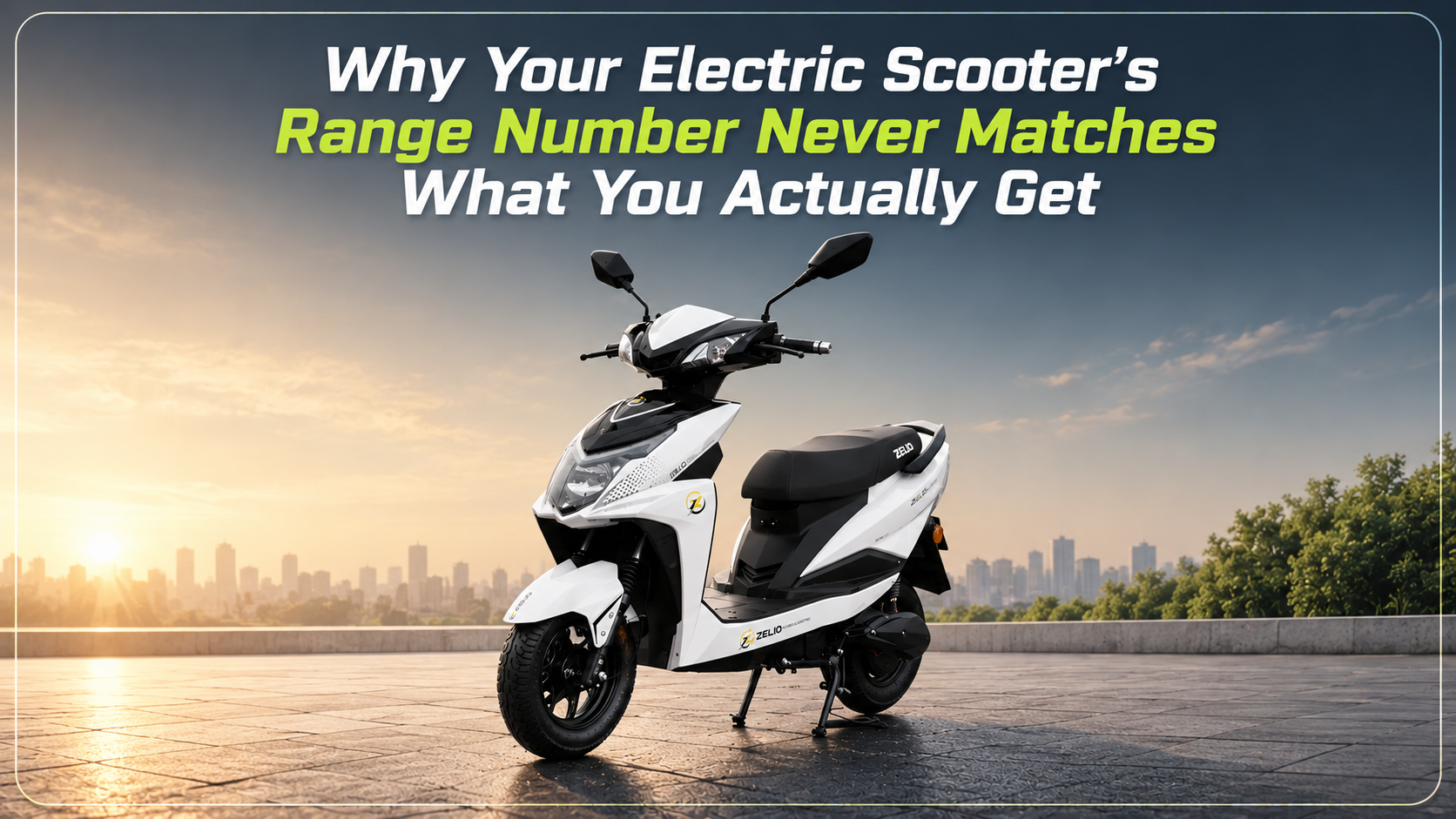
Why Your Electric Scooter's Range Number Never Matches What You Actually Get
Electric Scooters
17 July 2026

Why Your Electric Scooter's Range Number Never Matches What You Actually Get

The brochure said ninety kilometres. Your scooter has never once come close to that on a single charge, and by now you have probably started to wonder whether something is wrong with your battery. Nothing is wrong. This gap between the number printed on a spec sheet and the distance a rider actually covers is one of the most consistent complaints in electric mobility, and it exists for reasons that have very little to do with the quality of the scooter you bought.

Understanding where that number comes from changes how you read every future spec sheet, and it stops the range indicator from feeling like it is lying to you.


What That Claimed Figure Actually Represents

The range printed on an electric scooter's box comes from a certified test, usually carried out on a dynamometer by an authorised testing agency rather than on an actual road. The vehicle runs at a fixed, steady speed with no traffic signals, no braking, no wind resistance, and no gradient to climb. The rider used in these tests tends to be light, the tyres are at ideal pressure, the battery is brand new, and the ambient temperature sits at a comfortable level that neither strains the battery nor helps it.

India moved from an older single-cycle test to a combined urban and extra urban testing method a few years back, specifically to bring these numbers closer to how people actually ride. Even with that change, a laboratory can only simulate so much. It cannot simulate a red light every four hundred metres, a pothole that forces a sudden brake, or the particular way you twist the throttle when you are running late.

That printed number was never a promise. It was always a best case, measured under conditions almost nobody rides in every single day.


Check the latest on-road prices for all Zelio scooter models at the battery scooty price list

The Gap Is Real, and It Is Larger Than Most Riders Expect

Independent testing across several popular electric scooters has found real-world range typically landing somewhere between seventy and eighty five percent of the claimed figure, with some scooters falling well below that depending on how they are ridden. One well known scooter advertised a certified range in the high hundreds of kilometres, yet its own manufacturer's real-world figure, measured in the most efficient riding mode, came in over twenty percent lower, and dropped further still once a rider switched to a faster mode.

If you want a rough planning number that has held up across multiple independent tests, multiplying the claimed range by roughly seven tenths gets you close to what most riders should expect on an average day. It is not exact, but it saves you from planning a route around a number that was never realistic in the first place.


What Actually Eats Into Your Range

A handful of everyday factors are responsible for almost the entire gap, and none of them are unique to your scooter.

Your weight and whatever you are carrying - The test rider used for certification is deliberately light. A heavier rider, a filled grocery bag hanging off the handlebar, or a passenger riding pillion all mean the motor works harder to move the same distance, which drains the battery faster than the lab figure accounts for.

Stop and start traffic - Every red light, every slow crawl through a market, and every sudden brake costs you energy that a steady, uninterrupted lab test never has to spend. Indian city traffic is almost the opposite of the conditions a range figure is measured under.

How you use the throttle - Gentle, gradual acceleration sips power. Aggressive acceleration away from every signal, or riding at the scooter's top speed instead of a moderate one, pulls noticeably more current from the battery for the same distance covered.

Gradient and terrain - Climbing even a mild flyover or a sloped road takes more energy than flat ground, and that energy does not fully come back to you on the way down, unlike what regenerative braking marketing sometimes implies.

Temperature - Both extremes work against you. A battery performing at its coldest, on those mornings when it takes a few kilometres just to feel normal again, delivers less usable range until it warms through from riding. Extreme heat causes its own separate strain on the cells.

Tyre pressure and general upkeep - Underinflated tyres increase rolling resistance, which is a fancy way of saying the motor has to push harder for the same result. This is one of the few factors on this list that is genuinely within your control on a weekly basis.

Battery age - A two year old battery simply does not hold the same charge it did on day one. This is normal chemical wear, not a defect, though good charging habits over the years slow that decline considerably.

Every one of these factors stacks on top of the others - On a hot, heavy traffic day with a pillion rider and slightly soft tyres, do not be surprised if your real range sits well under what a single one of these factors alone would suggest.


Why This Matters More on a Low Speed Scooter

If you ride one of the low speed electric scooters that need no licence and no RTO registration, range behaviour tends to feel a little more forgiving day to day, simply because these scooters are not being pushed toward high speed cruising in the first place. A scooter capped around twenty five kilometres an hour naturally avoids the steep power draw that comes with sustained high speed riding, which is one of the biggest range killers on faster registered scooters. That does not mean the gap between claimed and real figures disappears entirely, but it tends to be a gentler drop rather than a dramatic one.


What Range Can You Expect from Zelio Scooters?

Zelio builds its electric scooters in India, with manufacturing spread across facilities in Haryana, Odisha, and Tamil Nadu, and every battery goes through testing under real riding conditions rather than only inside a laboratory. That approach matters here specifically, because a range figure tested closer to how Indian roads actually behave tends to hold up better once a scooter reaches an actual rider's daily commute.

Range figures across Zelio's lineup are built around realistic city use rather than a single flattering number, which is why most models are quoted with a range rather than one optimistic peak figure.

The Zelio Gracy i is rated between sixty and ninety kilometres depending on the battery variant, and in everyday city commuting most riders land comfortably within that band without chasing the upper limit. The Zelio Little Gracy is built lighter and suits shorter city routes, where stop and start traffic has less time to eat into the charge before you are home again. For riders covering longer daily distances, the Zelio Legender+ Premium carries a larger battery specifically to absorb the kind of real-world losses described above, so the range that actually matters, the one you experience on your commute, still holds up at the end of the day.


Getting a Number You Can Actually Trust

The only range figure worth planning around is the one you measure yourself. Charge fully, ride your normal route for a week, note the distance covered before the battery needs charging again, and you will have a far more honest baseline than anything printed on a spec sheet. That number will still shift a little with the seasons, since a battery riding through a cold December morning behaves differently from the same battery in April, but it will be grounded in how you actually ride rather than how a machine rode it in a lab. And the habits that protect a battery's long term health, avoiding deep discharges, charging with the right equipment, keeping it out of extreme heat, are the same habits that keep your real-world range closer to its best for years rather than months.


Sources


Zelio Team

Innovation Department

No tags
Share

Frequently Asked
Questions

RELATED POSTS

Why Electric Scooters Feel Slower in Winter - The Real Reason

Why Electric Scooters Feel Slower in Winter - The Real Reason

It's a cold winter morning. You start your scooter, twist the throttle, and immediately feel that something isn't quite the same. The pickup feels a little slower, climbing a flyover takes a bit more effort, and the battery percentage seems to be dropping faster than usual. If you've ever wondered, "Did something happen to my scooter overnight?" you're not alone. The good news is that it's usually nothing to worry about. Cold weather affects every electric scooter battery, so what you're noticing is completely normal during winter. What's Actually Going On Inside the Battery Your scooter's battery runs on a simple chemical process. Lithium ions move back and forth through a liquid called electrolyte, and that movement is what generates the power that turns your wheels. In warm weather, this happens quickly and smoothly. Cold changes the texture of that electrolyte. It thickens, almost like honey pulled straight from the fridge instead of left on the counter. Ions that would normally zip through now move sluggishly. The battery has to work harder to push out the same amount of power and it just can't do it as fast. There's a technical term for this: internal resistance goes up when it's cold. Some lab tests have found resistance can jump by roughly five times when temperature drops from a comfortable room level down to close to freezing. That's not a small shift. It's the difference between a battery that responds instantly and one that hesitates. None of this means your cells are damaged. Nothing has degraded. Warm the battery back up, whether that's from the sun coming out or simply riding for ten minutes, and it starts behaving normally again. Why This Feels Worse First Thing in the Morning If your electric scooter feels slower during the first few minutes of your morning ride, that's completely normal. After sitting in the cold overnight, the battery starts the day at a lower temperature. As you ride, it gradually warms up, allowing it to deliver power more efficiently. That's why the scooter often feels more responsive after a few kilometres. This is also why a short 2 to 3 km trip can feel slower than a longer commute. The battery simply doesn't get enough time to warm up. How Much Range Are We Actually Talking About Numbers vary depending on how cold it gets and how the battery is built, but studies on lithium-ion batteries in general have found range or power drops anywhere from 10 to 40 percent in cold conditions, with the steepest losses showing up closer to freezing point. Most of North India doesn't see those extremes. A winter morning in Punjab, Haryana, or Delhi typically sits somewhere between 5 and 12 degrees Celsius, cold enough to notice a dip, not cold enough to see the worst of it. Expect somewhat reduced pickup and a slightly shorter range on your coldest mornings, easing off as the day warms up. Check the latest on-road prices for all Zelio scooter models at the battery scooty price list . Charging Slows Down Too and That's Deliberate You might also notice your scooter takes a little longer to charge fully on a cold night. This isn't a fault either. It's the battery protecting itself. Pushing a fast charge into a cold battery can cause a problem called lithium plating, where metal builds up on the battery's internal surface instead of charging properly. Over time, that damages the cells. To avoid this, a well-built battery management system automatically slows the charging rate when it senses the battery is cold, trading a bit of speed for a battery that lasts years longer. What You Can Actually Do About It You can't change the weather, but a few small habits make a real difference through winter. Park somewhere sheltered overnight if you can, even just under a covered area rather than fully exposed outside. A few degrees warmer at the start of the day genuinely helps. Give the scooter a short warm up ride before you push it hard, especially before climbing an incline or carrying extra weight. Charge indoors where possible rather than in an open, unheated space. A battery that starts its charge cycle a little warmer accepts charge more efficiently. Don't panic if the range indicator looks lower than usual first thing in the morning. Ride a few kilometres and check again. It usually corrects itself. A Few Zelio Scooters Worth Knowing About If you are buying your first electric scooter and winter performance is on your mind, a few things are worth looking at directly with a dealer: battery type, how the battery management system handles cold starts, and how the scooter has performed for other riders through past winters. The Zelio Gracy i is a solid everyday option with dependable range across seasons. If you want something lighter and easier to manage on shorter city routes, the Zelio Little Gracy handles that well. And for riders who need longer range on a single charge, the Zelio Legender+ Premium is worth a look. To get more life out of whichever battery you choose, our guide on extending your electric scooter's battery life has practical tips that apply across all seasons, not just winter. Sources U.S. Department of Energy - Vehicle Technologies Office, research on temperature effects on EV batteries Consumer Reports, "How Much Do Cold Temperatures Affect an EV's Driving Range" PBS News, "Cold weather can cut electric vehicle range and make charging tough" ArXiv research paper, "From Range Loss to Recovery: Cold Weather Challenges and Design Strategies for Commercial Electric Vehicle Fleets"

Read More
Do Electric Scooter Batteries Really Catch Fire? Here's the Honest Answer

Do Electric Scooter Batteries Really Catch Fire? Here's the Honest Answer

Yes, it has happened. A few years ago, videos of scooters catching fire were all over social media, and some of those incidents ended in real tragedy. We are not going to dance around that. But the honest answer needs the full picture too, because "yes, it happened" and "you should worry every time you plug in your scooter" are two very different things. Here is what actually causes these fires, how often they really happen compared to what most people assume, and what genuinely keeps you safe. What Actually Happens Inside a Battery When It Catches Fire Every lithium-ion battery, whether it is in a scooter, a phone, or a laptop, packs a large amount of energy into a small space. Normally that energy comes out slowly and safely. A fire starts when something upsets that balance and the battery slips into what is called thermal runaway. In simple terms, if a cell inside the battery gets damaged, overheated, or was made with a flaw to begin with, it can short circuit from the inside. That short circuit creates heat. The heat sets off a reaction that creates even more heat, and that heat spreads to the cell sitting right next to it. Once this chain starts, the battery heats up faster than it can cool down, and that is when you see smoke and then flames. This is not unique to scooters. It is the same basic process behind battery fires in phones and laptops too. A scooter just holds a lot more of these cells packed close together, which is why it looks far more dramatic when it happens. What Actually Sets It Off in Real Scooters A handful of specific things tend to cause this, and none of them are a mystery once you know what to look for. Poor quality battery cells. Some past fire cases were traced back to cells that were never properly tested for Indian heat and road conditions before they were fitted into a scooter. Overcharging or charging left unattended for too long. Leaving a scooter plugged in far past what it needs, especially overnight with no one keeping an eye on it, puts stress on cells that a good system should already be preventing. Physical damage. A battery that has been dropped, punctured, or knocked around in a fall can develop a fault that does not show up right away. Sometimes the fire happens hours or even days later. Too much heat. Charging a scooter right after it has come in from a long ride in peak summer, or leaving it parked in direct sun for hours, pushes the battery closer to its limit. Fast charging on a hot day. Rapid charging naturally creates more heat than a normal charge. Doing that on an already hot day is one of the more avoidable risks. Unauthorised repairs. A battery pack opened up and fixed outside a proper service centre, usually to save a bit of money, is one of the more common causes flagged in past investigations. Check the latest on-road prices for all Zelio scooter models at the battery scooty price list . How Common Is This, Really This is the part most conversations skip, and it changes the picture quite a bit. Fire data collected around the world, drawing on transportation safety agencies and fire departments, shows electric vehicles catching fire at roughly 25 incidents for every 100,000 vehicles sold. Petrol and diesel vehicles sit at around 1,500 per 100,000, and hybrid vehicles, which carry both a fuel tank and a battery, actually come out worst at around 3,400 to 3,500 per 100,000. In plain terms, a petrol vehicle is far more likely to catch fire than an electric one. The difference is that petrol fires happen often enough that nobody films them anymore. A small number of electric scooter fires a few years ago, some fatal, spread quickly online because they were new and visually dramatic, and that shaped how people feel about this far more than the actual numbers support. That is not an excuse for the incidents that did happen, and the risk is not zero. But the worry should match the real risk, not how many times a clip has been shared. What Has Changed Since Then That earlier wave of fires was a genuine wake up call for the industry, and it led to real regulatory change, not just public statements. Battery testing requirements got a lot stricter. Manufacturers were pushed toward a tougher safety standard that requires batteries to survive vibration testing, thermal shock, mechanical drop tests, short circuit simulations, and controlled overcharge and discharge testing before they can be sold in a vehicle in India. More recently, an even tighter standard was introduced specifically covering the powertrain components of electric two-wheelers. The direction is clear. Every fire that made headlines pushed regulators to close a gap that some manufacturers had been getting away with. What Actually Keeps You Safe as a Rider Most of what protects you comes down to habit, not luck. Always use the charger that came with your scooter. A mismatched or third-party charger is one of the easiest ways to push a battery beyond what it was built to handle. Give the battery a few minutes to cool down after a long, hot ride before you plug it in, especially during peak summer. Do not leave your scooter charging for hours longer than it needs, particularly overnight in a closed room with poor airflow. If your scooter has taken a fall or been in a collision, get the battery checked before charging it again, even if nothing looks damaged on the outside. Get repairs done only at a proper service centre. A cheaper local fix on a battery pack rarely saves you money in the long run. Watch for warning signs. A battery that feels unusually hot, looks swollen, or shows any leakage should be checked immediately instead of charged again out of convenience. Zelio Scooters Built With This in Mind Every Zelio scooter goes through real world testing on Indian roads in Indian heat before it reaches a rider, not just controlled lab conditions. The battery management system tracks individual cell voltage and temperature throughout every ride, not just at charging time, which is what actually keeps a battery pack healthy over the years. If you are looking at options right now, the Zelio Gracy i is a solid everyday pick with a strong balance of range and reliability. For a lighter, easier to handle option, the Zelio Little Gracy works well for shorter city rides. And if range matters most to you, the Zelio Legender+ Premium covers longer distances comfortably on a single charge. To keep your battery running safely and lasting longer no matter which model you choose, our guide on extending your electric scooter's battery life covers the daily habits that matter most.

Read More
Zelio Eeva Now Comes in 4 Colours - Here's What Else Changed

Zelio Eeva Now Comes in 4 Colours - Here's What Else Changed

If you liked the Zelio Eeva but always wanted more colour options, you now have them. The Eeva is available in four colours, along with a few small updates that make it feel fresher without changing what already worked well. Here is a full look at what's new, what stayed the same, and where it fits if you are shopping for a daily scooter right now. The 4 New Colours The Eeva now comes in white and silver dual tone, a deep green paired with black, a clean all-white finish, and a bold blue. That is a good range of options for a scooter in this price bracket. Most electric scooters at this price stick to two or three safe colours. Zelio has picked four options that feel distinct from each other, not just four shades of the same idea. If you park this scooter outside your college , your office , or your building every day, having a colour that actually feels like yours makes a small but real difference. What's New Besides the Colours The bigger change is the digital speedometer. Earlier versions of the Eeva used a simpler display. Now every rider gets a proper digital speedometer, which makes checking your speed and battery level a lot easier at a glance, especially in traffic when you do not want to be squinting at a small dial. Zelio describes this version as "ideal for all types of riders," and going by the spec sheet, that holds up. The scooter feels light and manageable whether you are riding for the first time or you have been on scooters for years. Zelio Eeva - Specs, Price and What You Get Zelio Eeva | Price: Rs 55,834 (60V/32AH Lead Acid) | Range: 60-90 km | Motor: 60/72V BLDC | Licence: No Rs 55,834 gets you a scooter that covers all the basics well. The Eeva N runs on a Gel battery (60V or 72V, 32AH or 42AH) or a Lithium battery (60V/30AH or 74V/32AH). The Lithium option costs a bit more but charges faster and lasts longer over time. Either way, a few simple charging habits make a real difference, and our guide on extending your electric scooter's battery life covers what to do and what to avoid. The 60/72V BLDC motor is smooth and low maintenance, built for everyday city riding rather than speed. Since it is a low speed scooter, it also falls under the no licence, no RTO registration category, so you can ride it home the same day you buy it, no paperwork involved. Our low speed vs high speed electric scooter guide explains exactly how that classification works if you want to know more. Running cost comes to roughly 1.5 units of electricity per full charge, which makes it one of the cheapest ways to get around in India right now. You get drum brakes on both wheels, 90-90/12 tyres front and rear for a stable ride, and hydraulic suspension on both ends that handles potholes and speed breakers noticeably better than basic spring setups. Along with that, the Eeva N comes with a centre lock and anti-theft alarm, a USB charging port, a proper footrest, keyless drive, an LED headlamp, and more foot space than you would expect at this price. All of it comes with Zelio's standard 2 year warranty on the motor, controller, and frame. Price is ex-showroom, Haryana and Punjab, June 2026. Explore Zelio Eeva N Check the latest on-road prices for all Zelio scooter models at the battery scooty price list . Who Should Actually Buy This If your daily ride falls somewhere between 15 and 30 kilometres, the Eeva's 60 to 90 km range on a single charge means you are not thinking about charging every single day. Students, working professionals with a short office commute, and anyone who wants a scooter that does not need a licence will find this an easy choice. For a broader look at what makes a scooter genuinely good for everyday commuting, our guide to the best electric scooter for daily commute is worth reading, and if you want to compare prices across regions, our electric scooter price list for Delhi is a good place to check. Being a low speed scooter also means less to deal with overall. No RTO visits, no licence tests, no road tax. You buy it, charge it at home, and ride. Zelio has 360+ authorised dealers across 25+ states. Use the dealer locator to find your nearest Zelio authorised dealer. Then Walk in, take a test ride, and find the right scooter for your daily commute.

Read More