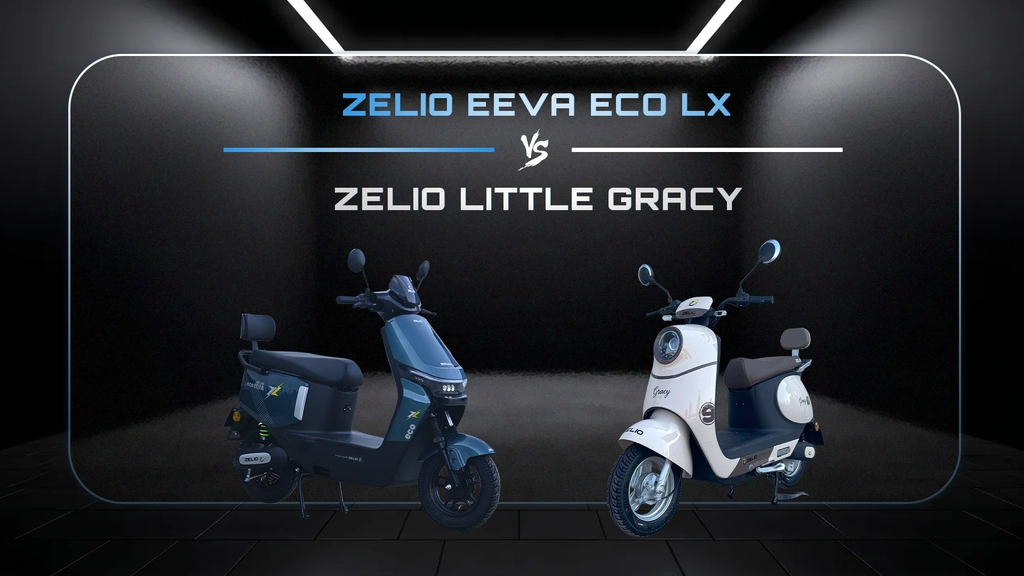
Zelio Eeva Eco LX vs Zelio Little Gracy - Which Electric Scooter Should You Buy?

Zelio Eeva Eco LX vs Zelio Little Gracy - Which Electric Scooter Should You Buy?

Zelio Eeva Eco LX and the Zelio Little Gracy both sit under Rs 50,000. Both are low-speed, no-licence electric scooters that charge from a standard home socket. Both are backed by Zelio’s 2-year warranty.

So what is actually different between them?

The braking setup, tyre size, battery options, design purpose, and who each scooter is truly built for are meaningfully different. This comparison breaks it all down so you spend your money right the first time.

Zelio Eeva Eco LX vs Zelio Little Gracy - Full Spec Comparison

Feature

Zelio Eeva Eco LX

Zelio Little Gracy

Price (48V Lead Acid, ex-showroom)

Rs 45,477

Rs 50,159

Price (60V Lead Acid, ex-showroom)

Rs 47,977

Rs 52,659

Motor

48/60V BLDC

48/60V BLDC

Gel Battery

48-60V / 28AH

48-60V / 32AH

Lithium Battery

60V / 30AH

60V / 30AH

Range (Gel Battery)

60-80 km/charge

60-90 km/charge

Electricity per Charge

1.5 units

1.5 units

Top Speed

Low Speed (under 25 km/h)

Low Speed (under 25 km/h)

Front Brake

Drum Brake

Drum Brake

Rear Brake

Drum Brake

Drum Brake

Tyres (Front)

Tubeless Alloy

3-10 inch

Tyres (Rear)

Tubeless Alloy

3-10 inch

Suspension

Hydraulic

Hydraulic

Keyless Drive

Yes

Yes

Anti-Theft Alarm with Centre Lock

Yes

Yes

USB Port

Yes

Yes

Footrest

Yes

Yes

Digital Speedometer

Yes

Yes

Driving Licence Required

No

No

RTO Registration Required

No

No

Warranty (Motor, Controller, Frame)

2 Years

2 Years

Warranty (Lithium Battery)

3 Years

3 Years

Made in India

Yes

Yes

The price gap between them is Rs 4,682 (48V Lead Acid). That is a real difference at this budget level. Whether the Gracy Little earns that extra spend depends entirely on what you are actually looking for.

These Prices are valid for Haryana and Punjab markets only (ex-showroom) , it may vary for other markets. 


Price - Eeva Eco LX Is the Most Affordable Zelio scooter in India

The Zelio Eeva Eco LX starts at Rs 45,477 (48V) and Rs 47,977 (60V Lead Acid). It is the cheapest electric scooter in Zelio’s entire lineup and one of the most affordable warranted electric scooters available in India in 2026.

The Zelio Little Gracy starts at Rs 50,159 (48V) and Rs 52,659 (60V Lead Acid). It costs Rs 4,682 more than the Eeva Eco LX on the same 60V Lead Acid variant.

For buyers on a tight budget for whom every rupee counts, the Eeva Eco LX is the honest answer. For buyers who can stretch slightly and want a more purpose-built compact scooter, the Gracy Little is the upgrade.

Range - Little Gracy Has a Slight Edge

Zelio Eeva Eco LX range:

  • Gel Battery: 60-80 km per charge
  • Lithium Battery (60V/30AH): up to 90 km per charge

Zelio Little Gracy range:

  • Gel Battery (48-60V/32AH): 60-90 km per charge
  • Lithium Battery (60V/30AH): up to 90 km per charge

On lead acid, the Little Gracy 32AH battery gives it a small range advantage over the Eeva Eco LX. On lithium, both top out at the same 90 km per charge.

For a rider doing 25-35 km daily, both scooters cover a full day comfortably without recharging. For someone doing 40-50 km daily, the lithium variant of either model is the safer choice.

Braking - Both Use Drum Brakes

Both the Zelio Eeva Eco LX and Zelio Little Gracy use front and rear drum brakes. This is not a differentiating factor between these two models.

The low-speed scooter (under 25 km/h) with drum brakes is perfect for city commuting. They provide consistent stopping in normal conditions and are simple to maintain. For stop-start city traffic at these speeds, drum brakes on both models are adequate and safe.

If your priority is a scooter with a disc brake or combi brake at this price point, consider the Zelio Gracy i (Rs 56,709) which steps up the braking setup.

Design and Size

This is where the Eeva Eco LX and Little Gracy are most clearly different from each other, and where the decision often gets made.

Zelio Eeva Eco LX is designed with a clean, straightforward profile. It is a practical urban scooter built to cover daily commutes efficiently without unnecessary bulk. Its tubeless alloy wheels give it a neat, modern road stance and make puncture management easier than tube tyres.

Zelio Little Gracy is explicitly a compact scooter – smaller body, shorter wheelbase, lighter kerb weight. It is purpose-built for riders who find a standard scooter slightly large or heavy to handle, particularly in slow moving traffic and tight parking situations. The name “Little” is intentional. This is a scooter designed for ease of use above everything else.

If you are comfortable on a regular-sized scooter and just want the most affordable Zelio, go with the Eeva Eco LX. If handling ease and a smaller footprint are what you are actually looking for, the Little Gracy justifies its higher price with a more specific purpose.

Who Should Buy the Zelio Eeva Eco LX?

Buy the Zelio Eeva Eco LX if:

  • You want the most affordable electric scooter in India with a brand warranty
  • You are a first-time EV buyer entering the electric scooter market for the first time
  • Your daily commute is 25-35 km and the lead acid range covers you comfortably
  • You want tubeless alloy wheels for easier flat tyre management
  • Budget is the primary decision factor and you need to stay under Rs 46,000


Who Should Buy the Zelio Little Gracy?

Buy the Zelio Little Gracy if:

  • You are a woman rider, senior citizen, or teenager buying your first scooter
  • You ride in congested city lanes and tight parking spaces daily
  • You want a scooter that is lighter and easier to balance and manoeuvre at low speeds
  • You can stretch to Rs 50,159 and want a scooter that is purpose-built for compact, easy riding
  • You are a parent buying a scooter for a young rider and want something smaller and more manageable

Explore Zelio  Little Gracy – Rs 50,159

Our Verdict

Decision Factor

Winner

Lowest price

Zelio Eeva Eco LX (Rs 45,477 vs Rs 50,159)

Range on lead acid

Zelio Little Gracy (32AH battery)

Range on lithium

Equal (both 90 km)

Easiest to handle and manoeuvre

Zelio Little Gracy (compact body)

Best for women and beginners

Zelio Little Gracy

Best for first-time EV buyers on budget

Zelio Eeva Eco LX

Tubeless alloy wheels

Zelio Eeva Eco LX

Braking system

Equal (both drum brake)

Warranty

Equal (2 years motor, frame; 3 years lithium)

The Zelio Eeva Eco LX wins on price. It is the right pick for a budget-first buyer who wants to enter the electric scooter market in India without overspending.

The Zelio Little Gracy wins on ease of use. It is the right pick for riders who want a compact, lighter, more manageable scooter for city riding daily, and for whom the smaller footprint is a genuine practical advantage.

The Rs 4,682 price gap is the deciding question. If size and handling ease are a priority, the Little Gracy earns the extra spend. If budget is the priority and a standard-size scooter works fine for you, save the money and go with the Eeva Eco LX.
Zelio Team

Innovation Department

No tags
Share

Frequently Asked
Questions

RELATED POSTS

Zelio E-Mobility Plans to Double Its Workforce in FY27
EV News
7/7/2026

Zelio E-Mobility Plans to Double Its Workforce in FY27

Zelio E-Mobility, the Hisar-based electric two and three-wheeler manufacturer, has announced it will more than double its workforce during the current financial year. The company currently has around 260 employees spread across its manufacturing facilities in Hisar, Bhubaneswar, and Coimbatore. The plan is to take that number past 500 before the end of FY27. This is not a speculative growth target. It is a response to actual business performance. Zelio reported revenue of Rs 313.68 crore in FY26, an 81.8 percent increase over the Rs 172.19 crore it posted the year before. The company has been profitable since inception and has recorded a revenue CAGR of approximately 121 percent over the last four years. The hiring push is the company catching up to where the business already is. Where the New Hires Are Going The expansion is spread across three locations, each with a specific purpose. Hisar - Zelio's headquarters and primary manufacturing base in Haryana. The bulk of the hiring here will focus on production, quality control, and core manufacturing operations. Bhubaneswar - Zelio's facility in Odisha supporting the East India and North-East expansion push. Coimbatore - The newest facility in the lineup. Coimbatore is still being commissioned and ramped up, which makes it the most significant of the three locations in terms of what the hiring signals. A hundred new employees at a facility that is just scaling up means Zelio is serious about South India as a growth market. The roles being filled span manufacturing, R&D, quality, production planning, zonal sales leadership, and after-sales service. These are not temporary or support hires. They are the people who run plants, lead sales territories, and keep the service network functional as dealerships grow. What Our CEO Said Divyanshu Agarwal, CEO of Zelio E-Mobility, explained the thinking behind how the company approaches expansion: "Our expansion is not only focused on manufacturing growth but also on building strong local ecosystems in each region we operate in, ensuring long-term value creation through employment and skill development." That framing matters. Zelio is not building factories and shipping in management from headquarters. The plan is to hire locally in Bhubaneswar and Coimbatore, creating jobs and skills in those markets specifically. For a company entering new geographies, that approach tends to build stickier relationships with local governments, dealers, and customers than a centralized model does. Divyanshu also made the point that this has been consistent with how Zelio has operated since its founding: "Since the beginning, Zelio has always been a people-first company. Wherever we enter, whether a state or a city, our focus is to create meaningful job opportunities and contribute to local employment." The Business Context Behind the Hiring Zelio listed on the BSE SME platform in October 2025. The IPO raised Rs 78.34 crore, including a fresh issue of Rs 58.84 crore and an offer for sale of Rs 15.50 crore. The IPO was subscribed 1.5 times overall. Since listing, the company has continued to perform. The FY26 revenue of Rs 313.68 crore represents the strongest year the company has had, and it came after years of consistent profitability that set Zelio apart from several larger EV peers that are still reporting losses. The dealership network currently stands at 400+ outlets across 25+ states. The target for FY27 is 550+ dealerships, with a specific focus on South India and the North-East. The Coimbatore hiring directly supports the South India push, and the Bhubaneswar hires support the East and North-East strategy. For a company to expand its dealer network to 550 locations and maintain after-sales quality across that footprint, it needs the backend workforce to match. That is the practical reason behind the 500+ headcount target. Why This Matters Beyond Zelio Zelio's expansion follows a pattern that tells you something about where the Indian EV market is heading, particularly in the slow-speed electric scooter segment. The brands seeing the fastest growth in this segment are not the ones with the biggest advertising spends. They are the ones building manufacturing depth, dealer width, and service reliability simultaneously. A dealer in a tier-2 city who cannot get spare parts within 48 hours or reach a service professional by phone becomes a liability, not an asset. Zelio's hiring of after-sales professionals and zonal sales leaders alongside plant staff reflects an understanding of this. The 121 percent revenue CAGR over four years, combined with consistent profitability, also tells a different story than the wider EV narrative in India, where many companies are still in investment mode and reporting operating losses. Zelio has been growing while keeping the business in the black, which gives the current expansion a more stable foundation than if it were funded purely by external capital. With 2 lakh+ riders already on Zelio scooters across India and a lineup of 19 models starting at Rs 47,784, the workforce expansion is ultimately about making sure the company can serve what it has already sold, and confidently sell more. For the latest on-road prices across Zelio's lineup, see the battery scooty price list . What Roles Zelio Is Hiring For Based on the official announcement, the hiring covers: - Plant heads and production planning specialists - R&D and quality control professionals - Zonal sales managers and regional sales leaders - After-sales service and customer support professionals - Manufacturing floor staff at Hisar and Coimbatore If you are looking to be part of Zelio's expansion, The Zelio E-Mobility careers is the right place to start. Sources Zelio E-Mobility to Double Workforce as EV Expansion Gains Pace Across India - EMobility+, 2026 Zelio set to cross 500 employees in FY27 - HR Katha, 2026 Zelio E-Mobility to Double Workforce to Over 500 Employees - Manufacturing Today India Zelio E-Mobility Plans to Double Workforce Following Strong Revenue Growth - Economic Times Auto, 2026 Zelio E-Mobility to Double Workforce, Expand Employee Strength Beyond 500 - GearFliq

Read More
Delhi’s New EV Policy 2026 - What It Means for Electric Scooter Buyers in Delhi
EV News
7/6/2026

Delhi’s New EV Policy 2026 - What It Means for Electric Scooter Buyers in Delhi

Delhi has approved its new Electric Vehicle Policy and it came into effect on July 1, 2026. For anyone who has been sitting on the fence about buying an electric scooter in Delhi, this policy changes the financial calculation significantly. Here is what the policy actually says, what it means for two-wheeler buyers specifically, and what people from inside the EV industry are saying about it. What the Delhi's New EV Policy 2026 Actually Covers The Delhi EV Policy 2026 is built around three pillars: consumer incentives to bring down the cost of buying an EV, infrastructure investment to make charging accessible across the city, and a phased timeline to move Delhi away from petrol and diesel vehicles over the coming years. 100% road tax and registration fee exemption - For electric cars priced up to Rs 30 lakh. This removes one of the most significant upfront costs for EV buyers in this segment. Subsidies for electric two-wheeler buyers - The policy introduces purchase incentives for electric two-wheelers, with subsidies of up to Rs 30,000 for buyers in the first year of the policy. For a Delhi rider looking at an electric scooter, this directly reduces the on-road cost. Expansion of EV charging infrastructure - The policy commits to a significant push on public charging points across the city, addressing the range anxiety and charging accessibility concerns that have held back EV adoption in Delhi's denser residential areas. Phased ICE phase-out timeline - The policy outlines a phased transition towards EV-only registrations in selected vehicle categories over the coming years, giving the industry and buyers a clear signal about the direction Delhi is heading. What the Chief Minister said, Delhi CM Rekha Gupta has pitched the policy as a savings measure first, an environmental one second. Her framing: buyers want to know if going electric actually saves money, and the mix of purchase subsidies, scrapping incentives, and lifetime road tax exemption is meant to make that answer an easy yes. Private car buyers don't get a purchase subsidy under the policy, but scrapping an old petrol or diesel car for an EV still qualifies for up to ₹1 lakh in scrapping benefits plus the tax waivers. On charging, she treats the rollout as a trust issue, not a checklist item. "Charging infrastructure is not merely about installing chargers," she said, framing the planned expansion to 32,000 points as the thing that actually gets people to switch. She's also been clear the transition won't happen overnight. Existing petrol and diesel vehicles keep running as long as they're legally on the road. The shift to electric-only registrations comes in phases, through 2027 and 2028. What This Means if You Are Buying an Electric Scooter in Delhi For a Delhi rider considering an electric scooter, the 2026 policy stacks multiple savings together in year one. The up to Rs 30,000 subsidy on two-wheelers, combined with the existing 100% road tax and registration exemption for low-speed electric scooters that was already in place before this policy, means the real out-of-pocket cost of switching to electric has dropped again. A Zelio Gracy i starting at Rs 58,159 in Delhi, with the two-wheeler subsidy applied, could effectively come down to around Rs 28,000-30,000 lower than its listed price for eligible buyers. Combined with the Rs 30,000-40,000 annual savings on fuel and servicing that any electric scooter already delivers at Rs 0.25 per km, the financial case for switching has never been stronger for Delhi commuters. The charging infrastructure push also directly addresses one of the real daily concerns for riders who live in apartments or shared housing where home charging is not always possible. The EV industry welcomed the policy with clear and specific reactions, not just generic approval. Kunal Arya, Co-founder and Managing Director of Zelio E Mobility, responded directly to the announcement: "Delhi's EV Policy 2026 is a decisive step toward making electric mobility mainstream, accessible, and infrastructure-backed. The combination of demand incentives including subsidies of up to Rs 30,000 for two-wheeler buyers in the first year along with a clear ICE phase-out timeline and a strong push for charging infrastructure, creates a practical ecosystem for accelerated EV adoption. What stands out is the policy's balanced approach: driving consumer demand while addressing the charging accessibility barrier head-on. For the EV industry, this sends a clear signal that policy is moving beyond intent to execution." Kunal also pointed to the particular impact the policy will have on two-wheeler and last-mile mobility adoption: "At Zelio E-Mobility, we believe such progressive frameworks will significantly accelerate EV penetration, especially in the two-wheeler and intra-city last-mile mobility segments, where adoption delivers immediate environmental and economic impact. Delhi is setting a benchmark that other urban centres will closely watch." Why Two-Wheelers Are at the Centre of This Delhi's vehicle population is dominated by two-wheelers. They account for the largest share of registered vehicles in the city and contribute significantly to both traffic congestion and air pollution. Any EV policy that moves the needle on two-wheeler electrification moves the needle on Delhi's air quality. The 2026 policy's explicit focus on two-wheeler subsidies and the eventual ICE phase-out timeline for this category signals that Delhi is not just thinking about EV cars for the affluent buyer. It is targeting the rider who currently uses a petrol scooter for daily commuting, because that is where the volume is and where the environmental impact is greatest. For that rider, the combination of the Rs 30,000 subsidy, zero road tax, zero registration fee, and Rs 0.25 per km running cost makes switching to an electric scooter in Delhi a decision that is financially hard to argue against in 2026. How Zelio Electric Scooters Fit Into This Zelio's lineup spans low-speed and high-speed electric scooters across several price points in Delhi. The low-speed models already qualify for no-licence, no-registration treatment under existing motor vehicle rules, and that now stacks with the new policy's subsidies for eligible buyers. For the full list of current models and prices, see the Delhi electric scooter price list . If you're curious how those prices compare once you factor in road tax exemptions, PM E-DRIVE subsidies, and the other line items that make up an on-road cost, the battery scooty price list breaks all of that down across budget, mid-range, and premium models. If you want to see the five-year cost breakdown against a petrol scooter, the electric vs petrol scooter comparison lays it out. And if you're trying to match a model to your commute and budget, the best electric scooters under ₹70,000 guide is a good starting point. The Bigger Picture Kunal Arya's observation that "Delhi is setting a benchmark that other urban centres will closely watch" reflects something worth noting. Delhi is not the first Indian city to offer EV subsidies, but the combination of the subsidy quantum, the charging infrastructure commitment, and the phased ICE transition timeline in a single cohesive policy is more structured than what most other cities have managed. If this policy drives meaningful two-wheeler electrification in Delhi over the next two to three years, the template will almost certainly be picked up by other state capitals. For EV brands operating in India, that trajectory matters more than any single subsidy figure. For individual buyers in Delhi in 2026, the question is simpler: has the policy made buying an electric scooter the better financial decision today? The answer, for most daily commuters doing 30-50 km a day, is yes. Sources Industry welcomes Delhi EV policy, sees strong push for electric vehicle adoption - BioEnergy Times, June 30, 2026 Delhi approves EV Policy 2026 with scrappage boost and tax waivers - SME Futures, 2026 Auto industry and experts welcome Delhi EV Policy 2026 - Jagran, 2026 Industry leaders hail Delhi's new EV policy as a blueprint for clean mobility - Navbharat Times, 2026 Delhi aiming for 32,000 public EV charging points by 2030: CM Rekha Gupta - The Tribune, 2026 Delhi EV Policy 2026 designed to save buyer's money: CM Rekha Gupta - DD News, 2026

Read More
Electric Scooter Price in Uttar Pradesh: Latest Price List 2026

Electric Scooter Price in Uttar Pradesh: Latest Price List 2026

Read More