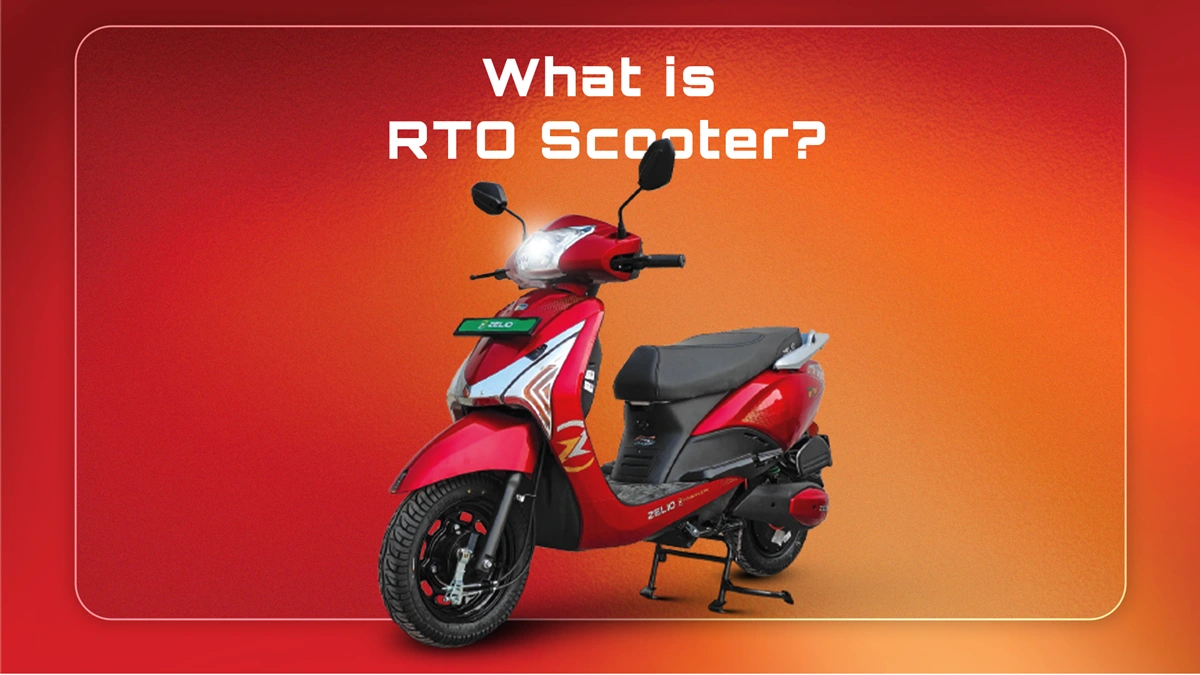
What is RTO Scooter?
Electric Scooters
21 April 2026

What is RTO Scooter?

If you’ve been exploring the electric scooter market in India, you may have come across the term “RTO Scooter” and wondered what it means. With rising fuel prices, growing environmental awareness, and the government’s push for clean mobility, electric scooters are rapidly becoming the preferred choice for daily commuters. But before you invest in one, understanding the concept of RTO registration – and whether your scooter requires it – is absolutely essential.

What Does RTO Mean?

RTO stands for Regional Transport Office – the government body in India responsible for vehicle registration, licensing, and enforcing transport laws.

Every motor vehicle that runs on public roads must be registered with the RTO under the Motor Vehicles Act, 1988.

This registration gives your vehicle a unique registration number (number plate), making it legally identifiable on Indian roads.

So, What is an RTO Scooter?

An RTO Scooter is a scooter that requires mandatory registration with the Regional Transport Office before it can be legally ridden on public roads.

These scooters typically have a motor power exceeding 250 watts and a top speed above 25 km/h. Because of their higher performance, they fall under the Motor Vehicles Act, which means:

  • They must be registered with the RTO and carry a valid registration certificate (RC).
  • The rider must possess a valid driving licence.
  • Third-party insurance is mandatory.
  • The scooter must have a proper number plate issued by the RTO.

In simple terms, an RTO scooter is a road-legal, high-performance electric scooter designed to be used just like any conventional petrol-powered two-wheeler – but with zero emissions and much lower running costs.

RTO vs Non-RTO Electric Scooters

Not all electric scooters require RTO registration. Low-speed electric scooters with motors up to 250 watts and a maximum speed of 25 km/h are exempt from registration, driving licenses, and insurance requirements. These are ideal for short, slow commutes within gated communities, campuses, or local areas. However, they are not permitted on highways or high-traffic public roads. RTO scooters, on the other hand, are built for real-world road conditions – faster speeds, longer ranges, and the ability to keep up with traffic on city roads and beyond.

If you need a scooter for everyday commuting, running errands, or office travel for short distance within city limits – buying a non-RTO scooters will be a good decision.

If you need scooter for everyday commuting of more than 20-30km using main roads / highways, an RTO-registered scooter is the right choice.

Meet the Zelio Mystery - Zelio's Only RTO Scooter

Across the entire range of Zelio electric scooters, the Zelio Mystery stands out as the one and only RTO scooter.

While Zelio offers a variety of electric scooters that cater to different needs and budgets, the Mystery is specifically designed to meet the standards required for RTO registration – making it the go-to option for riders who want a fully road-legal, high-performance electric scooter.

The Zelio Mystery is engineered for serious daily commuters. With a powerful motor that exceeds the 250W threshold, a top speed suitable for city and suburban roads, and a sleek, modern design, it ticks every box for riders who want the complete electric scooter experience – without compromise.

Zelio Mystery competes with TVS iQube, Bajaj Chetak, Ather Rizta, Ola S1 Pro and more.

Why Choose an RTO Scooter Like the Zelio Mystery?

Choosing an RTO-registered scooter like the Zelio Mystery comes with several significant advantages over non-RTO models.

First, it gives you complete road legality – you can confidently ride on any public road, highway, or city street without worrying about traffic police checkpoints.

Second, the higher motor power delivers better acceleration, making it easier to navigate busy intersections and keep up with traffic.

Third, RTO scooters generally offer longer battery range as it uses Lithium ion batteries.

How to Register Your RTO Scooter

Registering an electric scooter with the RTO is a straightforward process.

Once you purchase the Zelio Mystery from an authorized Zelio dealer, the dealer will typically assist you with the documentation and registration process.

The key documents required include the vehicle’s invoice, insurance certificate, identity proof, address proof, and passport-size photographs.

The RTO will then issue your Registration Certificate (RC) and a unique number plate. The entire process is now increasingly digital thanks to the Vahan portal, making it faster and more convenient.

An RTO scooter is not just a legal requirement – it is a smart investment in a cleaner, greener, and more affordable commute.

As India’s electric vehicle ecosystem continues to grow, owning an RTO-registered electric scooter puts you firmly on the right side of the road – literally and figuratively.

If you’re looking for a reliable, stylish, and fully road-legal electric scooter, the Zelio Mystery is your answer. As the only RTO scooter in Zelio’s entire lineup, it combines performance, practicality, and the freedom to ride anywhere – all with zero emissions and minimal running costs.
Zelio Team

Innovation Department

No tags
Share

RELATED POSTS

Best Electric Scooter for Teenagers in India 2026 - Legal, Safe, and Practical

Best Electric Scooter for Teenagers in India 2026 - Legal, Safe, and Practical

Every Indian family has this conversation at some point. The teenager wants a scooter. The parent has concerns - about safety, about the licence process, about what happens if something goes wrong on the road. In 2026, there is a version of that conversation that goes a lot more smoothly than it used to. Low-speed electric scooters have changed the picture entirely. No licence needed, no RTO paperwork, charges at home every night, and costs Rs 0.25 per km to run. The safety ceiling is literally built into the speed limit. But there are still questions that need honest answers before you buy - what the law actually allows at what age, what features genuinely matter for a first-time rider, and which scooter makes the most sense for which teenager. That is what this covers. What Age Can a Teenager Actually Ride an Electric Scooter in India? Parents search this and get different answers from different sources. Here is the clear version backed by the Central Motor Vehicles Rules (CMVR). Under 16: Cannot legally ride any motorised vehicle on public roads in India, including low-speed electric scooters. Riding is restricted to private property only. 16 to 18 years: Can legally ride a low-speed electric scooter on public roads without a driving licence, provided the scooter runs under 25 km/h and has a motor power under 250W. These vehicles are classified as non-motorised under CMVR and are completely exempt from registration, road tax, and licence requirements. A 16-year-old can walk into a Zelio showroom, buy a scooter, and ride home the same day. No RTO visit, no paperwork, nothing to wait for. There is also a separate provision worth knowing: riders aged 16-18 can apply for a Learner's Licence for gearless two-wheelers up to 4.0 kW motor power. This is not required for low-speed exempt models but is useful for families thinking ahead - if the teenager will eventually move to a registered, higher-speed scooter at 18, this gives them a head start. 18 and above: Eligible for a full permanent two-wheeler licence and can ride any electric scooter, including high-speed registered models. For most families buying a scooter for a teenager right now, a low-speed Zelio under 25 km/h is the answer. Zero paperwork, legal from 16, and safer by design. The non-RTO scooter guide walks through what all of this means legally before you visit a showroom. Why 25 km/h Is a Safety Feature, Not a Drawback Every parent's real question after the legal one is whether a teenager will actually be safe on it. This is where low-speed electric scooters have an advantage that no high-speed scooter can match - and it is built into the vehicle, not dependent on the rider's behaviour. A 25 km/h speed cap cannot be overridden. An eager 17-year-old cannot twist the throttle harder and make it go faster. The motor is physically limited. At 25 km/h, a fall is serious but rarely fatal. The same fall at 50-60 km/h is an entirely different outcome. Most fatal two-wheeler accidents in India happen above 40 km/h. A low-speed electric scooter cannot get there. For a teenager riding through a residential colony, to a coaching centre, or down a school route where traffic moves at 20-30 km/h anyway - the speed cap fits the environment exactly. Beyond the speed limit, here are the specific features that matter for a first-time rider: Braking (CBS over disc for beginners) - A disc brake gives direct, confident stopping power. A CBS (Combined Braking System) links front and rear braking automatically when you squeeze the front lever. For a first-time rider who might panic-grab the front brake on a slippery road, CBS is the more forgiving setup. The Zelio Little Gracy has CBS. The Gracy i has a disc brake and suits more experienced riders. Anti-theft alarm with centre lock - A scooter parked at school all day with no anti-theft system is an invitation. This is not optional. DRL (Daytime Running Light) - On a busy school route, being visible to other vehicles during daylight matters. A scooter with DRL is easier for cars and buses to spot at intersections. Telescopic suspension - Teenagers are still building road awareness. They do not always slow down before speed breakers. Telescopic suspension absorbs those moments better than basic setups. Seat height and weight - The first time a teenager tips over at a red light because they could not reach the ground, the scooter becomes scary instead of freeing. In the showroom, ask your teenager to sit on it. Both feet should be flat or close to flat. If they cannot manage that comfortably, a lighter or shorter model is the right call. Helmet for every ride, no exceptions - The law may not currently require it for low-speed exempt scooters everywhere. That does not matter. A 25 km/h fall without a helmet onto an Indian road is still a dangerous fall. ISI-certified helmet, every time. What It Actually Costs Per Month For most families, the parent is the one paying. So the monthly number matters. A petrol scooter for a student doing 20 km daily costs Rs 1,500-1,800 in fuel every month, plus Rs 400-600 every quarter in servicing. That is roughly Rs 1,700-2,100 per month all in. A Zelio electric scooter for the same student costs Rs 150-180 in electricity per month, plus Rs 250-400 per quarter in servicing. All in, roughly Rs 230-280 per month. That is a monthly saving of Rs 1,400-1,800. Over a 10-month school year, Rs 14,000-18,000 stays in the family budget rather than going to a petrol pump and a mechanic. Over three years of regular use, the scooter has essentially paid for itself from fuel savings alone. There is also no petrol pump detour in the morning routine. Plug in at night. Fully charged by morning. Every single day. The electric scooter battery life guide covers the simple habits that keep the battery performing well through three or four years of daily student use. Best Zelio Electric Scooters for Teenagers in India 2026 All prices are 60V/32AH Lead Acid variant, ex-showroom Haryana and Punjab, 2026. Prices vary by state - check your location price . Zelio Eeva Eco LX - Best Budget Electric Scooter for Teenagers Price: Rs 50,659 | Range: 60-80 km | Braking: Drum | Licence: No The lowest-priced Zelio with a full 2-year warranty and national service support. Tubeless alloy wheels, anti-theft alarm, keyless drive, digital speedometer, USB port. For a teenager who needs to cover 15-25 km daily to school or college and charge at home every night, the Eeva Eco LX covers that use completely without overspending. Tubeless tyres are particularly practical for a young rider because a tubeless puncture can be managed at a roadside shop in 10-15 minutes. A tube tyre puncture in the middle of a school run is a harder situation. Explore Zelio Eeva Eco LX Zelio Little Gracy - Best Electric Scooter for Teenage Girls Price: Rs 54,109 | Range: Up to 80 km | Braking: CBS | Licence: No The Little Gracy is consistently the first recommendation for younger and first-time riders, and for clear reasons. It is lighter and shorter than every other scooter in Zelio's lineup. At a red light, a shorter, lighter scooter is easier to hold upright on tip-toes. In a tight school parking area, it is easier to manoeuvre. For a teenage girl or a slightly shorter teenager who finds a standard scooter physically harder to manage, the Little Gracy removes that challenge. The CBS braking is the other standout feature for a first-time rider. It distributes braking across both wheels automatically. A teenager who panics and grabs only the front brake on a slippery road is far safer on a CBS system than on a single front drum or disc setup. Explore Zelio Little Gracy Zelio Gracy i - Best Electric Scooter for College Students Price: Rs 58,159 | Range: 60-90 km | Braking: Front Disc | Licence: No For a teenager at college doing 30-45 km daily, the Gracy i is the step up worth considering. Front disc brake for more confident stopping in unpredictable college traffic. Fast charging on the lithium variant means a mid-day top-up between lectures is possible. A stronger 60/72V motor handles the longer college route and the occasional pillion without strain. 2.5 lakh+ riders have already chosen the Gracy i for daily Indian commuting. For a college student, this is the most proven daily commuter in Zelio's lineup at under Rs 60,000. The best electric scooter for college girls guide covers the college commute angle in detail. Explore Zelio Gracy i Quick Comparison - Zelio Electric Scooters for Teenagers Model Price Range Braking Best For Zelio Eeva Eco LX Rs 50,659 60-80 km Drum Budget buyers, school commute under 25 km Zelio Little Gracy Rs 54,109 Up to 80 km CBS Teenage girls, first-time riders, lighter handling Zelio Gracy i Rs 58,159 60-90 km Front Disc College students, 30-45 km daily commute 60V/32AH Lead Acid, ex-showroom Haryana and Punjab, 2026. Check your state price . Five Things to Check Before You Pay at the Showroom Is this model under 250W and under 25 km/h? Confirm both specs on the official spec sheet, not just the brochure. Both conditions must be met for the scooter to qualify as exempt from registration and licence. What is the warranty and where is the nearest service centre? 2 years on motor, controller, and frame is the standard at Zelio. Ask the dealer to show you the nearest authorised service centre in your city before you buy. Is the seat height manageable for your teenager? Ask your teenager to sit on the scooter in the showroom. Both feet should rest flat or near-flat on the ground at a standstill. Lead acid or lithium battery? For a school student charging overnight at home, lead acid works perfectly well and keeps the price lower. For a college student who may need a mid-day charge, the lithium variant with fast charging is worth the extra cost. Does it come with an anti-theft alarm? For a scooter parked at a school or college campus all day, an alarm with centre lock is essential. Before the First Solo Ride - What Parents and Teenagers Both Need to Agree On Helmet, every time. Not negotiable. The law may not require it everywhere for low-speed scooters, but no speed limit eliminates the risk of a fall. ISI-certified helmet, every ride, full stop. Start on familiar roads - The first two weeks should be routes the teenager already knows - school, coaching centre, the local market. Busy arterial roads and unfamiliar areas can wait until the rider has genuine confidence. Most accidents with new riders happen when they are still figuring out how the scooter responds. Charge at home every night - Do not make it a habit to let the battery drop below 20%. Consistent overnight charging keeps battery health intact and ensures the scooter is always ready when it needs to be. Running a battery flat repeatedly shortens its lifespan significantly. No headphones - A Zelio scooter is very quiet. That means the rider's ears are the main tool for hearing approaching vehicles, horns, and changing traffic around them. Headphones remove that entirely. Road rules still apply - No licence does not mean no responsibility. Signal before turning. Stay left. Stop at red lights. Overtake carefully. These are not suggestions - they are the basics of riding safely in Indian traffic at any speed. About Zelio E Bikes Zelio E Bikes is a Made-in-India electric two-wheeler brand. We design, build, and sell electric scooters built specifically for Indian roads, Indian weather and the Indian daily commute. Every Zelio scooter carries a 2-year warranty on motor, controller, and frame, and a 3-year warranty on lithium batteries. We back that warranty with 350+ authorised service centres across India. Zelio has 2.5 lakh+ happy riders across India. We are a publicly listed company with over Rs 300 crore in annual turnover. When we say we will be around to service your scooter in year three, we mean it. Explore our full range | Find a dealer near you

Read More
Electric Scooter vs Petrol Scooter - What Nobody Tells You Before You Buy

Electric Scooter vs Petrol Scooter - What Nobody Tells You Before You Buy

A petrol scooter costs Rs 2.50 per km to run in India. A Zelio electric scooter costs Rs 0.25 per km. For a rider doing 35 km daily, that single difference adds up to Rs 32,000-34,000 in savings every year. We build electric scooters, so yes, we have a stake in this comparison. But the numbers are the numbers, and this is our honest breakdown of every factor that matters before you decide. The Number That Changes Everything Petrol in India costs roughly Rs 100-105 per litre right now. A typical petrol scooter gives you 45-50 km per litre. That works out to Rs 2 to Rs 2.50 per km. Our electric scooters cost Rs 0.25 per km to run. At Rs 8 per unit of electricity and roughly 1.5 units per charge for a 60-90 km range, you are spending about Rs 12 to cover the same distance a petrol scooter burns Rs 150-200 of fuel to cover. That is not a marginal difference. That is a 90% reduction in your daily fuel spend. For someone doing 35 km daily - a completely average urban commute in India - here is what that looks like over a year: Petrol Scooter Zelio Electric Scooter Cost per km Rs 2.50 Rs 0.25 Daily cost Rs 87 Rs 8 Monthly fuel cost Rs 2,625 Rs 240 Annual fuel cost Rs 31,500 Rs 2,880 Annual servicing Rs 4,000-6,000 Rs 0 Total annual cost Rs 35,500-37,500 Rs 2,880 Annual saving: Rs 32,000 to Rs 34,000. Think of it differently. Switching to a Zelio electric scooter is like getting a Rs 2,700 salary raise every single month, before you account for a single rupee of government subsidy. The Petrol Pump Problem Nobody Talks About Here is something every petrol scooter owner knows but nobody writes about in comparison blogs. You are running late for work. The fuel indicator is blinking. The nearest pump has a queue of eight scooters. You lose 12 minutes, you arrive flustered, and the day starts on the wrong foot. This happens roughly 3-4 times a month for most urban Indian riders. With a Zelio electric scooter, you plug in at home before you sleep and wake up to a full charge. Every single morning. No queue, no pump, no mid-commute detour. Every Zelio scooter charges from a standard 5-amp home socket - the same plug your phone charger uses. No special wiring, no wallbox, no installation cost. Lead acid battery variants charge fully in 7-10 hours. Lithium variants in 4-5 hours. The Gracy i's lithium variant also supports fast charging, so even a mid-afternoon top-up takes significantly less time than a petrol pump run. This is not a small quality-of-life improvement. Over a year of daily commuting, never visiting a petrol pump is quietly one of the most satisfying parts of owning an electric scooter. Maintenance - The Bill You Stop Getting A petrol engine has hundreds of moving parts. Pistons, crankshafts, valves, carburettors, timing belts, spark plugs, air filters, engine oil, clutch plates. Every one of them wears out at a different interval and every service visit costs money. Engine oil needs changing every 3,000 km. That alone is Rs 400-600 three or four times a year. Add a spark plug, an air filter, periodic carburettor cleaning, and brake pads over the year and a typical petrol scooter rider in India spends Rs 4,000-6,000 annually just keeping it running. And that is without anything unexpected going wrong. An electric scooter has one moving part in the drivetrain - the motor. There is no oil to change, no spark plug to replace, no air filter to clean, no carburettor to tune. When you bring a Zelio in for a service, we check the tyres, the brakes, and run an electrical health check. Annual servicing costs Rs 1,000-2,000. Many of our riders go longer than that between visits and the scooter does not notice. Over five years, the maintenance saving alone crosses Rs 15,000-20,000 on top of the fuel savings. No Licence. No RTO. No Road Tax. Every other electric scooter vs petrol scooter comparison blog covers running cost and maintenance. Almost none of them mention this. To legally ride any petrol scooter in India, you need a driving licence, RTO registration, road tax, and insurance. The licence alone means passing a test, paying fees, and waiting for a card. Registration means a day at the RTO with documents. Road tax is another charge on top. Insurance is mandatory. None of it is difficult, but all of it takes time and costs money. All of our low-speed Zelio electric scooters run under 25 km/h. Under Indian motor vehicle regulations, this means no driving licence, no RTO registration, and no road tax. You walk into a showroom, pay the price, and ride home the same day. The non-RTO electric scooter guide explains what this means legally if you want the full picture. For a student who does not yet have a licence, a senior citizen who no longer wants the paperwork, or a homemaker who just wants a scooter for local errands - this is a practical advantage that no petrol scooter can match. Where Petrol Scooters Still Win We build electric scooters, so we could write three paragraphs about why petrol is always wrong. But that would not be honest and it would not help you make the right decision. Petrol scooters still make more sense in three specific situations. Long highway distances. If you regularly cover 100-150 km in a single trip on state highways or rural roads, a petrol scooter's ability to refuel in two minutes at any pump along the route is a real advantage. Our low-speed Zelio scooters are not designed for highway speed or highway distances. They are built for city commuting and that is where they deliver. Areas with unreliable electricity. If your home has frequent power cuts lasting 6-8 hours regularly, overnight charging becomes less reliable. This is a minority situation in most Indian urban and semi-urban areas in 2026, but it is worth acknowledging honestly. Riders who need high speed. Our standard lineup runs under 25 km/h, which suits city commuting perfectly but is not the right choice for a rider who needs to maintain 40-50 km/h on an arterial road. The Zelio Mystery is our high-speed model if speed is non-negotiable for your route - though that one requires a licence and registration like any petrol scooter. If none of these three situations describes your daily life, an electric scooter is almost certainly the better financial decision in 2026. What Five Years on the Road Actually Costs Most comparisons stop at annual savings. Here is what five years of daily riding actually looks like. Take a mid-range petrol scooter at Rs 75,000-90,000. Over five years at 35 km daily, fuel alone costs Rs 1,57,500. Add servicing at Rs 4,000-6,000 a year and you are at Rs 20,000-30,000 more. Then registration, road tax, and insurance adds another Rs 10,000-15,000. Total five-year spend: Rs 2,62,500 to Rs 3,32,500. Now take the Zelio Gracy i at Rs 58,159. Five years of electricity at Rs 0.25 per km costs Rs 14,400. Servicing over five years costs Rs 7,500-10,000. No registration, no road tax, no licence costs. Total five-year spend: Rs 80,059 to Rs 82,559. Five-year saving: Rs 1,80,000 to Rs 2,50,000. That money does not disappear. It stays in your household. It funds groceries, school fees, savings, a holiday. That is the real answer to the electric scooter vs petrol scooter question over a meaningful time horizon. What Switching from Petrol to Electric, Actually Feels Like We hear this from riders who have switched. The first week, it feels different - quieter, smoother, a slight adjustment. By the second week, the daily rhythm of plugging in at night feels completely normal. By the first month, most riders tell us the thing they notice most is not the money saved. It is the absence of the petrol pump stop. No queue. No fuel smell on your hands. No mental note to fill up before a long day. Just a full charge waiting every morning. The Zelio Gracy i is where most of our first-time EV buyers start - Rs 58,159, front disc brake, fast charging, 60-90 km range, 2.5 lakh+ riders already on it across India. If you are doing a 30-50 km daily commute and have been riding a petrol scooter, there is nothing in this comparison that favours staying on petrol for your use case. If you want to see what the full Zelio range looks like across different budgets, the best electric scooter under 80,000 guide covers every current model with real prices for Haryana and Punjab. Side by Side - Everything That Matters Factor Petrol Scooter Zelio Electric Scooter Running cost per km Rs 2-2.50 Rs 0.25 Monthly fuel cost (35 km daily) Rs 2,625 Rs 240 Annual servicing Rs 4,000-6,000 Rs 1,000-2,000 Charging time 2 minutes at pump Overnight at home Driving licence required Yes No (low-speed models) RTO registration required Yes No (low-speed models) Road tax Yes No (low-speed models) Engine maintenance High (100+ moving parts) Near zero (1 moving part) Noise 70-85 dB Under 40 dB 5-year ownership cost (35 km daily) Rs 2.6-3.3 lakh Rs 80,000-82,000 Home charging No Yes, standard 5-amp socket Government subsidy None PM E-DRIVE up to Rs 5,000 (lithium, high-speed eligible models) Our Honest Take For anyone commuting 20-50 km daily in an Indian city or town, the electric scooter vs petrol scooter question has a fairly clear answer in 2026. Running cost is 90% lower. Maintenance practically disappears. No licence, no registration, no road tax for low-speed models. No petrol pump stops. Wake up every morning to a full charge. The only genuine reason to stay on petrol is if your daily route needs highway speed and range that our scooters are not built for. For most Indian riders, that is simply not the case. We have 2.5 lakh+ riders across India who made this switch. The first thing they stop noticing after a month is how much they are saving. The first thing they do notice is that they have not stopped at a petrol pump in weeks. See the full Zelio electric scooter range Find your nearest Zelio dealer Zelio Electric Scooters - Find the One That Fits Your Ride If you are ready to make the switch, here are the models most riders start with. All prices are 60V/32AH Lead Acid variant, ex-showroom Haryana and Punjab, 2026. Zelio Gracy i - Rs 58,159 Our bestselling model. 2.5 lakh+ riders, front disc brake, fast charging on the lithium variant, 60-90 km range. The most complete electric scooter for daily commute under Rs 60,000. Explore Zelio Gracy i Zelio Legender+ Premium - Rs 65,059 120 km on a single lithium charge. Front combi brake that links front and rear braking automatically. The best pick for riders doing 50+ km daily or anyone who wants to charge every second night instead of every night. Explore Zelio Legender+ Premium Zelio Little Gracy - Rs 54,109 Compact, lightweight, CBS braking. Built for riders who want something easy to handle in city traffic. The most recommended Zelio for women riders and senior citizens. Explore Zelio Little Gracy Zelio X-Men 2.0 - Rs 75,384 Dual disc brakes, telescopic suspension, 180 kg weight capacity. The most capable model for pillion riders and mixed road conditions under Rs 80,000. Explore Zelio X-Men 2.0 Zelio Eeva Eco LX - Rs 50,659 The lowest-priced affordable electric scooter in Zelio's lineup with a full 2-year warranty. Tubeless alloy wheels, anti-theft alarm, keyless drive. The right starting point for a first-time EV buyer. Explore Zelio Eeva Eco LX Not sure which one is right for your route and budget? The best electric scooter under 80,000 guide covers the full lineup with honest comparisons. About Zelio E Bikes Zelio E Bikes is a Made-in-India electric two-wheeler brand. We design, build, and sell electric scooters built specifically for Indian roads, Indian weather and the Indian daily commute. Every Zelio scooter carries a 2-year warranty on motor, controller, and frame, and a 3-year warranty on lithium batteries. We back that warranty with 350+ authorised service centres across India. Zelio has 2.5 lakh+ happy riders across India. We are a publicly listed company with over Rs 300 crore in annual turnover. When we say we will be around to service your scooter in year three, we mean it. Explore our full range | Find a dealer near you

Read More
Government Subsidy on Electric Scooter in India 2026

Government Subsidy on Electric Scooter in India 2026

FAME-II ended on March 31, 2024. The scheme active right now is PM E-DRIVE, and it runs until July 31, 2026 for electric two-wheelers. If you have been searching for "FAME subsidy on electric scooter" expecting it to still apply, it does not. This guide covers what is actually live in 2026, what you can really claim, and the one thing almost every other subsidy blog leaves out. If you are still comparing models before you buy, the best electric scooter under 70,000 guide is worth reading alongside this one. The Central Scheme - PM E-DRIVE PM E-DRIVE stands for Prime Minister Electric Drive Revolution in Innovative Vehicle Enhancement. It replaced FAME-II in October 2024 and is the active central subsidy programme for electric two-wheelers in India through July 31, 2026. Subsidy amount: Rs 2,500 per kWh of battery capacity, capped at Rs 5,000 per vehicle. A scooter with a 2 kWh battery gets 2 × Rs 2,500 = Rs 5,000 off. Anything above 2 kWh still caps at Rs 5,000. How it is applied: Deducted directly from your invoice at the dealership. No reimbursement, no separate application, no waiting period. The dealer generates an Aadhaar-linked e-Voucher and the discount reflects in your final on-road price. Eligibility conditions: Vehicle must be new, priced up to Rs 1.5 lakh ex-factory Vehicle must carry PM E-DRIVE certification from a Ministry of Heavy Industries-approved testing agency Buyer must be an Indian resident, 18 years or older Aadhaar e-KYC is mandatory at the point of purchase One subsidy per individual, tracked via Aadhaar Only advanced battery chemistry (lithium-ion, LFP, NMC) qualifies. Lead acid battery scooters are excluded. The lithium vs lead acid battery guide explains the practical difference between the two if you are weighing a lithium upgrade for this reason alone The deadline is real and the funds are limited. As of early 2026, roughly 19 lakh electric two-wheelers had already been sold against a quota of close to 25 lakh under this scheme. The remaining slots are first-come, first-served. If the quota fills before July 31, 2026, the subsidy ends regardless of the official deadline. Who This Subsidy Actually Excludes This matters more than most articles about government subsidy on electric scooter in India tell you upfront. Low-speed electric scooters under 25 km/h, which need no driving licence and no RTO registration, generally fall outside PM E-DRIVE's certification framework. The scheme targets registered, high-speed electric vehicles with lithium batteries that go through formal homologation. If you are buying a no-licence, low-speed scooter on a lead acid battery - which is exactly what most budget and mid-range buyers in India choose - you will likely not see this Rs 5,000 reflected at the counter. The non-RTO scooter guide explains exactly what makes a scooter exempt from registration in the first place. This is not a flaw in the scheme. It is simply built for a different category of buyer - someone purchasing a registered, lithium-powered, high-speed scooter. If that describes your purchase, ask your dealer directly whether the specific model and battery variant is PM E-DRIVE certified before you assume the subsidy applies. Certification varies by exact battery type, not just by brand. For the no-licence, low-speed segment, the real savings come from a different place entirely - the running cost. At Rs 0.25 per km versus Rs 2.5 per km for petrol, a 35 km daily commute saves roughly Rs 31,000 to Rs 34,000 every year without needing any subsidy paperwork at all. The best budget electric scooter in India guide breaks down this running cost math against several Zelio models if you want to see the full picture. State-Wise Electric Scooter Subsidy in India 2026 Central subsidy is the floor. States layer their own incentives on top, and this is where the real variation shows up. Policies change often, so treat the figures below as a starting point and confirm current status with your state transport department or RTO before you buy. Haryana Haryana Electric Vehicle Policy offers a subsidy of Rs 5,000 per kWh of battery capacity for electric two-wheelers, capped at Rs 30,000, along with registration fee and road tax exemption for eligible high-speed EVs. As with the central scheme, this primarily applies to registered, high-speed electric vehicles rather than low-speed, no-licence models. Punjab Punjab's EV policy includes incentives for electric two-wheelers along with the creation of green zones in cities like Chandigarh where only electric vehicles are permitted. The state has also rolled out cashback incentives for electric bicycles and three-wheelers under separate components of its EV push. Road tax and registration benefits for two-wheelers vary by vehicle category, so confirming current applicability with your local RTO is recommended. For buyers in Haryana and Punjab specifically, the electric scooter under 80,000 guide lists current Zelio prices for both states. Uttar Pradesh UP's EV subsidy scheme provides 15% of the ex-factory price for two-wheelers, capped at Rs 5,000, along with a 100% waiver on road tax and registration fees for up to five years on vehicles registered within the state. Some recent reports indicate parts of UP's tax waiver provisions have lapsed or are under review, so it is worth confirming current status at the time of registration. Delhi Delhi's EV Policy offers one of the most comprehensive state incentive structures in the country - a purchase incentive of up to Rs 30,000 for two-wheelers in earlier policy phases, alongside a 100% waiver on road tax and registration fees. A scrapping incentive of Rs 5,000 to Rs 7,000 is also available for buyers who scrap an old petrol two-wheeler when purchasing an EV. Maharashtra Maharashtra's EV policy provides a subsidy of up to 15% of the purchase price for two-wheelers, generally capped around Rs 25,000, with a full road tax exemption. The state also offers a scrapping incentive of up to Rs 7,000 for replacing an old petrol scooter. Gujarat Gujarat's earlier EV policy offered one of the highest per-kWh subsidy rates in the country for electric two-wheelers, along with road tax and registration exemptions. More recent reporting indicates the state's purchase subsidy component may have lapsed or been discontinued as policy windows close, so this should be verified directly with a Gujarat RTO before assuming eligibility. Rajasthan Rajasthan's EV policy (REVA) includes a capital subsidy for electric two-wheelers along with road tax exemption on new EV registrations. Karnataka Karnataka has historically offered registration fee waivers for electric two-wheelers. Some recent updates suggest the state has revised or rolled back parts of its earlier road tax exemption, so confirming the current applicable rate at registration is important. Tamil Nadu Tamil Nadu offers a 100% road tax exemption for electric vehicles along with registration fee benefits for two-wheelers under its EV policy. West Bengal West Bengal runs a state-level EV incentive scheme for eligible electric two-wheeler buyers, with benefits varying by vehicle category. How to Actually Claim the Subsidy For the central PM E-DRIVE subsidy: Confirm with your dealer that the specific model and battery variant is PM E-DRIVE certified Provide Aadhaar details for e-KYC at the time of purchase The dealer generates an e-Voucher and the subsidy is deducted directly from your invoice You pay the net amount - no separate application or reimbursement wait For state-level subsidies: Purchase from an authorised dealer within your state Submit required documents - typically Aadhaar, proof of residence, and bank account details Most states process this as a Direct Benefit Transfer to your bank account after registration, often within 30-45 days Road tax and registration waivers, where applicable, are usually applied directly at the RTO during registration Always confirm with the dealer or your state transport department before finalising a purchase, since subsidy windows, caps, and eligible categories change frequently. What This Means If You Are Buying a Low-Speed Electric Scooter If you are choosing a no-licence, low-speed electric scooter - the kind that needs no RTO registration and no driving licence - here is the honest picture for 2026. You may not directly receive the PM E-DRIVE central subsidy, since that scheme is largely built around registered, lithium-powered, high-speed vehicles. State-level road tax and registration benefits also typically apply to vehicles that go through RTO registration in the first place, which a low-speed scooter does not require. What you do get instead, automatically and without any application: No RTO registration fee to begin with, because low-speed scooters under 25 km/h are exempt from registration under Indian motor vehicle rules. No road tax, for the same reason - there is nothing to register, so there is no tax to waive. No driving licence cost or process, removing an entire layer of paperwork and fees that high-speed EV buyers go through regardless of subsidy. Rs 0.25 per km running cost, which over a 35 km daily commute saves roughly Rs 31,000 to Rs 34,000 a year compared to a petrol scooter - savings that show up every single month without needing a subsidy scheme at all. To protect that saving over the years, the electric scooter battery life guide covers the habits that keep your battery performing well for longer. For many buyers, the simplicity of a no-licence, no-registration purchase ends up being a more practical benefit than chasing a subsidy that was not designed for this category of vehicle in the first place. Sources Ministry of Heavy Industries - PM E-DRIVE Official Scheme Portal Bajaj Finserv - EV Subsidy on Electric Bikes and Scooters in India Bajaj Chetak - Maximise Subsidy on Electric Scooter Bajaj Chetak - How to Claim the Electric Vehicle Subsidy ScooterWale - PM e-Drive Subsidy 2026, How to Claim Your EV Discount Komaki - EV Scooter Subsidy India 2026, Complete State-by-State Guide

Read More