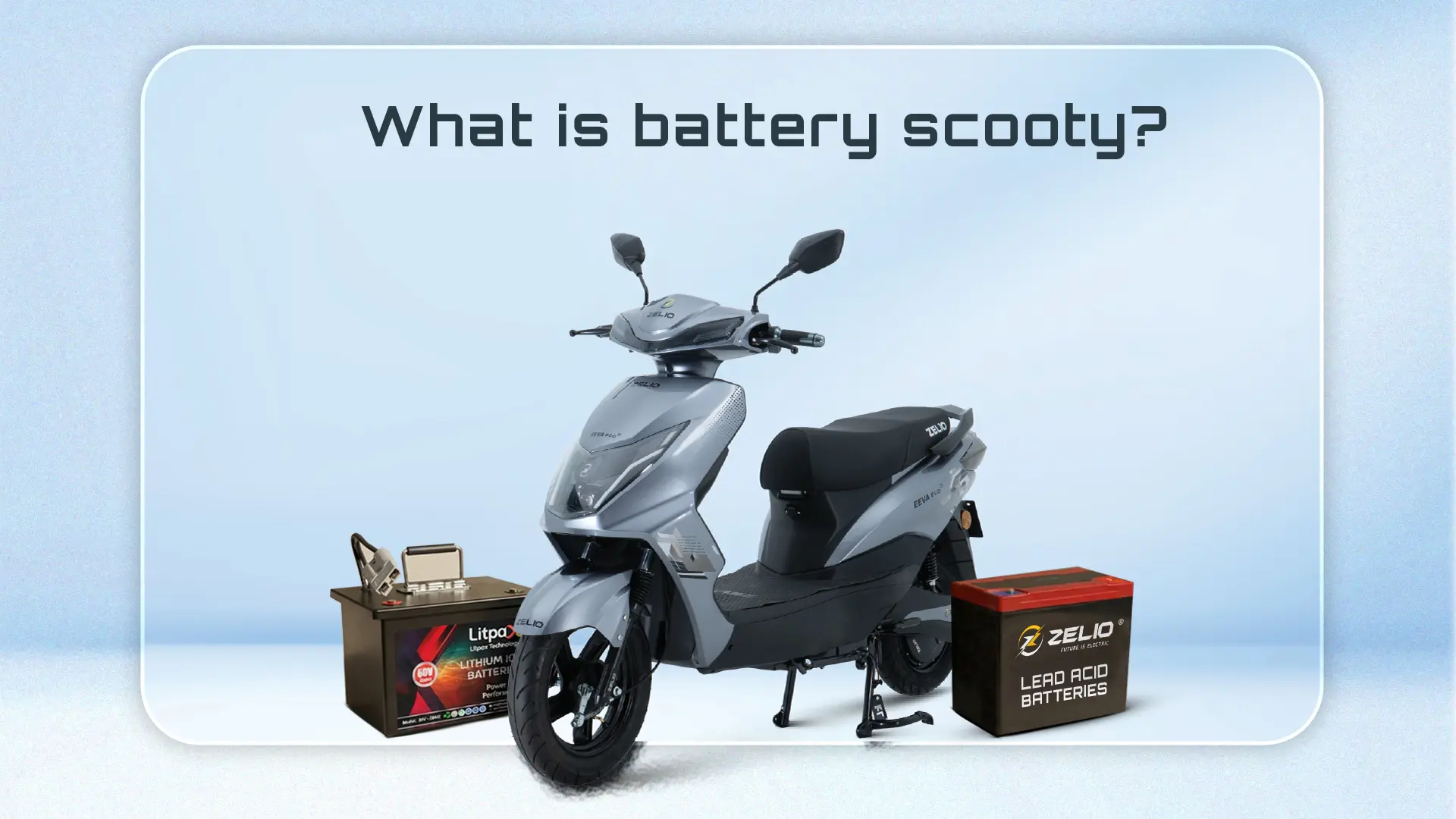
A battery scooty (electric scooter) is a two-wheeled vehicle powered by a rechargeable battery instead of a petrol engine. In India, battery scooties have become increasingly popular due to rising fuel prices, government incentives, and growing environmental awareness.
Electric Scooters
6 June 2026
What is battery scooty?
Table of Contents
What is a Battery Scooty?
A battery scooty is an electric scooter powered by rechargeable batteries instead of a petrol engine. It uses an electric motor to drive the wheels and can be charged from a standard household power outlet.
Unlike traditional petrol scooters, battery scooties produce zero direct emissions, run silently, and cost significantly less per kilometre to operate. They are ideal for daily commuting in cities and towns across India.
Low Cost
₹0.15–0.25/km
Eco Friendly
Zero Emissions
Silent Ride
Low Noise
Home Charging
Easy Charging
How Does a Battery Scooty Work?
A battery scooty operates through a simple but efficient system of components working together:
- Battery Pack – Stores electrical energy (usually lithium-ion or lead-acid).
- Controller – Manages power flow from battery to motor based on throttle input.
- Electric Motor – Converts electrical energy into mechanical motion to rotate the wheel.
- Charger – Replenishes the battery from a standard 5A or 15A household socket.
- Regenerative Braking (in premium models) – Recovers energy during braking and feeds it back to the battery.
Important: Battery range varies depending on rider weight, road conditions, speed, and weather. Always check the real-world range, not just the claimed range.
Types of Batteries Used in Electric Scooters
| Battery Type | Lifespan | Weight | Charging Time | Cost |
|---|---|---|---|---|
| Lithium-Ion (Li-Ion) | 4–6 Years | Lightweight | 3–5 Hours | Higher upfront |
| Lithium Iron Phosphate (LFP) | 6–8 Years | Moderate | 3–5 Hours | Premium |
| Lead Acid | 2–3 Years | Heavy | 6–8 Hours | Cheapest |
Most modern electric scooters in India now use lithium-ion batteries for their lightweight nature, longer lifespan, and faster charging. Lead-acid batteries are typically found only in budget or low-speed models.
Top Battery Scooty Models in India 2025
| Model | Range (Claimed) | Top Speed | Charging Time | Price (Approx.) |
|---|---|---|---|---|
| Ola S1 Pro Gen 2 | 195 km | 120 km/h | 6.5 Hours | ₹1,39,999 |
| TVS iQube ST | 150 km | 82 km/h | 4.5 Hours | ₹1,22,500 |
| Bajaj Chetak Premium | 126 km | 73 km/h | 5 Hours | ₹1,35,000 |
| Ather 450X Gen 3 | 150 km | 90 km/h | 5.4 Hours | ₹1,57,000 |
| Hero Vida V1 Pro | 165 km | 80 km/h | 5 Hours | ₹1,45,000 |
| Simple One | 212 km | 105 km/h | 3.5 Hours | ₹1,49,999 |
Note: Prices are ex-showroom and may vary by state. Range figures are under standard test conditions — real-world range is typically 20–30% lower.
Battery Scooty Price in India (2025)
Battery scooties in India are available across a wide price range to suit different budgets:
| Segment | Price Range | Examples |
|---|---|---|
| Budget | ₹50,000 – ₹80,000 | Ampere Magnus, Okinawa Lite |
| Mid-Range | ₹80,000 – ₹1,20,000 | TVS iQube S, Bajaj Chetak |
| Premium | ₹1,20,000 – ₹1,60,000 | Ola S1 Pro, Ather 450X |
| High-End | ₹1,60,000+ | Simple One, Ultraviolette |
FAME II subsidies and state government incentives can reduce the effective price significantly. Always check for applicable subsidies in your state before purchasing.
Battery Replacement Price
Battery replacement is the biggest long-term cost for electric scooter owners:
| Battery Type | Capacity | Replacement Cost |
|---|---|---|
| Lead Acid | 48V / 20–24Ah | ₹8,000 – ₹15,000 |
| Lithium-Ion | 2–3 kWh | ₹25,000 – ₹40,000 |
| Lithium-Ion (Premium) | 3–4+ kWh | ₹45,000 – ₹80,000 |
Tip: Most manufacturers offer a 3-year or 50,000 km battery warranty. Always verify the warranty terms before purchase and use an authorised service centre for replacements.
Range & Charging: What to Realistically Expect
Understanding real-world range and charging is essential for daily use:
| Condition | Effect on Range |
|---|---|
| Eco mode riding | Maximises range (best result) |
| Sport/Power mode | Reduces range by 25–40% |
| Heavy rider (80–100 kg) | Reduces range by 10–20% |
| Uphill / hilly terrain | Reduces range significantly |
| AC / accessories usage | Minor drain (if applicable) |
| Cold weather (<10°C) | Battery efficiency drops 10–20% |
Charging Options
- Standard Home Charging (5A socket): 6–8 hours for full charge
- Fast Home Charging (15A socket): 3–5 hours for full charge
- Public Fast Chargers: 1–2 hours (available in select cities)
- Portable Charger: Convenient for office or travel charging
✅ Advantages
- Very low running cost (₹0.15–0.25/km vs ₹3–4/km for petrol)
- Zero tailpipe emissions — better for environment
- Minimal maintenance (no oil changes, fewer moving parts)
- Quiet and smooth operation
- Easy home charging — no petrol station needed
- Government subsidies reduce purchase cost
- Instant torque for quick city acceleration
⚠️ Limitations
- Higher upfront purchase price than equivalent petrol scooters
- Battery replacement is expensive (₹25,000–₹80,000)
- Real-world range is less than claimed range
- Limited long-distance travel due to charging infrastructure gaps
- Charging takes longer than petrol refuelling
- Performance affected by cold weather
- Resale market still developing
Buying Guide: How to Choose the Right Battery Scooty
1. Define Your Daily Usage
Calculate your average daily riding distance. If you travel 30–40 km daily, a scooter with a real-world range of 60–80 km is sufficient. Don't overspend on high range if you don't need it.
2. Check Real-World Range
Manufacturer-claimed range is tested under ideal conditions. Look for independent real-world test results from YouTube reviewers or automotive publications for a realistic expectation.
3. Evaluate After-Sales Service
Service centre availability is crucial. Established brands like TVS, Bajaj, and Hero have wider networks. Newer brands may have limited service options in smaller cities.
4. Battery Warranty
Always check the battery warranty — ideally 3 years or 50,000 km. This protects you from the most expensive potential repair.
5. Total Cost of Ownership
Consider the full picture: purchase price minus subsidies, annual running cost, insurance, and expected battery replacement cost over 5–7 years. Electric scooters often win on total ownership cost despite higher upfront price.
Pro Tip: Test ride at least 2–3 models before deciding. Pay attention to ride comfort,
braking feel, dashboard usability, and app connectivity if that matters to you.
Battery Maintenance Tips
- Charge regularly — avoid letting the battery drop below 20%.
- Avoid deep discharge — never fully drain the battery repeatedly.
- Keep batteries away from excessive heat and direct sunlight.
- Use only the original or manufacturer-approved charger.
- Store at moderate temperatures (15°C–35°C is ideal).
- If not using for a long period, store the battery at 50–60% charge.
- Get a battery health check at your service centre once a year.
Frequently Asked Questions
How long does a battery scooty battery last?
Lithium-ion batteries generally last 4–6 years or 500–800 charge cycles depending on usage, charging habits, and storage conditions. LFP (Lithium Iron Phosphate) batteries can last 6–8 years. Lead-acid batteries typically need replacement every 2–3 years.
Can I charge my electric scooter at home?
Yes, all battery scooties available in India can be charged from a regular household socket (5A or 15A). A standard charge takes 4–8 hours. Many models come with a portable charger you can carry with you.
What is the average real-world range?
Most electric scooters provide 60–120 km of real-world range per charge, despite higher claimed figures. Actual range depends on your riding mode, speed, weight, terrain, and weather conditions.
Are electric scooters cheaper to maintain?
Yes, significantly. Electric scooters have no engine oil, spark plugs, fuel filters, or complex transmissions. Annual maintenance costs are typically ₹1,500–₹3,000 compared to ₹5,000–₹10,000 for petrol scooters.
Do I need a licence to ride a battery scooty in India?
Low-speed electric scooters (under 25 km/h, motor below 250W) do not require a licence or registration in India. High-speed models (above 25 km/h) require a valid driving licence and vehicle registration, just like petrol scooters.
What subsidies are available on electric scooters in India?
Under the FAME II scheme, eligible electric scooters receive central government subsidies. Additionally, many states like Delhi, Maharashtra, Gujarat, and Rajasthan offer additional state-level subsidies, reduced road tax, and registration fee waivers. Check your state government's EV policy for the latest benefits.
How much does it cost to charge an electric scooter?
A full charge typically costs ₹10–₹25 depending on your battery capacity and electricity rate. At an average of ₹8/unit electricity cost and a 3 kWh battery, a full charge costs around ₹24 — enough for 100+ km. That works out to roughly ₹0.20–₹0.25 per km.
Can a battery scooty be used in rain?
Most modern battery scooties have an IP rating (typically IP65 or IP67) that makes them resistant to rain and splashing water. However, avoid riding through deep waterlogging or flooded roads, as submerging the battery or motor can cause serious damage.
What happens if my battery runs out mid-journey?
Unlike petrol scooters, you cannot quickly "refuel" a battery scooty on the road unless there is a nearby charging point. Most modern scooters have a companion app that shows remaining range and locates nearby charging stations. Planning your route based on battery level is important for longer rides.
Is a battery scooty good for hilly areas?
Higher-end battery scooties with powerful motors (3–7 kW) handle hilly terrain well but consume more energy, reducing range. Budget models with weaker motors may struggle on steep gradients. Always check the motor power and torque specifications if you live in a hilly region.
Ready to Switch to Electric Mobility?
Explore modern battery scooties and enjoy affordable, eco-friendly transportation across India.
View ModelsAdmin User
RELATED POSTS
Electric Scooters
5 Oct, 2026
Electric Scooty for Students: Affordable, No Registration, No License
Read More
Electric Scooters
23 Sep, 2026
Electric Scooter Mileage: Best Range, High Mileage & Low Mileage Explained
Read More