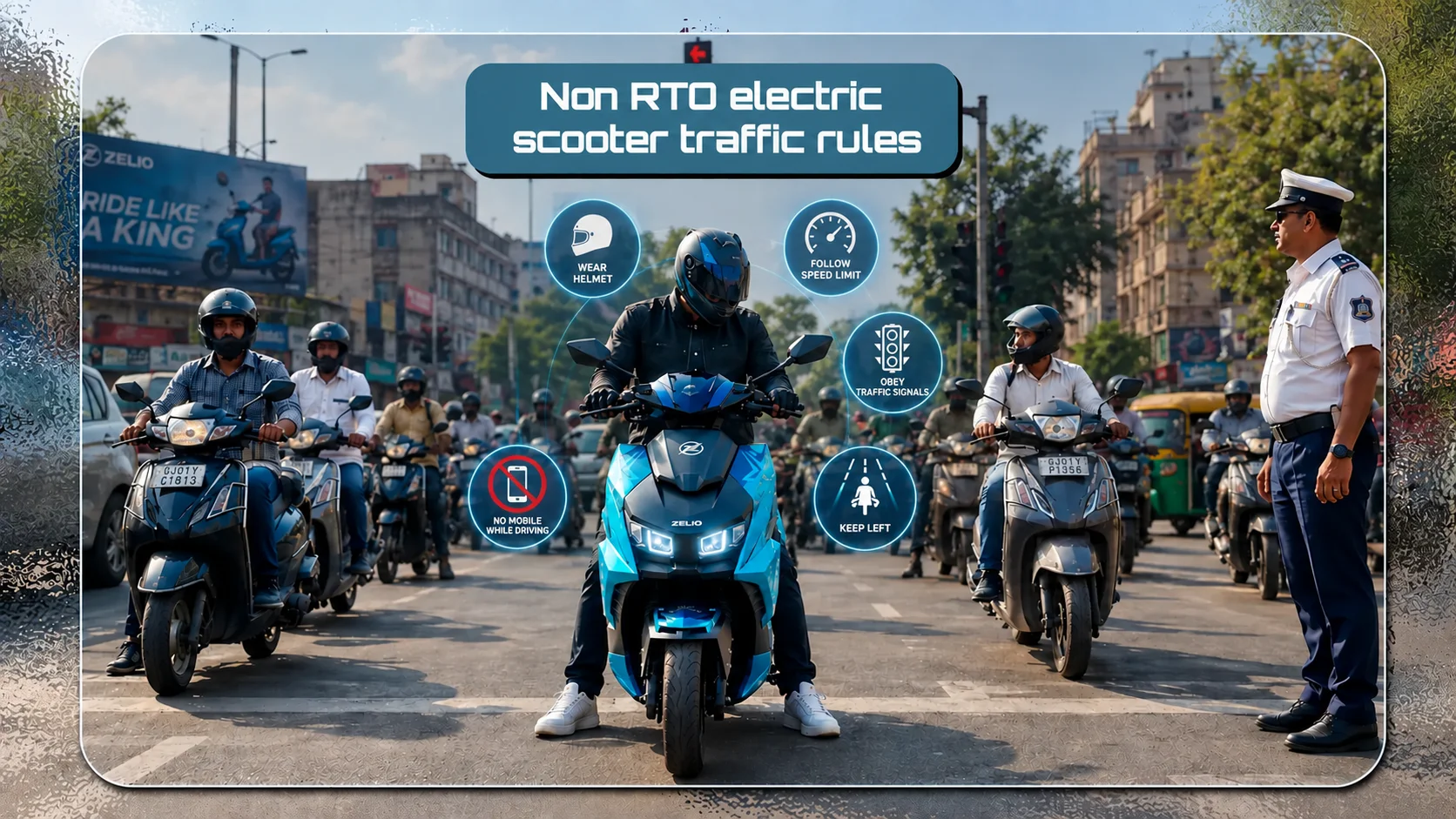
The first time an officer waves you down on a scooter with no number plate, the mind goes blank for a second. No registration certificate in the seat storage. No licence in the wallet. Nothing that looks like the paperwork every other rider on that road is carrying.
That blank second is where the trouble starts. Not because the law is against you, but because most riders cannot explain, on the spot, why it is on their side.
The Rule Your Scooter Sits Under
Rule 2(u) of the Central Motor Vehicles Rules, 1989 defines what the law calls a Battery Operated Vehicle. The clause came in through notification GSR 589(E) dated 16 September 2005. The conditions that matter today arrived later, through GSR 291(E) dated 24 April 2014, which replaced the earlier proviso.
As the rule stands now, a two wheeled battery operated vehicle is not deemed a motor vehicle when a testing agency notified under Rule 126 verifies three things:
-
The thirty minute rated power of the motor stays below 0.25 kW
-
The maximum speed of the vehicle stays below 25 km/h
-
The vehicle is fitted with suitable brakes plus retro-reflective devices
The power condition and the speed condition have to hold together. This is where most of the confusion on Indian roads begins. A scooter running a 1000 watt motor that has been software limited to 25 km/h does not qualify, because the motor rating on its own crosses the line. The exemption looks at what the motor is rated for, not what the controller happens to permit that morning. The difference between low speed and high speed electric scooters comes down to exactly this pair of numbers.
Clear both conditions and the vehicle sits outside the definition of a motor vehicle. No registration. No licence. No road tax.
There Is No RC to Show, So Carry This Instead
Here is the part riders get wrong before they even leave the showroom.
There is no registration certificate to produce. An exempt scooter is never issued one, because an RTO has no reason to register a vehicle the law does not treat as a motor vehicle. There is no driving licence to produce either.
What you should be carrying is the original purchase invoice from your dealer, along with any specification sheet or declaration from the manufacturer that states the motor rating plus the top speed. If your dealer can hand over a copy of the model's exemption test report from the authorised testing agency, keep that with the invoice.
None of this is legally mandatory the way an RC is for a registered vehicle. In practice it is the difference between a stop that lasts two minutes and one that lasts twenty.
What an Officer Can Check at the Roadside
With no RC or licence in the picture, an officer stopping a non-RTO scooter is really checking one thing. Does this vehicle qualify for the exemption it is claiming?
That comes down to three points. The motor rating, usually stamped or stickered on the motor housing itself. The top speed, which an officer may ask about or occasionally ask you to demonstrate over a short stretch. And in some cases the battery specification listed on the vehicle or in your paperwork, used as a rough cross check against motor output.
Checking those is well within an officer's authority. Fining you for the absence of a licence or a registration certificate the law never required you to hold is a separate matter entirely.
The Confusion Is Real, It Has Reached the Courts
This is not a hypothetical problem cooked up for a blog post.
A group of lawyers has taken the issue to both the Bangalore High Court and the Delhi High Court, flagging that low speed electric two wheelers are being sold in the market without the exemption certification a Rule 126 testing agency is supposed to grant. The same filings point out that several state RTO authorities are themselves unclear on what that certification involves, or that it is required at all.
If the offices meant to administer the rule are still catching up on it, an officer on a Tuesday afternoon at a busy junction is not going to have it memorised.
One challan made the rounds online for exactly this reason. An electric scooter owner was fined for not carrying a pollution under control certificate, a document an electric vehicle has no way of holding, since there is no tailpipe on it to test. The ticket was written anyway. That is the level of confusion a rider can walk into with a perfectly legal vehicle.
What to Say When the Officer Has Not Heard of the Exemption
Keep it short and keep it calm.
State that the scooter is a low speed electric vehicle exempt from registration plus licensing under Rule 2(u) of the Central Motor Vehicles Rules, because the motor stays under 250 watts and the top speed stays under 25 km/h. Then hand over the invoice rather than continuing to talk.
A document in hand settles far more roadside confusion than an explanation does, however correct the explanation happens to be. Most officers are not looking for an argument. They are looking for something that lets them close the interaction and move on.
If the officer is still unfamiliar with the rule and decides to proceed anyway, do not stand there debating it. Note the officer's name, badge number plus the location, then sort it out through the proper channel afterwards.
If a Challan Gets Issued Anyway
Yes, a challan can be issued at the roadside even when the scooter is exempt. That does not make the challan valid. It only means it can physically happen, usually where the officer is unaware of the rule or believes the vehicle does not meet the conditions.
The practical route after that is the grievance or dispute section on the e-challan portal, where you submit the purchase invoice plus specification sheet as evidence that the vehicle meets the Rule 2(u) conditions. Plenty of minor traffic disputes also get sorted directly at the local traffic police station, or through Lok Adalat sessions that several states run for uncontested traffic matters.
Keep a photo of the invoice plus the specification sheet saved on your phone alongside the physical copies. It makes the whole process considerably faster. It also means a wet monsoon afternoon does not leave you with nothing to show.
The Paperwork Settles It Faster Than the Argument
Across every account of this situation, the same pattern shows up. It is almost never the legal reasoning that ends a roadside stop. It is the dealer invoice with the motor rating plus the top speed printed on it in black and white.
An officer who has not encountered Rule 2(u) before is far more likely to accept a printed document with numbers on it than a verbal claim about a rule they have never been briefed on. So ask your dealer for that documentation at the time of purchase. Keep a physical copy in the scooter plus a digital one on your phone. Ownership of a non-RTO scooter is otherwise close to paperwork free, which the full picture of what a non-RTO scooter means day to day covers in more detail. This one document is the exception worth holding on to.
Zelio Models That Sit Inside This Exemption
Zelio Gracy i, Rs 58,159
Built to stay within the 250 watt motor plus 25 km/h limits that define the non-RTO category, with specification details provided at purchase confirming exactly that.
Zelio Little Gracy, Rs 51,233
A lighter, compact option in the same exempt category, suited to riders who want the paperwork free side of a non-RTO scooter without giving up build quality.
Zelio Legender+ Premium, Rs 65,059
Carries a larger battery for longer daily distances while staying in the same non-RTO classification as the rest of the low speed lineup.
Every Zelio dealer hands over the purchase invoice plus specification details at the time of sale, which is precisely the documentation this piece recommends keeping with you. Model by model pricing sits in the battery scooty price list. If you want to compare against a registered scooter instead, the breakdown of RTO fees for electric two wheelers shows what the other category actually costs to put on the road.
Sources
-
Section 2 in The Central Motor Vehicles Rules, 1989 - Indian Kanoon
-
Highlighting the violation of CMVR and CCPA norms in the sale of low-speed Electric 2Ws - EVreporter
-
Electric scooter owner fined for no pollution certificate, challan pic goes viral - The Tribune