Electric Scooter Service Cost in India
Electric Scooters
6 August 2026

Electric Scooter Service Cost in India

Every electric scooter ad in India leans on the same line. No oil changes, fewer moving parts, lower running cost. All of that is true. What most of them leave out is the one number that actually matters five years down the road, which is exactly the gap this piece is here to close.


Why the Bill Is Smaller to Begin With

A petrol engine has somewhere around 2,000 moving parts. An electric scooter's motor gets by with roughly 20. That is not a rounding difference, it is the entire reason service bills look the way they do.

Nothing in an electric scooter burns fuel, so there is no oil to change, no spark plugs to fit, no air filter clogging up with dust, no CVT belt wearing out the way it does on a geared or gearless petrol scooter. What is left to service is mostly the same across both, brakes, tyres, suspension and general wiring checks. Strip out the engine related work and you are looking at a genuinely shorter job sheet every time your scooter goes in.


What a Service Visit Actually Costs

Most Indian electric scooters need a service every 5,000 to 7,500 kilometres, or every six months, whichever comes first. A single visit at an authorised centre typically runs between Rs 400 and Rs 1,200, depending on what needs attention that time round.

Add it all up over a year and most riders land somewhere between Rs 1,000 and Rs 5,000 in total annual service cost. A comparable petrol scooter usually costs Rs 2,500 to Rs 6,000 a year to keep running, once you factor in oil changes, filter replacements and the CVT maintenance a petrol scooter needs and an electric one simply skips. That puts the real world saving at roughly 40 to 60 percent and it holds up across most brands and cities rather than only under ideal conditions.


Check the latest on-road prices for all Zelio scooter models at the battery scooty price list. 
 

What Actually Gets Checked at Each Visit

A typical service covers tyre pressure and wear, brake pad condition, suspension response and a visual check of wiring and connectors, particularly around the charging port where monsoon moisture tends to cause slow oxidation over time. None of this is exotic. It is the same basic upkeep any two wheeler needs, just without the combustion related work stacked on top.

Tyres usually last 12,000 to 15,000 kilometres before they need replacing. Brake pads get checked at every service rather than swapped on a fixed schedule, since wear depends heavily on how and where you ride.


The Cost Almost Nobody Talks About Honestly

Here is the part most comparison articles either skip or bury in a footnote. Every electric scooter eventually needs its main battery replaced and that single expense outweighs several years of routine servicing combined.

Depending on the battery's chemistry and capacity, replacement typically costs anywhere from Rs 18,000 to Rs 40,000, usually somewhere between year five and year eight of ownership. Lithium packs tend to sit toward the higher end of that range but also last longer, while lead acid packs cost less upfront and need replacing sooner. There is also a smaller, separate 12V battery in most electric scooters that runs the lights, horn and dashboard rather than the motor. It usually lasts three to four years and costs Rs 800 to Rs 1,500 to replace, a detail that rarely comes up anywhere.

None of this erases the savings electric scooters offer. It just means the honest total cost of ownership includes a battery line item that petrol scooters never have to plan for, the same way petrol scooters carry a fuel bill that electric ones never see. Once you spread that battery cost across five to eight years of ownership, it works out to roughly Rs 3,000 to Rs 8,000 a year set aside, which still lands well below what a petrol scooter costs to run and maintain over the same stretch.


The Real Five Year Picture

Put the numbers together and a clearer story shows up. Annual servicing on an electric scooter averages somewhere around Rs 1,000 to Rs 5,000. Spread the eventual battery replacement across its working life and you are adding roughly Rs 3,000 to Rs 8,000 a year on top of that. Even at the higher end of both ranges, total yearly cost sits well under what a petrol scooter demands once fuel and mechanical servicing are added up together.

The gap does not come from ignoring the battery cost. It comes from the fact that a petrol scooter's ongoing bill never stops climbing the way a battery replacement, planned for and set aside gradually, actually does.


How to Keep the Bill on the Lower End

A few habits genuinely make a difference here. Sticking to the charging routines that protect long term battery health pushes replacement closer to year eight than year five. Keeping tyres at the right pressure reduces uneven wear and cuts down on how often brakes need attention too, since a scooter working harder to move also brakes harder to stop. Getting the charging port checked during monsoon season catches oxidation early, before it turns into a bigger electrical issue.


A Few Zelio Electric Scooters and Their Service Footprint

Zelio Gracy i

Built around a straightforward BLDC motor setup, the Gracy i keeps service visits simple, mostly brakes, tyres and routine checks, with no engine related work to add to the bill.

Zelio Little Gracy

A lighter build generally means lighter wear on tyres and brakes over time, which tends to keep this model's service costs on the lower end within Zelio's range.

Zelio Legender+ Premium

Carries a larger battery for longer daily distances, though the servicing needs stay in line with the rest of the lineup despite the added range.


Every Zelio scooter also skips road tax and RTO registration if it falls under the non RTO category, which is worth factoring in alongside service cost when comparing total ownership expense against a petrol scooter. If you commute 15 to 35 kilometres a day, the running cost and service savings together tend to add up faster than most buyers expect.
Admin User

No tags
Share

Frequently Asked
Questions

RELATED POSTS

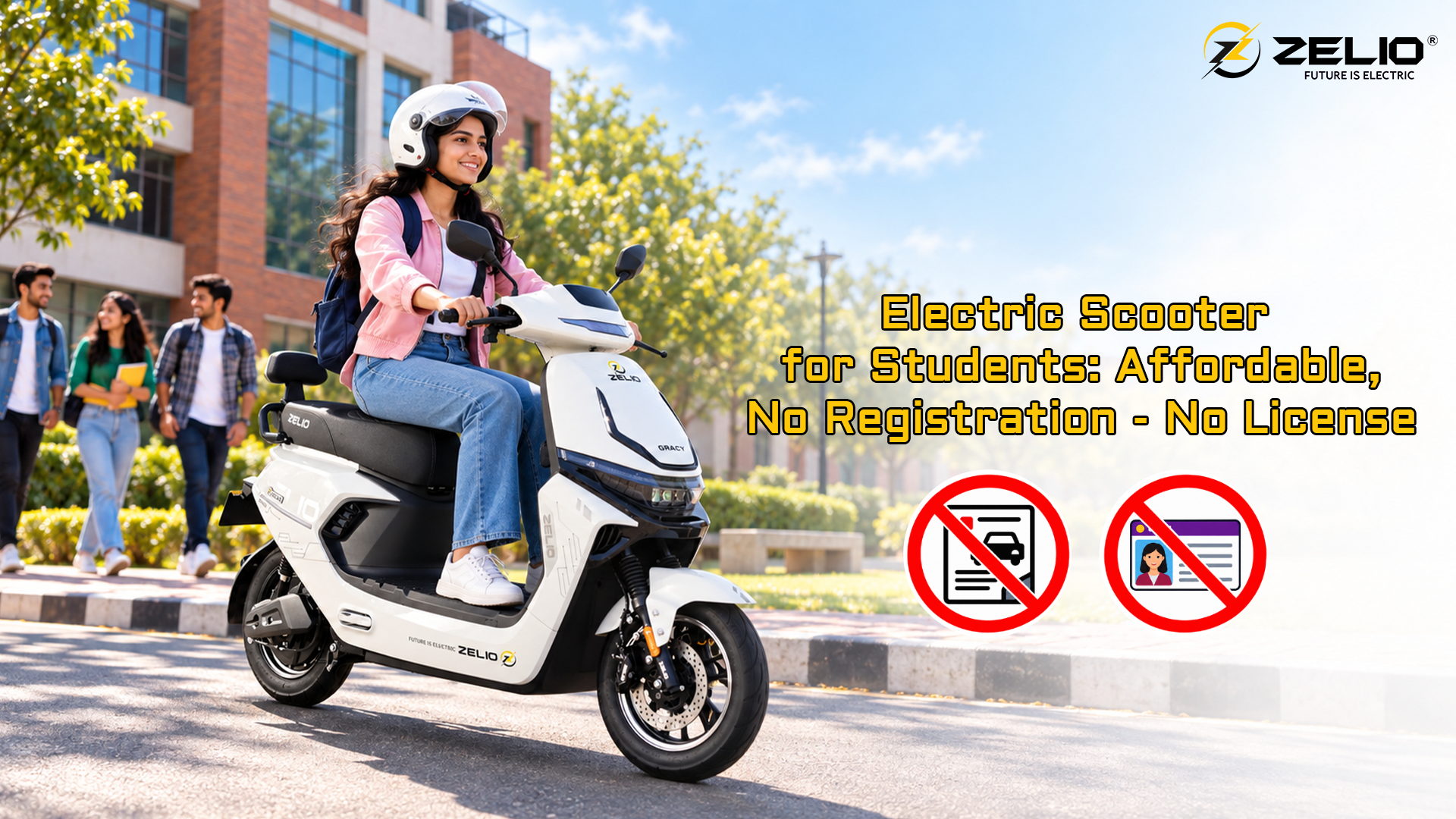
Electric Scooty for Students: Affordable, No Registration, No License

Electric Scooty for Students: Affordable, No Registration, No License

Getting to college or coaching every day costs money. Petrol, a license, registration and insurance all add up and many students do not need a fast vehicle at all. Their daily trip is usually short, so a low speed electric scooty can work well. It is cheaper to run, easy to ride and needs very little paperwork. This guide explains how these scooters work, who can ride them, what they cost and which Zelio electric scooters students can look at. Reasons Students Choose Zelio Scooty Most students travel a few kilometres each day. It could be a hostel to college, home to tuition or a quick trip to the market. A petrol scooter is more than what they need for this. Electric scooters or scooties make sense for a few simple reasons: The running cost is low. They are light and easy to handle, even for first time riders. They can be charged at home with a normal socket. Servicing is usually simpler than a petrol scooter. Low speed models need no license, registration or number plate. For many families, the lower paperwork and lower monthly cost are the main reasons to choose one. Low Speed Electric Scooty - No Registration, No License A low speed electric scooter is also called a non RTO scooter or battery scooty. Under the Central Motor Vehicle Rules, a two wheeled battery vehicle is not treated as a motor vehicle if its top speed is less than 25 km/h. If a scooter stays within speed limit, then: No driving license is needed. No registration is needed. No number plate is needed. RTO rules do not apply. You can read more on Zelio's page about an electric scooter without license and the low speed electric scooter category. Electric Scooty Rules for Students Aged 16 Years & Above Anyone aged 16 years or older can ride a low speed electric scooter in India. A license is not needed for these scooters, so a student who is 16 or 17 can ride one. Insurance is optional for low speed scooters, but it is mandatory for high speed ones. Even if it is not compulsory, some families choose to take it for safety of the vehicle. A helmet is a good habit for every rider, whatever the speed. Low speed scooters are also not meant for highways or fast traffic. They are best for city roads, campus routes and small town travel. Electric Scooty Cost for Students Price is usually the first thing students and parents check. Low speed Zelio scooters start below Rs 50,000 in the lead acid battery versions. The price depends on the model and the battery type. Here are a few examples from Zelio's battery scooty price list, updated on 24 September 2026. These prices are for Haryana, Uttar Pradesh and Punjab, so prices in your state may be different. Model Lead acid (48V/32AH) Lead acid (60V/32AH) Lithium ion (60V/32AH) Eeva Eco LX Rs 47,784 Rs 50,659 Rs 67,334 Eeva Eco ZX Rs 50,084 Rs 52,959 Rs 69,634 Little Gracy Rs 51,234 Rs 54,109 Rs 70,784 The battery choice changes the price more than anything else. Lithium ion versions cost more, but they are lighter and usually last longer. Lead acid versions cost less upfront but are heavier and take longer to charge. Since registration, road tax and license fees do not apply, the on-road price of a non RTO scooter stays close to the ex-showroom price. Dealers may still charge for handling and delivery. For the latest figures, check the full battery scooty price list or ask your nearest dealer. Zelio Electric Scooters for Students Zelio offers many low speed models. These are the ones that suit most students, mainly because of price and size. Eeva Eco LX: This is the lowest priced option on the price list. If keeping the budget low is the first goal, the Eeva Eco LX is a good place to start. Little Gracy: Zelio lists the Little Gracy as a good choice for students and first time buyers. It has a lighter frame that is easy to handle, which helps in crowded campus areas and tight parking spots. Eeva Eco ZX: A step above the Eeva Eco LX in price, and a useful option if you want a slightly different variant in the same Eeva Eco family. For a wider view of options for young riders, you can also read Zelio's guide on the best electric scooter for teenagers . Electric Scooter Range, Charging and Battery Warranty Range is how far a scooter can go on one full charge. Zelio's scooters have a claimed range between 60 km and 120 km, depending on the model and battery. Models like the Eeva Eco LX and Eeva Eco ZX are listed with 60 and 90 km options. The claimed range is not what you always get on the road. Real range is usually around 60 to 80 percent of the claimed figure. Rider weight, a pillion, traffic, road quality, speed and tyre pressure all make a difference. A student who rides 10 to 15 km a day will be fine with a basic range. A higher range is only needed if you want to charge once every two or three days. For charging, standard home charging usually takes around 4 to 5 hours. Many students charge overnight, so the scooter is ready the next morning. Zelio mentions a 2 year warranty on its scooters. Coverage can differ for each part, such as the motor, controller and battery. Read the warranty and claims page before buying so you know exactly what is covered. Running Cost Compared With Petrol Scooters Electricity costs very little compared to petrol. Zelio gives a simple example. If a scooter uses about 2 units of electricity for a full charge and one unit costs Rs 8, a full charge costs around Rs 16. If the scooter covers 80 km on that charge, the cost comes to about Rs 0.20 per km. Actual cost will change with your electricity rate, battery condition and real range. Servicing is also lower. There is no engine oil to change and fewer moving parts. For a student, the bigger savings come from skipping the registration, license and mandatory insurance costs that a petrol scooter needs. Things to Check Before Buying A few simple checks can help you pick the right scooter. Know your daily distance and choose a range with some extra room. Decide between lead acid and lithium ion based on budget and weight. Ask the dealer for the final price in your city, including handling charges. Confirm the scooter is a low speed model within the 250 watt and 25 km/h limits. Check warranty terms for the motor, controller and battery. Take a test ride before you decide. You can use the dealer locator to find a Zelio showroom near you. Conclusion A low speed electric scooter is a practical choice for students who travel short distances every day. It costs less to run, needs no license or registration and is easy to ride. Models like the Eeva Eco LX and Little Gracy keep the price low, so check the latest price in your state, compare battery options and take a test ride before you buy.

Read More
Electric Scooter Mileage: Best Range, High Mileage & Low Mileage Explained
Electric Scooters
23 Sep, 2026

Electric Scooter Mileage: Best Range, High Mileage & Low Mileage Explained

When people ask about electric scooter mileage , they usually want to know one simple thing: "How far can I travel on one full charge?" or "Ek charge mein kitna chalegi?" Electric scooter mileage, also called range, is the approximate distance a scooter can travel when its battery is fully charged. Depending on the model and battery, electric scooters in the market can offer anywhere from around 20 km to 160 km on a single charge. At Zelio E-Bikes , our electric scooters offer a claimed range of 60 km to 120 km per charge, depending on the model and battery type. Our lead-acid battery models offer approximately 60 km to 100 km of range, depending on the number of batteries used, while our lithium-ion battery models offer approximately 80 km to 120 km per charge. The range of an electric scooter can directly affect how often you need to charge it, whether it is suitable for your daily commute, and how convenient it will be to own. But there is one thing that is important to understand before comparing different electric scooters: The range mentioned on the specification sheet is not necessarily the range you will get in your everyday riding. Your actual range depends on several things - your speed, riding style, rider weight, traffic, road conditions, tyre pressure, battery condition, weather and even whether you regularly ride with a pillion. At Zelio E-Bikes , we believe it is better to understand these factors before buying an electric scooter rather than simply looking for the biggest range number. So, let's break it down. What Does Electric Scooter Mileage Actually Mean? With a petrol scooter, we normally talk about mileage in terms of kilometres per litre (km/l). With an electric scooter, mileage is kilometres per charge (km/charge) . For example, if a scooter has a claimed range of 100 km, it means the scooter is designed to travel up to around 100 km on a full charge under specified test conditions. But that doesn't mean every rider will get exactly 100 km. Think about it this way. Two people can drive the same car on the same road and get different fuel mileage. One person may accelerate aggressively, drive faster and brake frequently. Another may drive smoothly at a steady speed. The same principle applies to electric scooters. Claimed Range vs Real-World Range This is probably the most important thing to understand when comparing electric scooters. You may see a scooter advertised with: 100 km range It is easy to assume that you will get 100 km every time you charge the battery. In real life, things are rarely that predictable. Your scooter may be carrying : A heavier rider, A pillion passenger, Some luggage You may also be riding through : Heavy traffic, Flyovers, Uneven roads, Stop-and-go traffic, Different weather conditions And you may be riding at a higher speed than the conditions used during certification testing. All of these factors can affect range. This is why the claimed range should be treated as a reference point, rather than a guarantee of exactly how many kilometres you will get. At Zelio, we believe customers should look at both the claimed range and their own daily riding requirements before choosing a scooter. So, What Is a Good Mileage for an Electric Scooter? There isn't one number that is right for everyone. A person travelling 15 km a day doesn't have the same requirements as someone travelling 60 km every day. For example, if your daily travel is around 20-25 km, you may not need a very high-range scooter. But if you travel 50-60 km every day, choosing a higher-range battery configuration can make your life much easier. Here's a simple way to think about it: Daily Travel - What You Should Consider 10-20 km - Short to moderate range 20-40 km - Moderate range with a comfortable buffer 40-60 km - Higher-range configuration 60+ km - High-range scooter and battery configuration The important word here is buffer . If you travel 40 km every day, don't necessarily look for a scooter that claims exactly 40 km per charge. You don't want to reach home every evening wondering whether the battery will make it through the next day. A little extra range gives you flexibility. What Actually Affects Electric Scooter Mileage? This is where things get interesting. The same electric scooter can deliver different ranges to different people. Here are some of the biggest factors. 1. Your Riding Speed Speed has a direct impact on energy consumption. If you constantly ride at higher speeds and accelerate aggressively, your scooter will generally consume more energy. On the other hand, smooth acceleration and a steady riding speed can help you use the battery more efficiently. You don't need to ride unusually slowly. Just avoid unnecessary: Full throttle → sudden braking → full throttle → sudden braking. Smooth riding is usually more efficient. 2. Your Riding Style Two riders can have completely different riding styles. One rider may accelerate gently, anticipate traffic and maintain a steady speed. Another may accelerate hard every time the signal turns green and brake suddenly at the next signal. Both are riding the same scooter. But their range may be different. If you want to get more kilometres from every charge, try to: Accelerate smoothly Maintain a steady speed Avoid unnecessary hard braking Anticipate traffic Avoid unnecessary high-speed riding Small changes in riding habits can make a noticeable difference over time. 3. Rider and Pillion Weight This is simple physics. The more weight your scooter has to move, the more work the motor has to do. If you are riding alone, the scooter is moving one person. If you regularly ride with a pillion, the total load increases. And if you add luggage on top of that, the load increases further. This doesn't mean that carrying a passenger is a problem. Electric scooters are designed for everyday use. It simply means that your expected range should account for how you normally use your scooter. 4. Traffic Indian city traffic can be unpredictable. One minute you're moving at 40 km/h. The next minute you're standing at a signal. Then you accelerate again. Then another signal. Then a traffic jam. This constant: Start → Stop → Start → Stop can consume more energy than smooth, uninterrupted riding. This is one reason why your actual range in a busy city can be different from a controlled test. 5. Tyre Pressure This is one of the easiest things to overlook. If your tyres are underinflated, rolling resistance increases. The motor may have to work harder to move the scooter. That's why it is worth checking your tyre pressure regularly. But don't make the mistake of thinking: More air = better mileage. Always follow the tyre-pressure recommendation provided for your scooter. The goal is the right pressure, not the highest pressure. Does Battery Type Affect Electric Scooter Mileage? Yes, but it isn't the only thing that matters. Battery capacity, battery chemistry, motor, controller, scooter weight and riding conditions all work together to determine range. At Zelio, different electric scooter models are available with different battery configurations, including lead-acid/gel and lithium-ion batteries. Each has its own advantages. Lead-Acid/Gel Batteries These are generally more affordable and can be suitable for customers who are looking for a budget-friendly electric scooter. The trade-off is that they are generally heavier and take longer to charge. Lithium-Ion Batteries Lithium-ion batteries are lighter and generally offer faster charging and longer expected battery life. They can be particularly useful for people who use their scooter frequently and want a lighter battery system with convenient charging. The right choice ultimately depends on your budget and how you intend to use the scooter. How Much Difference Does Speed Make? Imagine two riders using the same scooter. Rider A Smooth acceleration Moderate speed Predictable braking Mostly open roads Rider B Aggressive acceleration Higher speeds Frequent braking Heavy traffic Even though they are using the same scooter, their energy consumption can be very different. This is why asking only: What is the mileage of this scooter? doesn't tell the whole story. A better question is: What range can I realistically expect based on how I ride? Can Weather Affect Electric Scooter Range? Yes. Batteries perform differently under different temperature conditions. India's weather can range from very hot summers to cold winters, depending on the location. Extreme temperatures can affect battery performance, while prolonged exposure to excessive heat can also contribute to battery ageing. A few simple habits can help: Park the scooter in a shaded or covered area when possible. Avoid unnecessary exposure to extreme heat. Follow the manufacturer's charging recommendations. Use the correct charger. Give the battery appropriate care if the scooter has been exposed to very high temperatures. Battery care isn't complicated, but it is important if you want your battery to perform well over its useful life. How Road Conditions Affect Mileage Where you ride also matters. A scooter travelling on a smooth, relatively flat road will generally use energy differently from one climbing steep roads or travelling over rough surfaces. If your daily route includes: Flyovers Hills Rough roads Unpaved roads your actual range may be different from someone riding mostly on flat, smooth roads. This is particularly important when comparing the range you see in a specification sheet with what you experience in your own city. How Can You Increase Your Electric Scooter Mileage? The good news is that you have quite a bit of control over your scooter's efficiency. Here are some simple habits that can help. Keep your tyres properly inflated - Check them regularly and maintain the recommended pressure. Avoid unnecessary hard acceleration - You don't have to accelerate at full throttle every time the signal turns green. Maintain a comfortable, consistent speed - Constantly changing speed can consume more energy. Don't carry unnecessary weight - If you don't need it, don't carry it. Keep your scooter maintained - Regular checks of tyres, brakes, battery and other components can help keep the scooter operating properly. Take care of the battery - Follow the recommended charging practices and use the correct charger. Plan your charging - If you know you'll be travelling a longer distance the next day, charge accordingly instead of starting your journey with a nearly empty battery. These are simple things, but they become important over hundreds or thousands of kilometres. How Much Does It Cost to Charge an Electric Scooter? One of the biggest attractions of an electric scooter is the relatively low energy cost of everyday riding. Let's take a simple example. Suppose a scooter uses approximately 2 kWh of electricity for a full charge. If electricity costs ₹8 per unit, the theoretical electricity cost would be: 2 × ₹8 = ₹16 If the scooter travels 80 km on that charge: ₹16 ÷ 80 = ₹0.20 per km Actual charging costs can be different because of charging losses, electricity tariffs, battery condition and actual range. But this calculation gives you a simple way to understand your scooter's running cost. Electric Scooter vs Petrol Scooter: Don't Compare Only Mileage This is another common mistake. A petrol scooter is usually discussed in terms of: km/litre An electric scooter is discussed in terms of: km/charge These aren't directly comparable numbers. Instead, if you are trying to understand the economics of ownership, look at: Purchase price Fuel/electricity cost Maintenance Battery cost Insurance Expected usage Long-term ownership period For someone who rides regularly, the running-cost difference can become an important part of the overall ownership calculation. How Much Range Do You Actually Need? Here's a simple calculation you can do before visiting a dealership. Suppose your daily commute is: 30 km You travel five or six days a week. Now think about how frequently you are comfortable charging your scooter. If you prefer charging every night, you don't necessarily need a huge battery. If you would rather charge once every couple of days, you may want a higher-range configuration. For example: 30 km daily travel × 2 days = 60 km In this situation, you could look for a scooter with a claimed range comfortably above your two-day requirement. This gives you some breathing room for: Unexpected trips Traffic A pillion ride Slightly longer routes Range variation What Is the Range of Zelio Electric Scooters? Zelio offers multiple electric scooter models and battery configurations for different types of riders. Our range includes models such as: EEVA Gracy Mystery X Men+ X Men 2.0 LOGIX LOGIX Loader Legender+ Premium Mystery - High Speed Electric Scooter Depending on the model and battery configuration, Zelio scooters are available with different claimed range options. Some configurations offer around 60-70 km, while others are designed for longer claimed ranges of 90 km, 100 km and up to around 120 km per charge. The exact range depends on the particular model and battery configuration. So rather than choosing a scooter simply because it has the highest range figure, look at your own usage first. Which Zelio Electric Scooter Is Right for Your Daily Commute? There is no single scooter that is perfect for every rider. Your daily usage should guide your decision. If you travel around 15-25 km per day A scooter with a moderate range may be more than sufficient for your everyday requirements. If you travel around 25-40 km per day Look for a configuration that gives you enough range for your daily travel with a comfortable reserve. If you travel 40-60 km per day A higher-range configuration may make more sense, especially if you don't want to charge during the day. If you regularly travel more than 60 km Focus on a higher-range model and pay attention to battery capacity, charging time, battery warranty and service support. Don't Buy an Electric Scooter Just for the Highest Mileage When you're shopping for an electric scooter, it is tempting to compare one number: This one gives 100 km. That one gives 120 km. So I'll buy the 120 km one. But that's not always the right way to decide. Think about your actual life. How far do you travel every day? Do you ride alone or with a passenger? Do you have a place to charge at home? How often do you want to charge? Do you mostly ride in traffic? Do you need the scooter for work, college, errands or family use? Once you answer these questions, choosing the right range becomes much easier. At Zelio E-Bikes , we offer multiple electric scooter models and battery configurations so customers can choose according to their requirements. Because the best range isn't necessarily the biggest number on the brochure. The best range is the one that comfortably fits your everyday life. If you are considering a Zelio electric scooter, explore the available models and compare their battery, range and features before making your decision. Ride electric. Ride smart. Ride Zelio.

Read More
Electric Scooty Price in Karnataka: What You Actually Pay
Electric Scooters
15 Sep, 2026

Electric Scooty Price in Karnataka: What You Actually Pay

Ask five people in Bangalore what an electric scooty costs and you will get five different numbers, because the on-road price almost never matches the figure on a billboard. Karnataka's mix of dense city traffic, long IT-corridor commutes and a genuinely large first-time EV buyer base makes the price question more layered here than in most states. This piece breaks down what actually goes into that number and where it lands across Zelio's lineup. Why the Price Conversation Is Different in Karnataka Three things shape how electric scooty pricing plays out for Karnataka riders specifically. Commutes run longer than the state averag: Bangalore's IT corridors, from Whitefield to Electronic City to Outer Ring Road, routinely push daily riding past 25-30 km one way for a large chunk of commuters, which changes which battery variant actually makes financial sense. Traffic time costs more than fuel does: Bangalore's average commute speed during peak hours often drops well below what any scooter, petrol or electric, can use meaningfully. That flattens the usual "electric is slower so it's less practical" argument, since neither vehicle type is moving fast in gridlock anyway. Karnataka has a large first-time EV buyer segment: particularly among students in cities like Mysuru, Mangaluru and Hubballi, where the non-RTO category removes a real barrier: no licence requirement for riders as young as 16. What Actually Sits Inside an On-Road Price Before comparing model prices, it helps to know what the final number is built from. Component What It Covers Ex-showroom price Base cost of the scooter before tax and registration Road tax Usually waived or heavily discounted for EVs in most states Registration fee Not applicable for non-RTO low-speed models Insurance Optional for non-RTO scooters, mandatory for high-speed ones Handling charges Dealer fee for documentation and delivery Central subsidy Applies mainly to high-speed, certified lithium-ion models under schemes like PM E-DRIVE Do You Need a Licence or Registration in Karnataka? The rule is national, not state-specific, but it is worth restating because it directly affects the final price you pay. Under Rule 2(u) of the Central Motor Vehicles Rules, 1989, a two-wheeled battery-operated vehicle is exempt from being classed as a motor vehicle when it clears two conditions together: Motor power stays under 250 watts Top speed stays under 25 km/h Meet both, and there is no RTO registration, no driving licence, no number plate and no road tax to add to the price. Cross either limit, even with a software-capped top speed, and the scooter is treated exactly like a petrol vehicle, licence and registration included. Factor Non-RTO Electric Scooty High-Speed Electric / Petrol Top speed Up to 25 km/h 50-100+ km/h Motor power Up to 250W 1000W and above Licence needed No Yes RTO registration No Yes Insurance Optional Mandatory Typical on-road cost added ₹0 ₹8,000-15,000 Zelio Electric Scooty Price List for Karnataka Model Lead Acid Price Lithium-ion Price Claimed Range Zelio Little Gracy ₹51,233 ₹70,784 60-90 km Zelio Gracyi ₹58,159 ₹74,834 70-130 km Zelio Eeva ₹55,834 ₹72,509 90-100 km Zelio Legender+ ₹61,609 ₹78,284 100-120 km Zelio Logix ₹61,584 ₹78,259 80-100 km Zelio X Men+ ₹66,184 ₹82,859 Up to 100 km Prices vary slightly by state and dealer, so treat this as a starting reference. The full, regularly updated version sits on the battery scooty price list . Running Cost: Bangalore Traffic Included For a rider covering roughly 30 km a day, mostly in stop-start city traffic: Cost head Petrol Scooter Electric Scooty Cost per km ₹2.5-3 ₹0.25-0.30 Monthly fuel/power cost ₹2,250-2,700 ₹225-270 Annual servicing ₹4,000-6,000 ₹1,000-2,500 Registration, tax, insurance Mandatory Not applicable (non-RTO category) Stop-start traffic actually works in an electric scooter's favour on cost, since idling at a signal burns fuel on a petrol engine but costs nothing on a battery-powered motor. Zelio Models Worth Comparing for Karnataka Riders Zelio Little Gracy: The most budget-friendly non-RTO option, well suited to students in Mysuru, Mangaluru and Hubballi who want to skip licensing costs entirely. Zelio Gracyi: Zelio's best-selling model, with a lead-acid range stretching up to 130 km, useful for riders who don't want to charge every single night. Zelio Eeva: A balanced daily commuter with dependable range and comfort, a solid pick for city riders who want the option between lead-acid and lithium without stepping into a higher price bracket. Zelio Legender+: Built for riders who need more range per rupee, useful for Bangalore's longer IT-corridor commutes where 20-25 km one way isn't unusual. Zelio Logix: A balanced mid-range model that fits the everyday commute without pushing into premium pricing. Zelio X Men+: A sportier-styled option aimed at younger riders and urban commuters who still want to stay within the non-RTO limits. Is an Electric Scooty Worth the Price in Karnataka? If your daily commute sits under 40 km and involves the kind of stop-start traffic Bangalore, Mysuru or Mangaluru riders deal with every day, the price gap between electric and petrol closes fast once you count fuel, servicing and skipped registration together. The exception is long highway travel between cities, where a high-speed EV or petrol scooter still makes more practical sense. Want to check state-specific pricing or book a test ride? Use the Zelio dealer locator to find the nearest showroom in Karnataka.

Read More