Best Electric Scooter for Ladies
Electric Scooters
21 April 2026

Best Electric Scooter for Ladies

Women Riders are one of the Zelio's largest consumer segment

Across India, from bustling metros to tier-2 cities, a quiet revolution is taking place. Women are reclaiming their independence, one electric scooter ride at a time.

At Zelio E Mobility, we’ve witnessed firsthand how our electric scooters are transforming the lives of Indian women, giving them the freedom to move on their own terms. 

For countless women, “battery scooty” now simply means Zelio.

The New Face of Women's Mobility in India

For decades, Indian women have navigated a challenging mobility landscape. Relying on husbands, fathers, or brothers for simple errands. Waiting for autos that never arrive. Avoiding public transport during certain hours. Managing children’s school runs while juggling household responsibilities. The story was all too familiar, and the constraints were real.

Today, that narrative is changing. Electric scooters designed specifically for women are rewriting the rules of urban mobility in India.

Design Innovation for Indian Women: Little Gracy, Gracy Pro, and EEVA ZX+

At Zelio, we understand that Indian women don’t just need any electric scooter. They need scooters designed with their specific requirements in mind. That’s why our models like Little Gracy, Gracy Pro, and EEVA ZX+ have become favorites among women across India.

Little Gracy: Perfect for First-Time Riders

Little Gracy has become particularly popular among women who are new to riding. Its lightweight design, easy handling, and approachable aesthetics make it ideal for housewives and young women taking their first steps toward independent mobility.

The design philosophy behind Little Gracy recognizes a simple truth: many Indian women approach their first scooter with some hesitation. Little Gracy’s user-friendly design builds confidence from the very first ride.

Gracy Pro: For the Confident Rider

Gracy Pro appeals to women who’ve graduated from first-time nervousness and want a scooter that matches their growing confidence. With enhanced features and performance, Gracy Pro serves women managing longer commutes and more demanding daily schedules.

EEVA ZX+: Style Meets Substance

EEVA ZX+ represents the premium choice for women who want their scooter to make a statement. Combining advanced features with contemporary design, EEVA ZX+ has become the choice of young professionals and style-conscious riders who refuse to compromise between functionality and aesthetics.

Who's Riding Zelio Scooty? Meet the Women Transforming Their Daily Lives

The Housewife: India's Largest Zelio User Segment

Our largest and fastest-growing customer segment is Indian housewives, and their reasons for choosing Zelio are deeply rooted in their daily realities.

Morning School Runs Without Dependencies

Every morning across Indian cities, thousands of mothers use their Zelio scooters to drop their children at school. No more waiting for their husband to finish his tea before leaving. No more negotiating with the neighbor for a ride. Just simple, straightforward independence.

The same applies to afternoon tuition pickups. When your child’s class ends at 5 PM in a different part of the city, you’re no longer dependent on coordinating schedules with family members. Your Zelio is ready when you are.

Shopping That Fits Your Schedule

For many Indian housewives, a quick trip to the sabzi mandi or the neighborhood market was a logistical challenge. Wait for someone to drive you, or manage public transport with heavy shopping bags. Neither option was ideal.

With a Zelio electric scooter, market runs happen on your time. Need fresh vegetables for dinner? You go. Forgot an ingredient while cooking? You handle it. Weekend shopping at the mall? You’re not asking for favors anymore.

Daily Errands, Daily Freedom

From picking up groceries to paying bills, from attending kitty parties to visiting the parlor, from parent-teacher meetings to doctor’s appointments, Indian housewives manage countless errands daily. A Zelio scooter transfor

The Student & Young Professional: Building Independence Early

The second major segment of Zelio riders comprises young women, students and working professionals who are using our scooters to build their independence from an early age.

College and University Commutes

Girls heading to tuition classes after school. University students navigating across campus and to nearby areas. These young women are experiencing mobility freedom that previous generations couldn’t imagine.

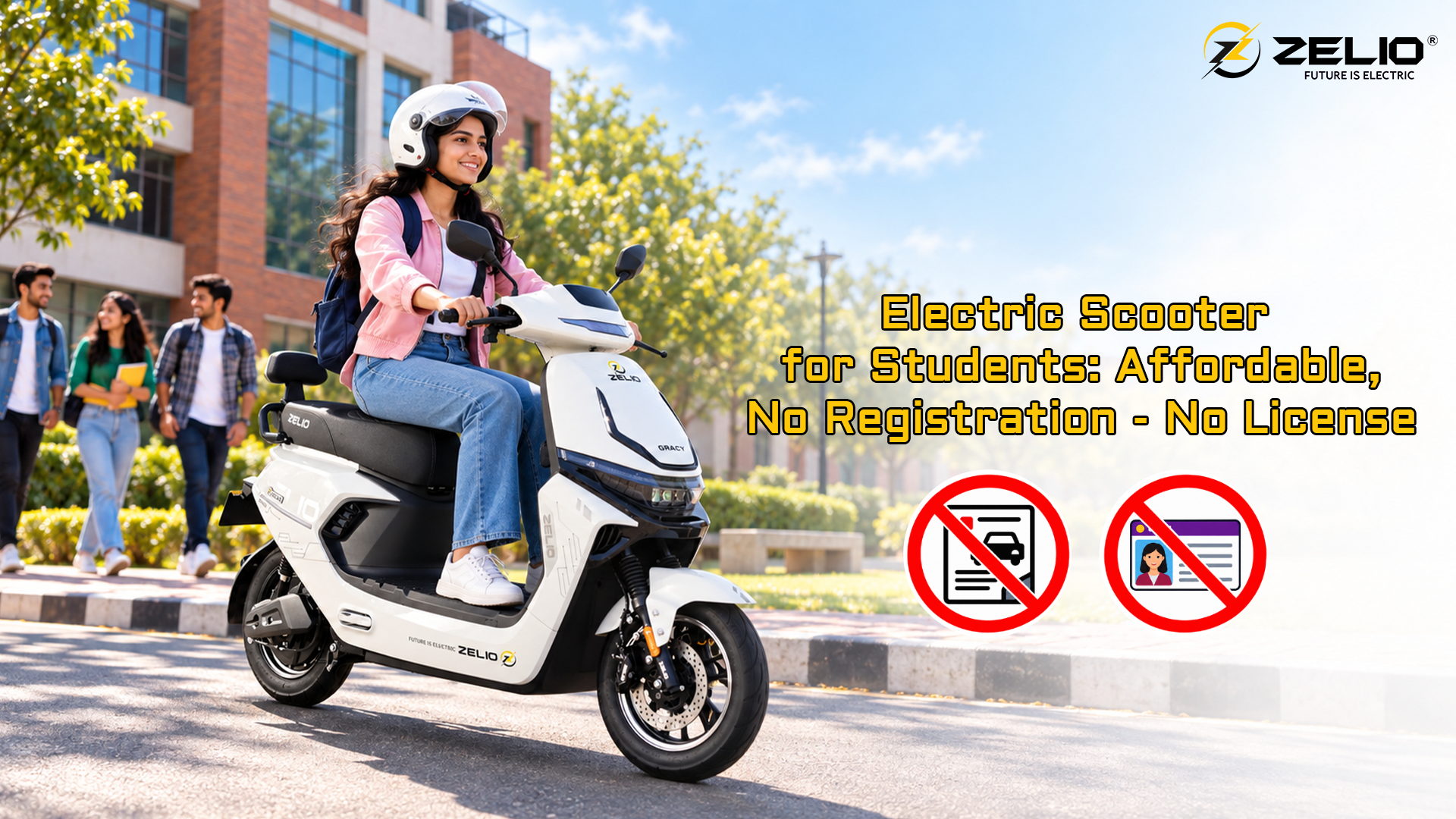
In cities across India, young women are choosing Zelio electric scooters for their daily college commute. Safe, economical, and perfectly suited for Indian traffic conditions, these scooters offer young riders the independence they need while giving parents peace of mind.

The Working Woman’s Companion

Young professionals in Indian cities are increasingly choosing Zelio for their work commute. Navigating through traffic, finding parking in congested commercial areas, and avoiding the unpredictability of ride-sharing apps, working women find that a Zelio scooter gives them control over their most valuable resource: time.

The Independence Factor: More Than Just Transportation

When we speak with our customers, one theme emerges consistently: independence. Not just the practical independence of getting from Point A to Point B, but the psychological and emotional independence that comes with self-reliance.

“I don’t need to ask anymore” – this simple statement captures something profound. Women who previously had to coordinate, request, or wait can now simply decide and go. The mental shift is as significant as the practical one.

Less Reliance on Male Family Members

Indian women have traditionally depended on husbands, fathers, or brothers for mobility. This dependency created not just practical constraints but also emotional ones. Every trip required consideration: Is he free? Will he mind? Can I ask again?


A Zelio electric scooter eliminates these questions. Women riders tell us that beyond the convenience, there’s a sense of dignity and self-sufficiency that comes with managing their own transportation.

Real Indian Conditions, Real Indian Solutions

Zelio’s design innovation isn’t about copying international models. It’s about understanding Indian conditions and Indian women’s needs.

  1. Navigating Indian Traffic – Indian traffic demands specific capabilities: quick acceleration to navigate gaps, stable handling on uneven roads, and responsive braking for sudden stops. Our scooters are designed for these exact conditions.
  2. Practical Storage Solutions – Indian women need to carry things: shopping bags from the market, their children’s school bags, groceries, even the occasional package. Zelio scooters offer practical storage solutions that acknowledge these real-world needs.
  3. Suited for Indian Climate – From the summer heat of North India to the monsoon rains, Zelio scooters are built to handle Indian weather conditions. The battery performance remains consistent, and the build quality ensures reliability across seasons.
  4. Safety in Indian Contexts – Safety means different things in different contexts. For Indian women, it means bright lights for visibility during early morning or evening rides, stable handling on crowded roads, reliable braking, and a design that inspires confidence rather than intimidation.

The Economic Case: Savings That Add Up

Beyond independence and convenience, Zelio electric scooters make strong economic sense for Indian families.

Running Costs

Compared to petrol scooters, the running cost of a Zelio electric scooter is significantly lower. 

Maintenance Simplicity

Electric scooters require significantly less maintenance than traditional vehicles. No oil changes, no engine servicing, fewer moving parts to repair. For busy Indian women managing households, this simplicity is valuable in itself.

Creating a Movement: Women Riders Across India

What started as individual women seeking practical transportation solutions has evolved into something larger. Across India, women riding Zelio scooters are part of a visible shift in urban mobility patterns.

In residential neighborhoods, seeing women on their scooters has become normal. At school gates, mothers arrive independently on their Zelio scooters. Near colleges and offices, young women navigate traffic with growing confidence. This visibility matters because it normalizes women’s independent mobility and inspires others.

Safety and Confidence: Addressing Real Concerns

We understand that safety is a primary concern for women riders and their families. Zelio scooters are designed with multiple safety features, but equally important is building rider confidence.

Beginner-Friendly Design

Our scooters are designed to be non-intimidating for first-time riders. The learning curve is gentle, allowing women to build their skills progressively. Many of our customers report feeling comfortable riding independently within just a few days.

Predictable Handling

In Indian traffic, predictability matters. Zelio scooters offer consistent, predictable handling that allows riders to focus on navigation rather than fighting with their vehicle.

Community Support

Zelio riders across India form an informal community, sharing tips, experiences, and encouragement. This social dimension adds to the confidence factor, especially for new riders.

The Bigger Picture: Changing Indian Society

When women gain independent mobility, the effects ripple outward. Children see their mothers as capable and independent. Families adjust to new patterns where women’s time and schedules are respected differently. Neighborhoods see women moving freely and safely. These small shifts accumulate into broader social change.

At Zelioebikes.com, we’re proud to be part of this transformation. We’re not just selling electric scooters; we’re enabling independence, supporting aspirations, and contributing to a more equitable mobility landscape for Indian women.

Choosing Your Zelio: What to Consider

If you’re considering joining the growing community of women Zelio riders, here are the factors to think about:

  • Your Daily Distance – Consider your typical daily travel. School runs, market visits, and commutes all add up. Choose a model with a range that comfortably covers your needs with room to spare.
  • Your Confidence Level – Are you a first-time rider or someone with prior experience? Models like Little Gracy are perfect for beginners, while Gracy Pro and EEVA ZX+ serve more experienced riders.
  • Your Style Preference – Your scooter should reflect your personality. Zelio’s range offers options from subtle and elegant to bold and contemporary.
  • Your Budget – Zelio offers models at different price points, ensuring that there’s an option for every budget without compromising on quality and safety.

Taking the First Step

For many Indian women, the decision to get their first electric scooter represents more than a purchase. It represents a commitment to their own independence and convenience.

If you’re hesitating, remember that thousands of women across India have already taken this step. They’ve discovered that the concerns they had before riding melted away after a few confident trips around their neighborhood.

Join the Community of Independent Women Riders

Every woman who chooses a Zelio scooter joins a growing community of riders who’ve chosen independence over dependency, action over waiting, and confidence over hesitation.

Whether you’re a housewife managing a busy household, a girl building your future, or a young working professional navigating city life, there’s a Zelio scooter designed for your needs.


Visit your nearest Electric Scooter Dealer today and check Zelio’s range of electric scooters designed specifically for Indian women. Discover why Little Gracy, Gracy Pro, and EEVA ZX+ have become the new favorites of women across India.


Your journey to independence is just one ride away.
Zelio Team

Innovation Department

No tags
Share

Frequently Asked
Questions

RELATED POSTS

Electric Scooter Insurance in India - Do You Need It?

Electric Scooter Insurance in India - Do You Need It?

If your scooter is a high-speed, RTO-registered model, insurance is not optional. It is mandatory by law to have insurance for that scooter, But If your scooter is a low-speed model under 25 km/h that needs no licence and no registration, insurance is not legally required. But "not required" and "not needed" are two very different things, and that gap is where most buyers get confused. We build both kinds of scooters at Zelio, so we get this question at almost every showroom conversation. The Legal Position - What the Law Actually Says India splits electric two-wheelers into two categories under the Central Motor Vehicles Rules, and your insurance obligation depends entirely on which category your scooter falls into. High-speed electric scooters (motor above 250W or top speed above 25 km/h) are treated exactly like a petrol scooter under the Motor Vehicles Act. Third-party insurance is compulsory. Riding without it is a punishable offence, and traffic police can fine you, impound the vehicle, and in an accident you are personally liable for damages that a valid policy would otherwise have covered. Our low speed vs high speed electric scooter guide breaks down exactly how these two categories are defined and what changes between them. Low-speed electric scooters (250W or less, 25 km/h or less) are classified as non-motorised vehicles. No licence, no RTO registration, no road tax, and no mandatory insurance. Every standard Zelio model falls in this category. Our RTO fees guide for electric two-wheelers covers the full registration picture if you want to understand why this exemption exists in the first place. That is the legal answer. Now here is the part that actually matters for your decision. Which Zelio Models Need Insurance and Which Don't Since this is the question we get asked most directly, here is the straight breakdown by model. No insurance legally required (low-speed, exempt category): Eeva , Eeva Eco , Eeva Eco LX , Eeva Eco ZX , Eeva ZX , Eeva ZX+ , Little Gracy , Gracy , Gracy i , Gracy+ , Gracy Pro , Legender , Legender+ , Legender+ Premium , Logix , Loader , X-Men+ and X-Men 2.0 are all built to run at or under 25 km/h with a motor of 250W or less. Every one of these qualifies as a non-motorised vehicle under CMVR, which means no licence, no RTO registration, no road tax, and no mandatory insurance. This covers the entire standard Zelio lineup. Insurance legally mandatory (high-speed, registered category): Mystery is Zelio's only high-speed model. Its motor and top speed cross the CMVR exemption limits, which means it is classified as a motor vehicle under the Motor Vehicles Act. If you ride a Mystery, you must have a valid driving licence, RTO registration and at minimum third-party insurance before taking it on public roads. Skipping insurance on this model is not a grey area. It is a legal requirement, same as any petrol scooter. For the latest on-road prices across Zelio's lineup, see the battery scooty price list . Why "Not Mandatory" Does Not Mean "Skip It Without Thinking" This is where most articles on this topic stop short. They tell you insurance is optional for low-speed scooters and move on. We think that leaves out the one detail that should actually shape your decision. If you are riding a low-speed scooter with no insurance and you accidentally hit a parked car, damage someone's shop shutter, or injure a pedestrian, the fact that your scooter is legally exempt from insurance does not make you exempt from paying for the damage. You are personally liable. There is no insurer standing behind you. If the claim runs into lakhs, and vehicle damage or medical claims genuinely can, you are paying that out of your own pocket, not an insurance company's. This is not a scare tactic. It is simply how liability works. The exemption removes a legal requirement to hold a policy. It does not remove your responsibility if something goes wrong on the road. For a scooter that mostly does 15-20 km/h through a colony or a market lane, the odds of a serious incident are genuinely low. But low odds are not zero odds, and the one time it matters is exactly the time you wish you had covered it for a few hundred rupees a year. Warranty Is Not Insurance - A Confusion Worth Clearing Up We hear this mix-up often enough that it deserves its own section. A 2-year warranty on your scooter's motor, controller, and frame protects you against manufacturing defects. If a part fails because of how it was built, the warranty covers the repair or replacement. It does not cover theft. It does not cover accident damage. It does not cover fire, flood, or a scooter stolen from outside your building. Warranty and insurance solve two completely different problems, and treating your warranty card as if it is also your insurance policy is a mistake that only becomes obvious the day something actually happens. If your scooter is stolen tomorrow, your warranty is worthless in that situation. Only insurance, or the money in your own pocket, replaces it. What Voluntary Insurance Actually Costs for a Low-Speed Scooter For a scooter priced between Rs 50,000 and Rs 80,000, a standalone fire and theft policy typically costs somewhere between Rs 600 and Rs 1,200 a year, depending on the insurer and your city. A more complete comprehensive-style policy covering accidental damage as well usually falls between Rs 1,200 and Rs 2,500 annually, again depending on your scooter's value and where you live. Put that against the price of the scooter itself. On a Rs 58,159 Zelio Gracy i, a full year of comprehensive-style protection costs roughly what you would spend on two tanks of petrol for a comparable commute. It is a genuinely small number next to what it protects. Insurers do not currently offer these policies specifically branded for "low-speed EVs" in every market, since the category is newer and the policy language is still catching up. In practice, most riders get this cover through a general asset or personal accident add-on, or through a standalone two-wheeler policy that some insurers extend even to non-registered low-speed vehicles on request. It is worth calling two or three general insurers directly and asking, because coverage availability does vary. What Happens If Your Scooter Is Stolen and You Have No Insurance This is the scenario every rider without insurance eventually has to face, and it plays out simply. The scooter is gone. There is no registration certificate to file against, since low-speed scooters are not registered. You can file a police complaint using your purchase invoice and the chassis or motor number, which helps if the scooter is later recovered, but there is no payout coming. The replacement cost comes entirely from you. If you had a fire and theft policy in place, this is exactly the situation it was built for. You file a claim with your invoice, the FIR copy, and any other documents the insurer asks for, and you get compensated based on the scooter's current insured value. High-Speed Electric Scooter Insurance - What It Actually Involves If you are riding one of Zelio's high-speed models, insurance is not a choice, so the more useful question is what it costs and what to look for. Third-party insurance is the legal minimum and covers damage or injury you cause to someone else, not damage to your own scooter. For most electric scooters in the mid-price range, third-party premiums typically run a few hundred rupees to around a thousand rupees a year, set by IRDAI-mandated slabs rather than by individual insurers. Comprehensive insurance adds coverage for your own scooter against accident damage, theft, and fire, on top of the mandatory third-party portion. This costs more, usually a percentage of your scooter's insured value, but it is the difference between paying for your own repair bill and having it covered. Whichever level you choose, always carry your registration certificate, your driving licence, and your valid insurance policy while riding a high-speed scooter. All three get checked during routine stops, and missing any one of them results in a fine. Who Should Seriously Consider Voluntary Insurance Not every low-speed scooter owner needs to rush out and buy a policy, but a few situations make it a genuinely smart call rather than an optional extra. You park on the street rather than inside a gated society. Theft risk goes up meaningfully when the scooter sits outside overnight without any building security. You ride in dense city traffic daily. More traffic exposure means more chances of a minor collision, even at 25 km/h. Your scooter is on the higher end of the price range. A Rs 75,000+ lithium model losing to theft or fire is a bigger financial hit than a Rs 45,000 entry model, and the insurance cost difference between the two is small in comparison. You are the sole earner relying on the scooter for daily commute or delivery work. Losing the scooter without a replacement plan directly hits your income, not just your convenience. If none of these apply and your scooter stays inside a secure compound with light daily use, the case for voluntary insurance is weaker, though never zero. A Quick Way to Decide Ask yourself three questions. Where does the scooter sleep at night? How much would replacing it cost you today, in cash, with no notice? And how would you feel if it never came back? If the answers make you uneasy, a few hundred rupees a year for peace of mind is not a hard decision. For daily commuters using a Zelio scooter to save on fuel every month, as covered in our best electric scooter for daily commute guide , protecting that saving with a small annual premium is a sensible extension of the same financial thinking that led to buying an electric scooter in the first place.

Read More
Zelio E-Mobility Plans to Double Its Workforce in FY27
EV News
7/7/2026

Zelio E-Mobility Plans to Double Its Workforce in FY27

Zelio E-Mobility, the Hisar-based electric two and three-wheeler manufacturer, has announced it will more than double its workforce during the current financial year. The company currently has around 260 employees spread across its manufacturing facilities in Hisar, Bhubaneswar, and Coimbatore. The plan is to take that number past 500 before the end of FY27. This is not a speculative growth target. It is a response to actual business performance. Zelio reported revenue of Rs 313.68 crore in FY26, an 81.8 percent increase over the Rs 172.19 crore it posted the year before. The company has been profitable since inception and has recorded a revenue CAGR of approximately 121 percent over the last four years. The hiring push is the company catching up to where the business already is. Where the New Hires Are Going The expansion is spread across three locations, each with a specific purpose. Hisar - Zelio's headquarters and primary manufacturing base in Haryana. The bulk of the hiring here will focus on production, quality control, and core manufacturing operations. Bhubaneswar - Zelio's facility in Odisha supporting the East India and North-East expansion push. Coimbatore - The newest facility in the lineup. Coimbatore is still being commissioned and ramped up, which makes it the most significant of the three locations in terms of what the hiring signals. A hundred new employees at a facility that is just scaling up means Zelio is serious about South India as a growth market. The roles being filled span manufacturing, R&D, quality, production planning, zonal sales leadership, and after-sales service. These are not temporary or support hires. They are the people who run plants, lead sales territories, and keep the service network functional as dealerships grow. What Our CEO Said Divyanshu Agarwal, CEO of Zelio E-Mobility, explained the thinking behind how the company approaches expansion: "Our expansion is not only focused on manufacturing growth but also on building strong local ecosystems in each region we operate in, ensuring long-term value creation through employment and skill development." That framing matters. Zelio is not building factories and shipping in management from headquarters. The plan is to hire locally in Bhubaneswar and Coimbatore, creating jobs and skills in those markets specifically. For a company entering new geographies, that approach tends to build stickier relationships with local governments, dealers, and customers than a centralized model does. Divyanshu also made the point that this has been consistent with how Zelio has operated since its founding: "Since the beginning, Zelio has always been a people-first company. Wherever we enter, whether a state or a city, our focus is to create meaningful job opportunities and contribute to local employment." The Business Context Behind the Hiring Zelio listed on the BSE SME platform in October 2025. The IPO raised Rs 78.34 crore, including a fresh issue of Rs 58.84 crore and an offer for sale of Rs 15.50 crore. The IPO was subscribed 1.5 times overall. Since listing, the company has continued to perform. The FY26 revenue of Rs 313.68 crore represents the strongest year the company has had, and it came after years of consistent profitability that set Zelio apart from several larger EV peers that are still reporting losses. The dealership network currently stands at 400+ outlets across 25+ states. The target for FY27 is 550+ dealerships, with a specific focus on South India and the North-East. The Coimbatore hiring directly supports the South India push, and the Bhubaneswar hires support the East and North-East strategy. For a company to expand its dealer network to 550 locations and maintain after-sales quality across that footprint, it needs the backend workforce to match. That is the practical reason behind the 500+ headcount target. Why This Matters Beyond Zelio Zelio's expansion follows a pattern that tells you something about where the Indian EV market is heading, particularly in the slow-speed electric scooter segment. The brands seeing the fastest growth in this segment are not the ones with the biggest advertising spends. They are the ones building manufacturing depth, dealer width, and service reliability simultaneously. A dealer in a tier-2 city who cannot get spare parts within 48 hours or reach a service professional by phone becomes a liability, not an asset. Zelio's hiring of after-sales professionals and zonal sales leaders alongside plant staff reflects an understanding of this. The 121 percent revenue CAGR over four years, combined with consistent profitability, also tells a different story than the wider EV narrative in India, where many companies are still in investment mode and reporting operating losses. Zelio has been growing while keeping the business in the black, which gives the current expansion a more stable foundation than if it were funded purely by external capital. With 2 lakh+ riders already on Zelio scooters across India and a lineup of 19 models starting at Rs 47,784, the workforce expansion is ultimately about making sure the company can serve what it has already sold, and confidently sell more. For the latest on-road prices across Zelio's lineup, see the battery scooty price list . What Roles Zelio Is Hiring For Based on the official announcement, the hiring covers: - Plant heads and production planning specialists - R&D and quality control professionals - Zonal sales managers and regional sales leaders - After-sales service and customer support professionals - Manufacturing floor staff at Hisar and Coimbatore If you are looking to be part of Zelio's expansion, The Zelio E-Mobility careers is the right place to start. Sources Zelio E-Mobility to Double Workforce as EV Expansion Gains Pace Across India - EMobility+, 2026 Zelio set to cross 500 employees in FY27 - HR Katha, 2026 Zelio E-Mobility to Double Workforce to Over 500 Employees - Manufacturing Today India Zelio E-Mobility Plans to Double Workforce Following Strong Revenue Growth - Economic Times Auto, 2026 Zelio E-Mobility to Double Workforce, Expand Employee Strength Beyond 500 - GearFliq

Read More
Delhi’s New EV Policy 2026 - What It Means for Electric Scooter Buyers in Delhi
EV News
7/6/2026

Delhi’s New EV Policy 2026 - What It Means for Electric Scooter Buyers in Delhi

Delhi has approved its new Electric Vehicle Policy and it came into effect on July 1, 2026. For anyone who has been sitting on the fence about buying an electric scooter in Delhi, this policy changes the financial calculation significantly. Here is what the policy actually says, what it means for two-wheeler buyers specifically, and what people from inside the EV industry are saying about it. What the Delhi's New EV Policy 2026 Actually Covers The Delhi EV Policy 2026 is built around three pillars: consumer incentives to bring down the cost of buying an EV, infrastructure investment to make charging accessible across the city, and a phased timeline to move Delhi away from petrol and diesel vehicles over the coming years. 100% road tax and registration fee exemption - For electric cars priced up to Rs 30 lakh. This removes one of the most significant upfront costs for EV buyers in this segment. Subsidies for electric two-wheeler buyers - The policy introduces purchase incentives for electric two-wheelers, with subsidies of up to Rs 30,000 for buyers in the first year of the policy. For a Delhi rider looking at an electric scooter, this directly reduces the on-road cost. Expansion of EV charging infrastructure - The policy commits to a significant push on public charging points across the city, addressing the range anxiety and charging accessibility concerns that have held back EV adoption in Delhi's denser residential areas. Phased ICE phase-out timeline - The policy outlines a phased transition towards EV-only registrations in selected vehicle categories over the coming years, giving the industry and buyers a clear signal about the direction Delhi is heading. What the Chief Minister said, Delhi CM Rekha Gupta has pitched the policy as a savings measure first, an environmental one second. Her framing: buyers want to know if going electric actually saves money, and the mix of purchase subsidies, scrapping incentives, and lifetime road tax exemption is meant to make that answer an easy yes. Private car buyers don't get a purchase subsidy under the policy, but scrapping an old petrol or diesel car for an EV still qualifies for up to ₹1 lakh in scrapping benefits plus the tax waivers. On charging, she treats the rollout as a trust issue, not a checklist item. "Charging infrastructure is not merely about installing chargers," she said, framing the planned expansion to 32,000 points as the thing that actually gets people to switch. She's also been clear the transition won't happen overnight. Existing petrol and diesel vehicles keep running as long as they're legally on the road. The shift to electric-only registrations comes in phases, through 2027 and 2028. What This Means if You Are Buying an Electric Scooter in Delhi For a Delhi rider considering an electric scooter, the 2026 policy stacks multiple savings together in year one. The up to Rs 30,000 subsidy on two-wheelers, combined with the existing 100% road tax and registration exemption for low-speed electric scooters that was already in place before this policy, means the real out-of-pocket cost of switching to electric has dropped again. A Zelio Gracy i starting at Rs 58,159 in Delhi, with the two-wheeler subsidy applied, could effectively come down to around Rs 28,000-30,000 lower than its listed price for eligible buyers. Combined with the Rs 30,000-40,000 annual savings on fuel and servicing that any electric scooter already delivers at Rs 0.25 per km, the financial case for switching has never been stronger for Delhi commuters. The charging infrastructure push also directly addresses one of the real daily concerns for riders who live in apartments or shared housing where home charging is not always possible. The EV industry welcomed the policy with clear and specific reactions, not just generic approval. Kunal Arya, Co-founder and Managing Director of Zelio E Mobility, responded directly to the announcement: "Delhi's EV Policy 2026 is a decisive step toward making electric mobility mainstream, accessible, and infrastructure-backed. The combination of demand incentives including subsidies of up to Rs 30,000 for two-wheeler buyers in the first year along with a clear ICE phase-out timeline and a strong push for charging infrastructure, creates a practical ecosystem for accelerated EV adoption. What stands out is the policy's balanced approach: driving consumer demand while addressing the charging accessibility barrier head-on. For the EV industry, this sends a clear signal that policy is moving beyond intent to execution." Kunal also pointed to the particular impact the policy will have on two-wheeler and last-mile mobility adoption: "At Zelio E-Mobility, we believe such progressive frameworks will significantly accelerate EV penetration, especially in the two-wheeler and intra-city last-mile mobility segments, where adoption delivers immediate environmental and economic impact. Delhi is setting a benchmark that other urban centres will closely watch." Why Two-Wheelers Are at the Centre of This Delhi's vehicle population is dominated by two-wheelers. They account for the largest share of registered vehicles in the city and contribute significantly to both traffic congestion and air pollution. Any EV policy that moves the needle on two-wheeler electrification moves the needle on Delhi's air quality. The 2026 policy's explicit focus on two-wheeler subsidies and the eventual ICE phase-out timeline for this category signals that Delhi is not just thinking about EV cars for the affluent buyer. It is targeting the rider who currently uses a petrol scooter for daily commuting, because that is where the volume is and where the environmental impact is greatest. For that rider, the combination of the Rs 30,000 subsidy, zero road tax, zero registration fee, and Rs 0.25 per km running cost makes switching to an electric scooter in Delhi a decision that is financially hard to argue against in 2026. How Zelio Electric Scooters Fit Into This Zelio's lineup spans low-speed and high-speed electric scooters across several price points in Delhi. The low-speed models already qualify for no-licence, no-registration treatment under existing motor vehicle rules, and that now stacks with the new policy's subsidies for eligible buyers. For the full list of current models and prices, see the Delhi electric scooter price list . If you're curious how those prices compare once you factor in road tax exemptions, PM E-DRIVE subsidies, and the other line items that make up an on-road cost, the battery scooty price list breaks all of that down across budget, mid-range, and premium models. If you want to see the five-year cost breakdown against a petrol scooter, the electric vs petrol scooter comparison lays it out. And if you're trying to match a model to your commute and budget, the best electric scooters under ₹70,000 guide is a good starting point. The Bigger Picture Kunal Arya's observation that "Delhi is setting a benchmark that other urban centres will closely watch" reflects something worth noting. Delhi is not the first Indian city to offer EV subsidies, but the combination of the subsidy quantum, the charging infrastructure commitment, and the phased ICE transition timeline in a single cohesive policy is more structured than what most other cities have managed. If this policy drives meaningful two-wheeler electrification in Delhi over the next two to three years, the template will almost certainly be picked up by other state capitals. For EV brands operating in India, that trajectory matters more than any single subsidy figure. For individual buyers in Delhi in 2026, the question is simpler: has the policy made buying an electric scooter the better financial decision today? The answer, for most daily commuters doing 30-50 km a day, is yes. Sources Industry welcomes Delhi EV policy, sees strong push for electric vehicle adoption - BioEnergy Times, June 30, 2026 Delhi approves EV Policy 2026 with scrappage boost and tax waivers - SME Futures, 2026 Auto industry and experts welcome Delhi EV Policy 2026 - Jagran, 2026 Industry leaders hail Delhi's new EV policy as a blueprint for clean mobility - Navbharat Times, 2026 Delhi aiming for 32,000 public EV charging points by 2030: CM Rekha Gupta - The Tribune, 2026 Delhi EV Policy 2026 designed to save buyer's money: CM Rekha Gupta - DD News, 2026

Read More