Electric Scooters
24 November 2026

Graphene Battery Electric Scooter: Benefits, Charging And Best Models Available

Graphene Battery Electric Scooter: Benefits, Charging And Best Models Available

A graphene battery electric scooter uses a battery that adds graphene to its construction to improve charging, power delivery and heat handling, and it costs less than a lithium-ion battery. In low-speed scooters, graphene batteries are typically lead-acid based. They suit riders who want a budget-friendly scooter for short daily trips and they usually take about 6 to 8 hours to charge at home. Zelio offers graphene battery 12V 32Ah (Super Graphene) and graphene battery 12V 41Ah, so you can choose the pack that fits your daily distance and budget.

This guide explains what a graphene battery is, its benefits, its limits and which Zelio scooters carry it. If you are still deciding between battery types, you can also read our comparison of lithium-ion and lead-acid batteries.

What Is a Graphene Battery?

Graphene is a very thin, strong and highly conductive form of carbon. Battery makers add it to the plates inside a battery to help current flow more easily and heat spread more evenly. In the scooters of this class, a graphene battery is usually a graphene-enhanced lead-acid battery, which sits between a conventional lead-acid battery and a lithium-ion battery in price and performance. Ask your dealer to confirm the exact construction of the pack on the model you choose.

Benefits of a Graphene Battery in an Electric Scooter

  • Lower upfront cost. A graphene variant keeps the purchase price low, which matters most to first-time buyers, students and shopkeepers in Tier 2 and Tier 3 cities.

  • Better charge handling than a conventional lead-acid battery. The graphene content helps the battery accept charge more readily, according to manufacturers.

  • Improved heat handling. Graphene conducts heat well, which helps the battery cope with warm Indian conditions.

  • A practical fit for short daily trips. For school runs, market visits and short commutes, a graphene battery gives all the range most riders use.

  • Familiar, widely serviceable technology. The battery is easy for your dealer to service and replace.

Benefits like these depend on the pack and the way you ride, so treat them as a guide and ask your dealer for specifics.

Limits to Know Before You Buy

  • Heavier than lithium-ion. A lead-acid based pack weighs more than a lithium pack of similar capacity.

  • Slower to charge. Expect about 6 to 8 hours at home, compared with roughly 4 to 6 hours for lithium-ion.

  • Shorter expected life than lithium-ion. Lithium batteries generally last longer, which is why Zelio's warranty differs by battery type. Check the terms for your pack on the Warranty & Claims page.

The trade-off is simple: you accept a heavier battery and a longer charge in return for a lower price.

Who Should Choose a Graphene Battery?

A graphene battery makes sense if:

  • You ride short distances every day, such as to college, work or the market.

  • You want the lowest purchase price in the Zelio range.

  • You can charge overnight and do not mind a longer charge time.

  • You are comfortable with a heavier battery in return for a lower price. If a lighter battery and longer life matter more, compare the lithium-ion option instead.

If you want to see where each battery sits in price and weight, our guide on lithium-ion vs lead-acid batteries covers the comparison in detail.

Zelio Scooters With Graphene Batteries

Zelio electric scooters are cost effective and hence they need no subsidy to be affordable. You can compare every model and its battery options in the electric scooter range and check current prices on the battery scooty price list. Real-world range depends on your load, speed and road. 

Charging a Graphene Battery

Charge a graphene battery the same way as any Zelio electric scooter: use the original charger, plug it into a standard socket in a dry, ventilated spot, and unplug when the indicator shows full. You will find the full process in our guide on how to charge an electric scooter at home. Graphene and lead-acid batteries generally do better with regular complete charges than with many tiny top-ups, so check your manual for your model.

Final Word

A graphene battery keeps the purchase price low and handles short daily rides well. If your priorities are a lighter battery and a longer life, compare the lithium-ion option. To see both side by side, visit your nearest Zelio dealer and take a test ride.
Kaushiki Agarwal

Frequently Asked
Questions

RELATED POSTS

Electric Scooter Not Charging? 9 Causes and What to Do
Electric Scooters
24 Nov, 2026

Electric Scooter Not Charging? 9 Causes and What to Do

You plug in the charger in your electric scooter and nothing happens. The indicator stays off, the battery percentage doesn't move, or the charger stops early. Before you worry about a new battery, know that the problem is often something simple, such as a dead socket, a loose plug or a damp charging port. This guide helps you work out what is going wrong, shows the safe checks you can do yourself in a few minutes and tells you when to stop and call your dealer. It is for troubleshooting only. If you want to look after your battery over the long term, read our guide on how to extend electric scooter battery life in India . Safety first: Never open the charger or the battery and never try to repair either one yourself. If you notice swelling, a burning smell or smoke, unplug the charger only if it is safe to do so, move away from the scooter and contact your dealer or service centre right away. Quick Symptom Guide What you see Most likely cause What to do first Charger indicator doesn't light up at all No power at the socket, or a loose connection Try another earthed socket, reseat both plugs Indicator lights up but the battery doesn't charge Loose or dirty charging port, or a damaged cable Switch off, unplug, inspect and dry the port Charging stops before the battery is full Hot battery, unstable power supply, or an ageing battery Let it cool, try a stable socket, then see your dealer Charging is much slower than before Weak supply, a mismatched charger or an ageing battery Use the original charger on a stable supply Charger or battery gets unusually hot Poor ventilation, a faulty charger or battery Unplug, let it cool, don't use it, call your dealer Indicator behaves differently from normal A fault or protection mode Check your manual for your model's indicator meanings 9 Common Reasons an Electric Scooter Won't Charge 1. The socket or power supply is the problem Start with the easiest check. Plug a lamp, a phone charger or a fan into the same socket to see if it works. Also check whether the MCB or switch has tripped. Then try the scooter charger in a different, properly earthed wall socket. If it charges there, the first socket (or its wiring) is the fault. 2. The plug or connector is loose A plug that isn't pushed in fully is a very common cause. Switch the charger off at the wall, unplug both ends, then reconnect them firmly, wall end first and scooter end second. If the connection feels loose or wobbles, don't force it. Show it to your dealer . 3. The charging port is wet, dirty or damaged Dust, dirt or moisture in the charging port can stop the connection, especially after a ride in rain or a wash. Wipe the outside of the port with a dry cloth and let it dry fully before you try again. Never use a water jet near the port, and don't poke metal objects inside it. If the pins look bent, burnt or discoloured, stop and call your dealer. 4. The charger or cable is damaged Look along the whole cable for cuts, kinks, exposed wire, loose pins or burn marks, and check the charger body for cracks. A charger that has been dropped, pulled by the cable or run over can fail without looking badly broken. If you see damage, stop using it and replace it through your dealer. 5. You are using the wrong or a non-original charger A charger that doesn't match your battery's voltage and charging profile may not charge it at all, may charge it slowly, or can overcharge or undercharge it. Use only the charger supplied with your scooter. If you have lost or damaged it, get a replacement from your Zelio dealer . Not sure which battery you have? See our guide to lithium-ion vs lead-acid batteries . 6. The battery is too hot after a ride A battery that has just come off a long ride, or has sat in a strong sun, can be warm. Many chargers and battery systems limit or pause charging when the battery is too hot, so charging can start late, slow down or stop. Switch off and move the scooter to a shaded, airy spot, wait for the battery to cool, then try again. Never place the battery or charger in the sun, or cover them while charging. 7. A protection mode has been triggered Some scooters stop charging if they detect a fault, such as a power surge, an unstable supply or a connection problem. If the charger indicator shows something unusual, such as a different colour, blinking or no light, look up what it means in your owner's manual. The meanings vary by model and charger, so don't guess. Unplug, wait a few minutes, then reconnect once. If the same pattern comes back, don't keep retrying. Connect with your dealer. 8. The battery was left empty for a long time An electric scooter left unused for weeks or months can end up with a very low battery, and some batteries then won't accept a normal charge. Don't try to "jump-start" it or use a different charger. Take it to your dealer, who can test the battery safely. 9. The battery is ageing or faulty Electric scooter batteries might wear out gradually. If your scooter charges, but the range has dropped noticeably, a full charge takes much longer or much shorter than before, or charging keeps stopping early, the battery may be losing capacity. Only a proper test can tell you for sure, and your dealer can do that. The exact battery type and warranty terms are in your manual and on the Warranty & Claims page. Zelio offers a 3-year warranty on lithium batteries and a 1-year warranty on lead-acid and gel batteries. 5-Minute Checklist Before You Call Anyone Test the wall socket with another appliance, and check the MCB. Try a different earthed socket. Avoid loose sockets and overloaded extension boards. Switch off, unplug and reconnect both ends firmly. Check the cable and charger for cuts, kinks, burn marks or a burning smell. Wipe the charging port dry and look for dirt, moisture or damage. Let a warm battery cool in the shade for 10 to 15 minutes. Check that you are using the original charger that came with your scooter. Note what the charger indicator is doing, and check your manual for what it means. If the scooter still won't charge after these steps, stop. Repeated plugging in and unplugging won't help and can make things worse. What Not to Do Don't open the charger or the battery, and don't try to repair either one Don't use a non-original or "universal" charger to test your scooter Don't charge with wet hands, in the rain or with a wet port Don't keep retrying if the charger or battery feels hot or smells of burning Don't charge a scooter that has swelling, damage or exposed wiring Don't use extension boards that are loose, damaged or overloaded When to Call Your Dealer or Service Centre Contact your authorised Zelio dealer or Service & Support if: The scooter still won't charge after the checklist above The charger or battery gets unusually hot You see damage to the charger, cable or charging port Charging keeps stopping early or has become much slower You notice swelling, a burning smell or smoke (call right away) To speed things up, tell them: your scooter model, whether it has a lithium or lead-acid/gel battery, what the charger indicator shows, when the problem started and what you have already tried. A photo of the charger and charging port also helps. Your dealer can be found through the dealer locator. If the battery is under warranty, mention that too, and check the terms on the Warranty & Claims page. Final Word Most charging problems have a simple cause, and a few safe checks can often sort them out in minutes. If they don't, stop and let your dealer take over rather than risk damaging the battery. Once you're back up and running, our guide to charging an electric scooter at home covers the correct process, and the Zelio electric scooter range is there when you're ready to compare models and book a test ride.

Read More
How to Charge an Electric Scooter at Home in India: The Complete Guide
Electric Scooters
20 Nov, 2026

How to Charge an Electric Scooter at Home in India: The Complete Guide

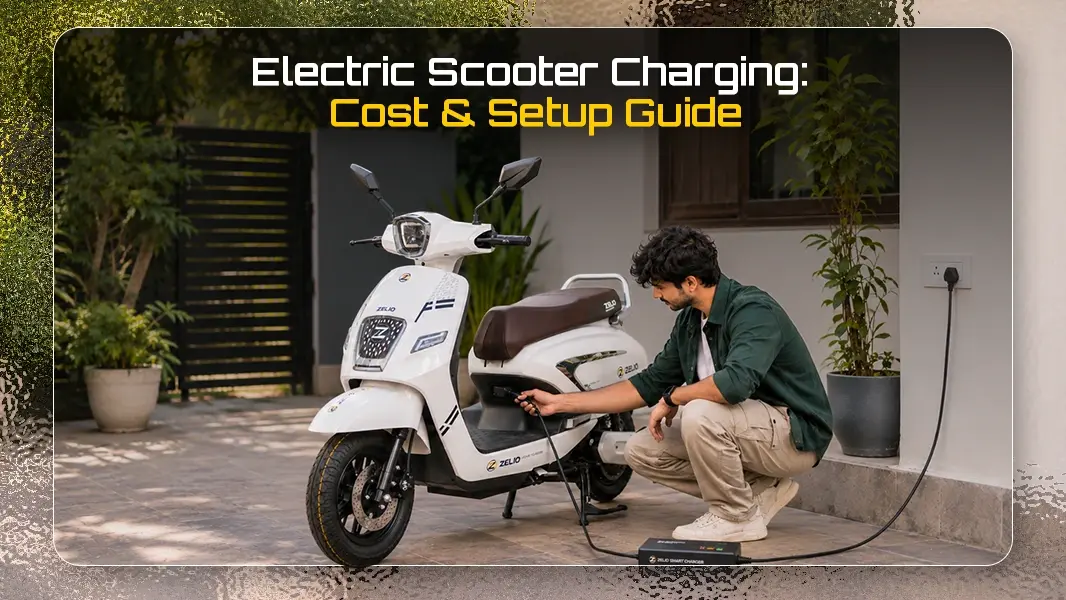
Charging an electric scooter at home in India is much simpler than you think. Connect the charger supplied with your scooter to the vehicle or its battery, plug it into a standard household socket and unplug it once the indicator shows a full charge. A complete charge typically takes 4 to 8 hours and costs approximately ₹10 to ₹20, which makes overnight charging the most convenient and economical option for daily riders. Every Zelio electric scooter ships with its own charger that runs on a regular home supply, so you need no special wiring, no charging station and no visit to a fuel pump. Home charging is a major reason why Indian commuters are choosing Zelio electric scooters and it works equally well in an independent house and in an apartment. This guide explains the correct charging process, the time and cost involved, the options available to apartment residents and the common mistakes that shorten battery life. Can we Charge the Zelio Electric Scooter at Home? Every Zelio electric scooter ships with its own charger, built to run on the same household supply that powers your fan or phone charger. India's EV charging guidelines also support home and private charging, so you can plug in at your own parking spot or inside your home, subject to your society's rules. You can read the national guidance on the Ministry of Power website . This is the biggest reason Zelio electric scooters, or electric scooty win on convenience. Unlike petrol scooters that require regular trips to the fuel pump, an electric scooter can be charged right at home. Simply plug it in overnight and it's ready for your daily commute by morning. How to Charge an Electric Scooter at Home, Step by Step Follow these six steps every time: Switch off the scooter and remove the key. Let the battery cool for 10 to 15 minutes if you have just finished a long ride. Choose a safe spot. Pick a dry, shaded, well-ventilated place close to a working wall socket. Connect the charger to the scooter or battery first. Use the charging port, or the battery itself if your model has a removable battery. Plug the charger into the wall socket. Make sure the socket is firm, not loose or burnt. Watch the charger indicator. It shows when charging starts and when the battery is full. Unplug the charger from the wall first, then from the scooter. Ride out with a full battery. See your owner's manual for the exact indicator colours on your model, as they might differ between chargers. How Long Does it Take to Charge an Electric Scooter? Charging time depends on battery type and capacity. As a general guide for low-speed electric scooters: Battery type Typical full charge at home Lead-acid / graphene battery 6 to 8 hours Lithium-ion battery 4 to 6 hours A battery does not need to reach 0% before you charge it. A top-up while you work or watch a match works fine, and a partial charge is easy on the battery. Check your model's exact charging time on its page, such as Gracy , Eeva Eco , Legender+ or X Men+ , or ask your dealer. How Much Does it Cost to Charge an Electric scooter at Home? The formula is simple: Cost per charge = battery units (kWh) × your electricity rate per unit Home electricity in India usually costs between ₹3 and ₹8 per unit, depending on your state and slab. Here is a quick example for a scooter that draws about 2 units for a full charge: Your tariff Cost of one full charge Approx. cost per km (60 km range) ₹5 per unit ₹10 ₹0.17 ₹6.50 per unit ₹13 ₹0.22 ₹8 per unit ₹16 ₹0.27 Compare that with a petrol scooter. At around 45 km per litre and ₹95 per litre, petrol costs about ₹2 per km. Your electric scooter costs roughly one-tenth of that. Ride 30 km a day and you can save several thousand rupees every month. Zelio electric scooters offer an affordable alternative for everyday commuting. Their competitive upfront pricing makes them accessible without relying on government subsidy benefits, while their low running costs add to the savings. You spend just a few rupees a day on charging, save on petrol expenses and avoid regular engine servicing. This makes Zelio a cost-effective choice for daily mobility, with affordability built into the purchase price itself. Browse the full range and prices on the Zelio electric scooty price list . Costs are indicative. Your actual cost depends on your battery size and local electricity tariff. How to Charge an Electric Scooter in an Apartment Living on the fourth floor with no parking socket? You can still charge. Riders in apartments use three simple options: Carry the battery home. If your Zelio model has a removable battery, take it out and charge it inside your flat like a laptop. No wiring, no approvals. Use a socket near your parking spot. Ask your society if a metered or shared socket is available. Offer to pay your share of the electricity. Request a dedicated point. Speak to your RWA and request a charging point with its own meter. Many societies now welcome this because more residents are going electric. Tips for a smooth conversation with your RWA: Explain that an OEM charger runs on a normal supply, much like a household appliance. Offer to pay for the electricity you use. Use a good-quality socket with proper earthing, and never run extension cords through corridors or stairwells. Where to Charge an Electric Scooter Outside Your Home A low-speed electric scooter is built for the daily city run: office, college, market, school drop. For these rides, home charging handles almost everything. When you need a top-up away from home: Office or college. Ask if you can use a socket in the parking area. A few hours at your desk adds plenty of range. Your dealer's showroom. Authorised dealers can often help in an emergency. Find yours on the dealer locator . A friend's or relative's home. Carry your charger and plug into any earthed socket. A spare battery. Zelio sells batteries and accessories in its battery shop and accessories store . Electric Scooter Charging Do's and Don'ts to Protect Your Battery Do's Use only the charger that came with your scooter. Charge in a dry, shaded and ventilated place. Let the battery cool after a long ride before you plug it in. Top up regularly instead of running the battery to zero every time. Check the cable and plug for cuts, heat marks or loose pins once a month. Don'ts Don't use a duplicate or unbranded charger, even if the plug fits. Don't charge in the rain, near water or on a damp floor. Don't cover the charger or battery with cloth or plastic while it charges. Don't leave the scooter plugged in for days when you are away. Unplug once the battery is full. Don't open the battery or charger yourself. Take it to an authorised service centre. Electric Scooter Charging Myths; Busted Myth 1: Charging an electric scooter will shoot up my electricity bill. Fact: A full charge uses about as much power as running an air conditioner for an hour or two. Your monthly bill rises by a modest amount, while your petrol bill drops to zero. Myth 2: Charging overnight is dangerous. Fact: Use the original charger, a good socket and a ventilated spot, and overnight charging is a routine practice for riders across India. Myth 3: I need a special charging station at home. Fact: A regular wall socket is enough. Myth 4: I must drain the battery completely before charging. Fact: Frequent partial top-ups are fine. Myth 5: Electric scooters cannot work in an apartment. Fact: Removable batteries and shared sockets make apartment charging easy. Why Zelio Makes Charging Simple Zelio is built for riders who want an electric scooty that fits real Indian life. With 18 models, 200,000+ happy riders and a dealer network across 350+ cities, Zelio keeps ownership simple: Plug-and-charge convenience. Every scooter comes with a charger that works with your home supply. Low running cost. Pay a few rupees per day to charge, with no petrol and far less maintenance. Models for every rider. Pick a low-speed scooter that suits students, homemakers, professionals and delivery partners, then compare options in our electric scooter range . Support you can reach. Get help from Service & Support and read the warranty terms . Easy finance. Zelio works with leading finance partners, so you can ride home sooner. Ready to feel the difference? Book a test ride or find your nearest Zelio dealer today. Charging time, battery specifications, range and prices vary by model, battery type and city. Please check with your nearest Zelio dealer for the latest details before you buy. Conclusion Charging an electric scooter at home takes about as much effort as charging your phone, and it costs a tiny fraction of what you spend on petrol. Plug in at night, ride in the morning, and enjoy the quiet savings.

Read More
EV Scooter Subsidy in Karnataka 2026: Road Tax Change and What It Means for Two-Wheelers
Electric Scooters
20 Nov, 2026

EV Scooter Subsidy in Karnataka 2026: Road Tax Change and What It Means for Two-Wheelers

Karnataka began its EV road tax exemption in 2017 under its first EV policy, and the Karnataka Motor Vehicles Taxation (Amendment) Act, 2026, effective 1 April 2026, ended that blanket waiver for other EV categories. But the road tax waiver for electric scooters in Karnataka has not ended. Scooters are the largest EV segment in the state, and the government kept them outside the new levy. A scooter buyer in Karnataka still pays zero road tax in 2026. Karnataka does not run a separate cash subsidy for scooters and the central PM E-DRIVE incentive covers only registered, type-approved electric two-wheelers. Low-speed scooters, like the Zelio Electric Scooter range, skip both the paperwork and the need for a subsidy. What Exactly Changed in April 2026 Electric two-wheelers: 0% lifetime road tax. The exemption continues. Other EV categories: now pay a lifetime tax based on vehicle price. Reason for the shift: the state moved from an incentive-led approach to revenue collection, according to industry coverage. Is There an Electric Scooter Subsidy in Karnataka Karnataka's Clean Mobility Policy 2025-30 focuses mainly on investment, manufacturing clusters, charging and battery-swapping infrastructure. The policy targets ₹50,000 crore in investment and one lakh jobs by 2030. It does not offer a large, blanket cash rebate for scooter buyers. In practice, the benefit for a Karnataka scooter buyer comes in two forms: Zero road tax: the exemption that remains in force for electric two-wheelers. Central incentives: the PM E-DRIVE support available for eligible, registered electric two-wheelers (covered below). If your daily commute mainly involves short distances, explore the Zelio electric scooty range . With budget-friendly and cost-effective options, you can find an electric scooter that fits your needs without having to depend on a separate purchase subsidy. What Makes Zelio Electric Scooter A Better Choice Zelio electric scooters are designed to make everyday commuting more affordable, convenient and hassle-free. Whether you're travelling to a nearby market, commuting to college or making short daily trips, they offer a practical mobility solution with low running costs and budget-friendly pricing. Many Zelio models also offer the advantage of no RTO registration or driving licence requirement, making ownership simpler for eligible riders. With an affordable upfront price and reduced day-to-day expenses, Zelio makes electric mobility a smart choice for everyday travel. Lower upfront cost. Zelio focuses on value-for-money scooters that are affordable for first-time buyers in Tier 2 and Tier 3 cities. No registration hassle. You skip RTO visits, number plates and renewal paperwork. Strong warranty cover. Zelio offers 2 years on the motor, controller and frame, and 3 years on lithium batteries (1 year on lead-acid and gel batteries). Battery choices. Options include 74V 32Ah, 60V 32Ah and 48V 26Ah lithium-ion packs, plus graphene battery variants . Ideal for short daily trips. School runs, market visits, short commutes and local errands are where a low-speed scooty works best. Why Zelio Is an Affordable Electric Scooter Choice, Even Without Subsidies A subsidy matters less when running costs are this low. Take a Zelio scooter with a 60V 32Ah lithium-ion battery. That pack stores about 1.9 kWh of energy (60V × 32Ah). At an assumed home tariff of ₹8 per unit, a full charge costs roughly ₹15. A 74V 32Ah pack stores about 2.4 kWh, so a full charge costs roughly ₹19. A petrol scooter burns fuel on every trip, and petrol prices keep climbing. An electric scooter plugs into a regular home socket. Over a year of daily short trips, the savings add up well past the one-time ₹5,000 that a central subsidy would offer. Your actual tariff and usage will vary, so treat these figures as a guide. Where to Buy a Zelio scooty in Karnataka Zelio electric scooters are sold through authorised dealers, not directly by the company. Visit your nearest Zelio dealer to see the models, compare battery options and take a test ride. Find your nearest dealer at Zelio Dealer Locator . Looking at other states? Read our guides on the EV scooter subsidy in Rajasthan , the subsidy on electric scooters in Punjab , the EV scooter subsidy in Tamil Nadu and the EV scooter subsidy in West Bengal .

Read More