Electric Scooter Mileage: Best Range, High Mileage & Low Mileage Explained
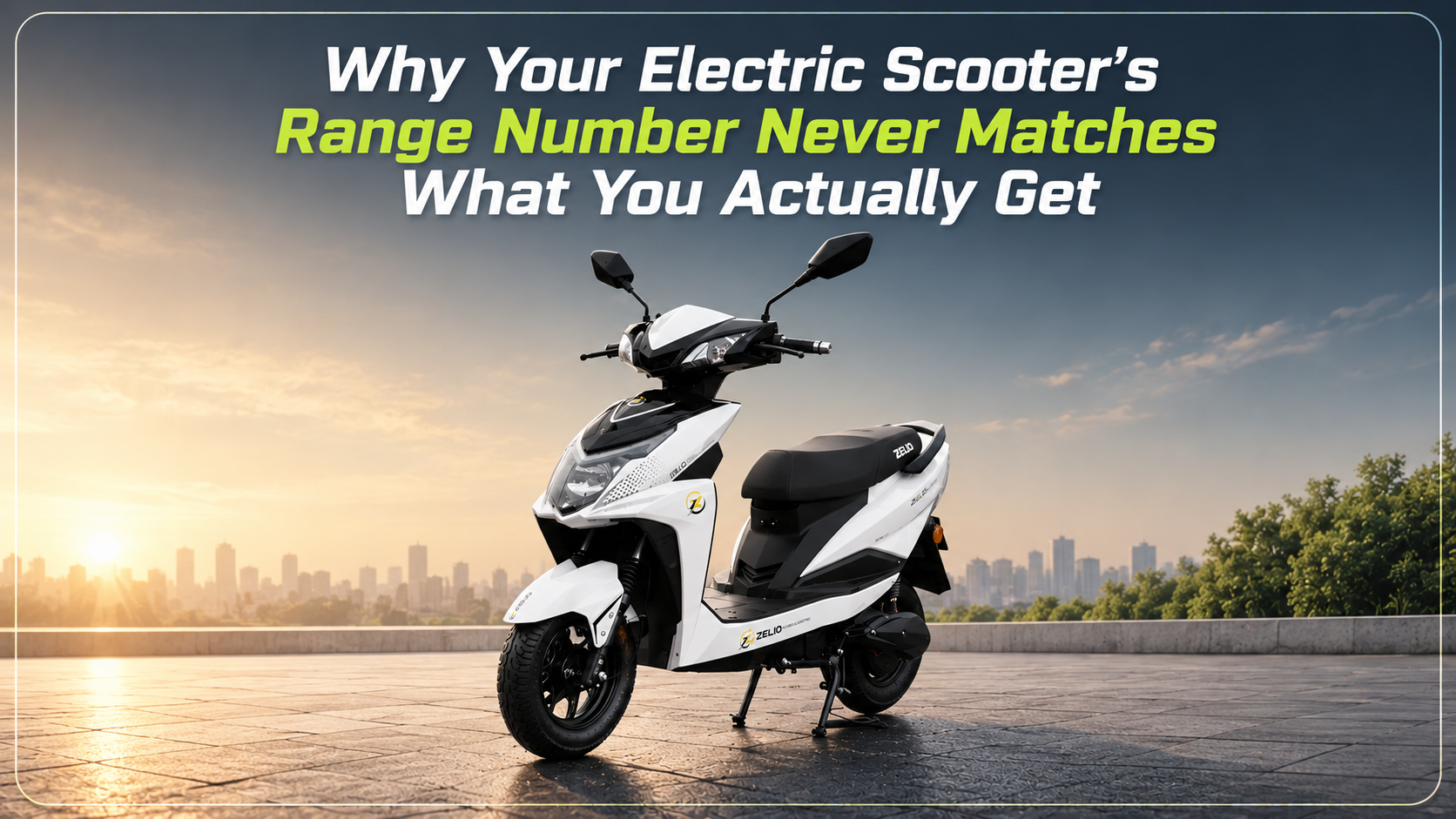
When people ask about electric scooter mileage , they usually want to know one simple thing: "How far can I travel on one full charge?" or "Ek charge mein kitna chalegi?" Electric scooter mileage, also called range, is the approximate distance a scooter can travel when its battery is fully charged. Depending on the model and battery, electric scooters in the market can offer anywhere from around 20 km to 160 km on a single charge. At Zelio E-Bikes , our electric scooters offer a claimed range of 60 km to 120 km per charge, depending on the model and battery type. Our lead-acid battery models offer approximately 60 km to 100 km of range, depending on the number of batteries used, while our lithium-ion battery models offer approximately 80 km to 120 km per charge. The range of an electric scooter can directly affect how often you need to charge it, whether it is suitable for your daily commute, and how convenient it will be to own. But there is one thing that is important to understand before comparing different electric scooters: The range mentioned on the specification sheet is not necessarily the range you will get in your everyday riding. Your actual range depends on several things - your speed, riding style, rider weight, traffic, road conditions, tyre pressure, battery condition, weather and even whether you regularly ride with a pillion. At Zelio E-Bikes , we believe it is better to understand these factors before buying an electric scooter rather than simply looking for the biggest range number. So, let's break it down. What Does Electric Scooter Mileage Actually Mean? With a petrol scooter, we normally talk about mileage in terms of kilometres per litre (km/l). With an electric scooter, mileage is kilometres per charge (km/charge) . For example, if a scooter has a claimed range of 100 km, it means the scooter is designed to travel up to around 100 km on a full charge under specified test conditions. But that doesn't mean every rider will get exactly 100 km. Think about it this way. Two people can drive the same car on the same road and get different fuel mileage. One person may accelerate aggressively, drive faster and brake frequently. Another may drive smoothly at a steady speed. The same principle applies to electric scooters. Claimed Range vs Real-World Range This is probably the most important thing to understand when comparing electric scooters. You may see a scooter advertised with: 100 km range It is easy to assume that you will get 100 km every time you charge the battery. In real life, things are rarely that predictable. Your scooter may be carrying : A heavier rider, A pillion passenger, Some luggage You may also be riding through : Heavy traffic, Flyovers, Uneven roads, Stop-and-go traffic, Different weather conditions And you may be riding at a higher speed than the conditions used during certification testing. All of these factors can affect range. This is why the claimed range should be treated as a reference point, rather than a guarantee of exactly how many kilometres you will get. At Zelio, we believe customers should look at both the claimed range and their own daily riding requirements before choosing a scooter. So, What Is a Good Mileage for an Electric Scooter? There isn't one number that is right for everyone. A person travelling 15 km a day doesn't have the same requirements as someone travelling 60 km every day. For example, if your daily travel is around 20-25 km, you may not need a very high-range scooter. But if you travel 50-60 km every day, choosing a higher-range battery configuration can make your life much easier. Here's a simple way to think about it: Daily Travel - What You Should Consider 10-20 km - Short to moderate range 20-40 km - Moderate range with a comfortable buffer 40-60 km - Higher-range configuration 60+ km - High-range scooter and battery configuration The important word here is buffer . If you travel 40 km every day, don't necessarily look for a scooter that claims exactly 40 km per charge. You don't want to reach home every evening wondering whether the battery will make it through the next day. A little extra range gives you flexibility. What Actually Affects Electric Scooter Mileage? This is where things get interesting. The same electric scooter can deliver different ranges to different people. Here are some of the biggest factors. 1. Your Riding Speed Speed has a direct impact on energy consumption. If you constantly ride at higher speeds and accelerate aggressively, your scooter will generally consume more energy. On the other hand, smooth acceleration and a steady riding speed can help you use the battery more efficiently. You don't need to ride unusually slowly. Just avoid unnecessary: Full throttle → sudden braking → full throttle → sudden braking. Smooth riding is usually more efficient. 2. Your Riding Style Two riders can have completely different riding styles. One rider may accelerate gently, anticipate traffic and maintain a steady speed. Another may accelerate hard every time the signal turns green and brake suddenly at the next signal. Both are riding the same scooter. But their range may be different. If you want to get more kilometres from every charge, try to: Accelerate smoothly Maintain a steady speed Avoid unnecessary hard braking Anticipate traffic Avoid unnecessary high-speed riding Small changes in riding habits can make a noticeable difference over time. 3. Rider and Pillion Weight This is simple physics. The more weight your scooter has to move, the more work the motor has to do. If you are riding alone, the scooter is moving one person. If you regularly ride with a pillion, the total load increases. And if you add luggage on top of that, the load increases further. This doesn't mean that carrying a passenger is a problem. Electric scooters are designed for everyday use. It simply means that your expected range should account for how you normally use your scooter. 4. Traffic Indian city traffic can be unpredictable. One minute you're moving at 40 km/h. The next minute you're standing at a signal. Then you accelerate again. Then another signal. Then a traffic jam. This constant: Start → Stop → Start → Stop can consume more energy than smooth, uninterrupted riding. This is one reason why your actual range in a busy city can be different from a controlled test. 5. Tyre Pressure This is one of the easiest things to overlook. If your tyres are underinflated, rolling resistance increases. The motor may have to work harder to move the scooter. That's why it is worth checking your tyre pressure regularly. But don't make the mistake of thinking: More air = better mileage. Always follow the tyre-pressure recommendation provided for your scooter. The goal is the right pressure, not the highest pressure. Does Battery Type Affect Electric Scooter Mileage? Yes, but it isn't the only thing that matters. Battery capacity, battery chemistry, motor, controller, scooter weight and riding conditions all work together to determine range. At Zelio, different electric scooter models are available with different battery configurations, including lead-acid/gel and lithium-ion batteries. Each has its own advantages. Lead-Acid/Gel Batteries These are generally more affordable and can be suitable for customers who are looking for a budget-friendly electric scooter. The trade-off is that they are generally heavier and take longer to charge. Lithium-Ion Batteries Lithium-ion batteries are lighter and generally offer faster charging and longer expected battery life. They can be particularly useful for people who use their scooter frequently and want a lighter battery system with convenient charging. The right choice ultimately depends on your budget and how you intend to use the scooter. How Much Difference Does Speed Make? Imagine two riders using the same scooter. Rider A Smooth acceleration Moderate speed Predictable braking Mostly open roads Rider B Aggressive acceleration Higher speeds Frequent braking Heavy traffic Even though they are using the same scooter, their energy consumption can be very different. This is why asking only: What is the mileage of this scooter? doesn't tell the whole story. A better question is: What range can I realistically expect based on how I ride? Can Weather Affect Electric Scooter Range? Yes. Batteries perform differently under different temperature conditions. India's weather can range from very hot summers to cold winters, depending on the location. Extreme temperatures can affect battery performance, while prolonged exposure to excessive heat can also contribute to battery ageing. A few simple habits can help: Park the scooter in a shaded or covered area when possible. Avoid unnecessary exposure to extreme heat. Follow the manufacturer's charging recommendations. Use the correct charger. Give the battery appropriate care if the scooter has been exposed to very high temperatures. Battery care isn't complicated, but it is important if you want your battery to perform well over its useful life. How Road Conditions Affect Mileage Where you ride also matters. A scooter travelling on a smooth, relatively flat road will generally use energy differently from one climbing steep roads or travelling over rough surfaces. If your daily route includes: Flyovers Hills Rough roads Unpaved roads your actual range may be different from someone riding mostly on flat, smooth roads. This is particularly important when comparing the range you see in a specification sheet with what you experience in your own city. How Can You Increase Your Electric Scooter Mileage? The good news is that you have quite a bit of control over your scooter's efficiency. Here are some simple habits that can help. Keep your tyres properly inflated - Check them regularly and maintain the recommended pressure. Avoid unnecessary hard acceleration - You don't have to accelerate at full throttle every time the signal turns green. Maintain a comfortable, consistent speed - Constantly changing speed can consume more energy. Don't carry unnecessary weight - If you don't need it, don't carry it. Keep your scooter maintained - Regular checks of tyres, brakes, battery and other components can help keep the scooter operating properly. Take care of the battery - Follow the recommended charging practices and use the correct charger. Plan your charging - If you know you'll be travelling a longer distance the next day, charge accordingly instead of starting your journey with a nearly empty battery. These are simple things, but they become important over hundreds or thousands of kilometres. How Much Does It Cost to Charge an Electric Scooter? One of the biggest attractions of an electric scooter is the relatively low energy cost of everyday riding. Let's take a simple example. Suppose a scooter uses approximately 2 kWh of electricity for a full charge. If electricity costs ₹8 per unit, the theoretical electricity cost would be: 2 × ₹8 = ₹16 If the scooter travels 80 km on that charge: ₹16 ÷ 80 = ₹0.20 per km Actual charging costs can be different because of charging losses, electricity tariffs, battery condition and actual range. But this calculation gives you a simple way to understand your scooter's running cost. Electric Scooter vs Petrol Scooter: Don't Compare Only Mileage This is another common mistake. A petrol scooter is usually discussed in terms of: km/litre An electric scooter is discussed in terms of: km/charge These aren't directly comparable numbers. Instead, if you are trying to understand the economics of ownership, look at: Purchase price Fuel/electricity cost Maintenance Battery cost Insurance Expected usage Long-term ownership period For someone who rides regularly, the running-cost difference can become an important part of the overall ownership calculation. How Much Range Do You Actually Need? Here's a simple calculation you can do before visiting a dealership. Suppose your daily commute is: 30 km You travel five or six days a week. Now think about how frequently you are comfortable charging your scooter. If you prefer charging every night, you don't necessarily need a huge battery. If you would rather charge once every couple of days, you may want a higher-range configuration. For example: 30 km daily travel × 2 days = 60 km In this situation, you could look for a scooter with a claimed range comfortably above your two-day requirement. This gives you some breathing room for: Unexpected trips Traffic A pillion ride Slightly longer routes Range variation What Is the Range of Zelio Electric Scooters? Zelio offers multiple electric scooter models and battery configurations for different types of riders. Our range includes models such as: EEVA Gracy Mystery X Men+ X Men 2.0 LOGIX LOGIX Loader Legender+ Premium Mystery - High Speed Electric Scooter Depending on the model and battery configuration, Zelio scooters are available with different claimed range options. Some configurations offer around 60-70 km, while others are designed for longer claimed ranges of 90 km, 100 km and up to around 120 km per charge. The exact range depends on the particular model and battery configuration. So rather than choosing a scooter simply because it has the highest range figure, look at your own usage first. Which Zelio Electric Scooter Is Right for Your Daily Commute? There is no single scooter that is perfect for every rider. Your daily usage should guide your decision. If you travel around 15-25 km per day A scooter with a moderate range may be more than sufficient for your everyday requirements. If you travel around 25-40 km per day Look for a configuration that gives you enough range for your daily travel with a comfortable reserve. If you travel 40-60 km per day A higher-range configuration may make more sense, especially if you don't want to charge during the day. If you regularly travel more than 60 km Focus on a higher-range model and pay attention to battery capacity, charging time, battery warranty and service support. Don't Buy an Electric Scooter Just for the Highest Mileage When you're shopping for an electric scooter, it is tempting to compare one number: This one gives 100 km. That one gives 120 km. So I'll buy the 120 km one. But that's not always the right way to decide. Think about your actual life. How far do you travel every day? Do you ride alone or with a passenger? Do you have a place to charge at home? How often do you want to charge? Do you mostly ride in traffic? Do you need the scooter for work, college, errands or family use? Once you answer these questions, choosing the right range becomes much easier. At Zelio E-Bikes , we offer multiple electric scooter models and battery configurations so customers can choose according to their requirements. Because the best range isn't necessarily the biggest number on the brochure. The best range is the one that comfortably fits your everyday life. If you are considering a Zelio electric scooter, explore the available models and compare their battery, range and features before making your decision. Ride electric. Ride smart. Ride Zelio.